 Anacortes
 Two Products, One Decision
If you're replacing siding in Anacortes, you've probably run into two names that keep coming up: James Hardie fiber cement and LP SmartSide engineered wood. Both are marketed as upgrades over vinyl or old cedar lap siding. Both come in lap, panel, and shingle profiles. Both promise low maintenance and a long service life. But they are fundamentally different materials, made from different raw ingredients, and they behave differently once they're on a house that sits a few miles from saltwater and gets soaked by driving rain for half the year.
This page walks through what each product actually is, how they hold up under Skagit County conditions, and why our crews install James Hardie exclusively. We're not going to tell you LP SmartSide is a bad product — it isn't, and plenty of licensed contractors install it well. We're going to explain the trade-offs honestly and tell you why, after years in this trade, fiber cement is what we're willing to warranty and put our name behind.
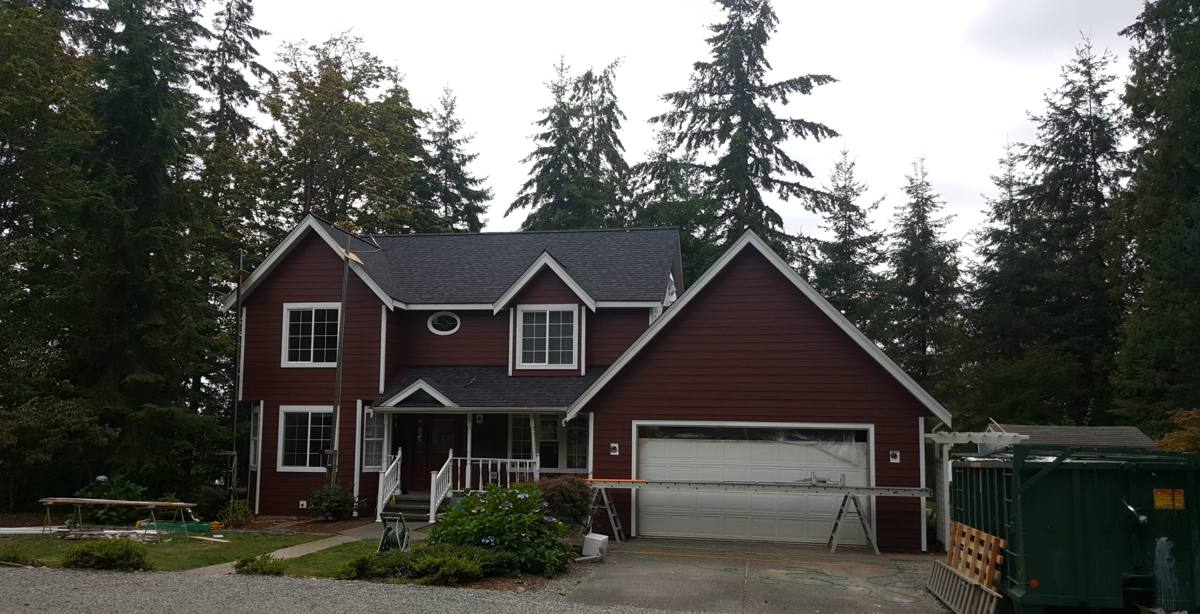
What James Hardie Fiber Cement Actually Is
James Hardie siding is made from Portland cement, sand, and cellulose fiber, cured under pressure and heat. The result is a rigid, dense board that doesn't have wood grain, doesn't have an organic food source for rot or insects, and doesn't expand and contract the way wood-based products do when they get wet. Hardie's HZ5 product line is specifically engineered for cold, wet climates like ours, with a formulation designed to resist moisture-related damage in freeze-thaw conditions.
Most Hardie siding installed today comes with a factory-applied finish called ColorPlus — a baked-on, multi-coat finish applied in a controlled environment rather than sprayed or brushed on site. That matters more than it sounds like it should, and we'll get into why below.
What LP SmartSide Actually Is
LP SmartSide is an engineered wood product — strand board made from wood fibers bonded with resin and wax, then treated with a zinc-borate preservative and coated with a resin-saturated overlay to resist moisture. It's a genuine improvement over old OSB siding and standard cedar in terms of impact resistance and consistency. It's lighter than fiber cement, easier to cut without special tools, and generally costs less installed.
But it's still wood-based at its core. The zinc-borate treatment protects against fungal decay and insects, and the resin overlay is a real moisture barrier — but both of those protections depend entirely on the coating and edge sealing staying intact. Once you cut a panel, drill through it, or nick an edge on the job site, you've exposed the substrate underneath, and that cut edge needs to be sealed correctly or it becomes a place where water can start working its way in.
Salt Air, Driving Rain, and Moss: How Skagit County Weather Tests Both
Anacortes sits right on the water, and that changes the math on siding decisions in ways that don't apply to a house in, say, eastern Washington. Three things matter here specifically:
Salt Air
Salt-laden air accelerates the breakdown of coatings and finishes over time, and it's harder on fasteners and any exposed wood fiber. Fiber cement's cement-based composition isn't a food source for anything and doesn't corrode the way metal does, and a factory-cured finish holds up to salt exposure better than a field-applied coating that was sprayed on-site under less controlled conditions.
Driving Rain
Wind-driven rain off the Sound doesn't just wet the face of your siding — it pushes moisture up under laps and into any gap in the water-resistive barrier. This is where installation quality matters as much as the product itself, but the product's tolerance for repeated wetting and drying cycles still matters. Wood-based products are more dimensionally reactive to moisture cycling than cement-based ones; they can swell, and swelling stresses the coating and any caulked joints.
Moss and Algae Season
Our extended wet season, mild temperatures, and shaded, tree-lined lots across Skagit County are close to ideal conditions for moss and algae growth on exterior surfaces. Both products will get surface growth if a wall stays damp and shaded long enough — no siding is immune to that. The difference is what happens underneath the growth. On fiber cement, moss and algae are a cosmetic, cleanable surface issue on an inert substrate. On any wood-based product, sustained surface moisture sitting against the material for long periods is exactly the condition that stresses the protective coating over time.
Fire Performance
This is a straightforward, well-documented difference. James Hardie fiber cement is noncombustible — it's cement and sand, not wood. LP SmartSide is a wood-based product; it carries treatments intended to slow ignition and flame spread, but the underlying material is still combustible wood fiber. For homeowners near wildland-urban interface areas, or anyone whose insurance carrier asks about exterior materials, that's a real and relevant distinction, not a marketing point.
Installation: Where Products Succeed or Fail
Both products are installation-sensitive, meaning a mediocre install will shorten the life of either one. But the failure modes are different:
- Fiber cement requires proper fastener placement, correct clearances from grade and roof lines, and factory-specified caulking at joints — get those wrong and you risk moisture intrusion behind the board, but the board itself won't decay.
- Engineered wood requires all of the above, plus scrupulous sealing of every field cut, every fastener hole, and every exposed edge — because those are the points where the substrate is no longer protected by its factory coating, and any lapse becomes a slow, hidden problem rather than an obvious one.
In practice, this means LP SmartSide leaves less room for error on a job site, especially on a house with a lot of trim, corners, and cuts — which describes most homes in older Anacortes neighborhoods. We'd rather install a product where a caulking touch-up handles most edge cases than one where a missed cut edge can turn into a callback two winters later.
Warranty and Long-Term Cost
Warranty structure is one of the more overlooked parts of this decision, and it's worth reading the fine print on either product before you commit.
| Factor | James Hardie (HZ5 + ColorPlus) | LP SmartSide |
|---|---|---|
| Core material | Fiber cement (noncombustible) | Engineered wood strand (combustible, treated) |
| Factory finish | Baked-on ColorPlus, multi-coat | Primed or factory-finished depending on line |
| Repainting interval (typical) | Long interval before repaint needed | Shorter interval; field-applied finishes weather faster |
| Sensitivity to cut/drilled edges | Low — inert substrate | High — must be sealed per manufacturer spec |
| Product warranty | Long-term, transferable | Limited warranty, terms vary by component |
| Installed cost | Higher upfront | Generally lower upfront |
LP SmartSide's lower upfront cost is real and shouldn't be dismissed — for some budgets, it's the deciding factor, and that's a legitimate call for a homeowner to make. Our position is that when we amortize the coating and touch-up maintenance most engineered wood installations eventually need against Hardie's longer repaint interval and transferable warranty, fiber cement tends to be the better value over the time most people actually own their home.
Side-by-Side: What Each Product Is Best At
| James Hardie | LP SmartSide | |
|---|---|---|
| Best for | Long-term durability, fire resistance, low-maintenance coastal exposure | Budget-conscious projects, faster installs, DIY-friendly cutting |
| Weight | Heavier, denser | Lighter, easier to handle on site |
| Workability | Requires fiber-cement-rated blades and dust control | Cuts with standard woodworking tools |
| Moisture tolerance | Not affected by moisture cycling the way wood is | Protected by coating and treatment; substrate vulnerable if breached |
Why We Only Install James Hardie
We made the decision years ago to standardize on James Hardie and stop installing engineered wood, vinyl, and other alternatives. It wasn't about chasing the most expensive product on the market — it was about picking one system we could install to spec every time, stand behind with a real warranty, and trust to perform on homes that sit in salt air, take driving rain off the water, and sit under moss-friendly tree cover for months at a stretch. Hardie's noncombustible core, factory-cured finish, and climate-specific HZ5 formulation match the conditions we actually build in here, and a single-product focus means our crews install it the same correct way on every job rather than switching techniques between materials.
If you're weighing James Hardie against LP SmartSide, or any other siding option, for a home in Anacortes or elsewhere in Skagit County, we're glad to walk through your specific house — sun exposure, tree cover, current siding condition — and give you a straight answer about what makes sense. Reach out for a free, no-pressure estimate using the form below.