 Anacortes
 Siding in Skyline: Built for Fidalgo Island Weather
Skyline is one of the residential pockets of Anacortes that sits close enough to the water to feel it in the exterior of a house. Fidalgo Island weather isn't dramatic in the way a hailstorm or a hard freeze is dramatic — it's persistent. Salt-laden air moves in off the water, rain falls sideways more often than straight down, and long gray stretches of the year keep exterior surfaces damp for days at a time. None of that is unusual for anyone who has lived in Skagit County for a while, but it is exactly the combination that wears out the wrong siding material faster than most homeowners expect.
We've worked on enough homes in this part of Anacortes to know the pattern: siding that looks fine from the street can be quietly failing at the seams, the bottom courses, and anywhere caulk has been doing more work than it should. A siding system that's genuinely matched to this climate isn't a luxury here — it's the difference between a 10-year repaint cycle and a system that holds its finish and its shape for decades.
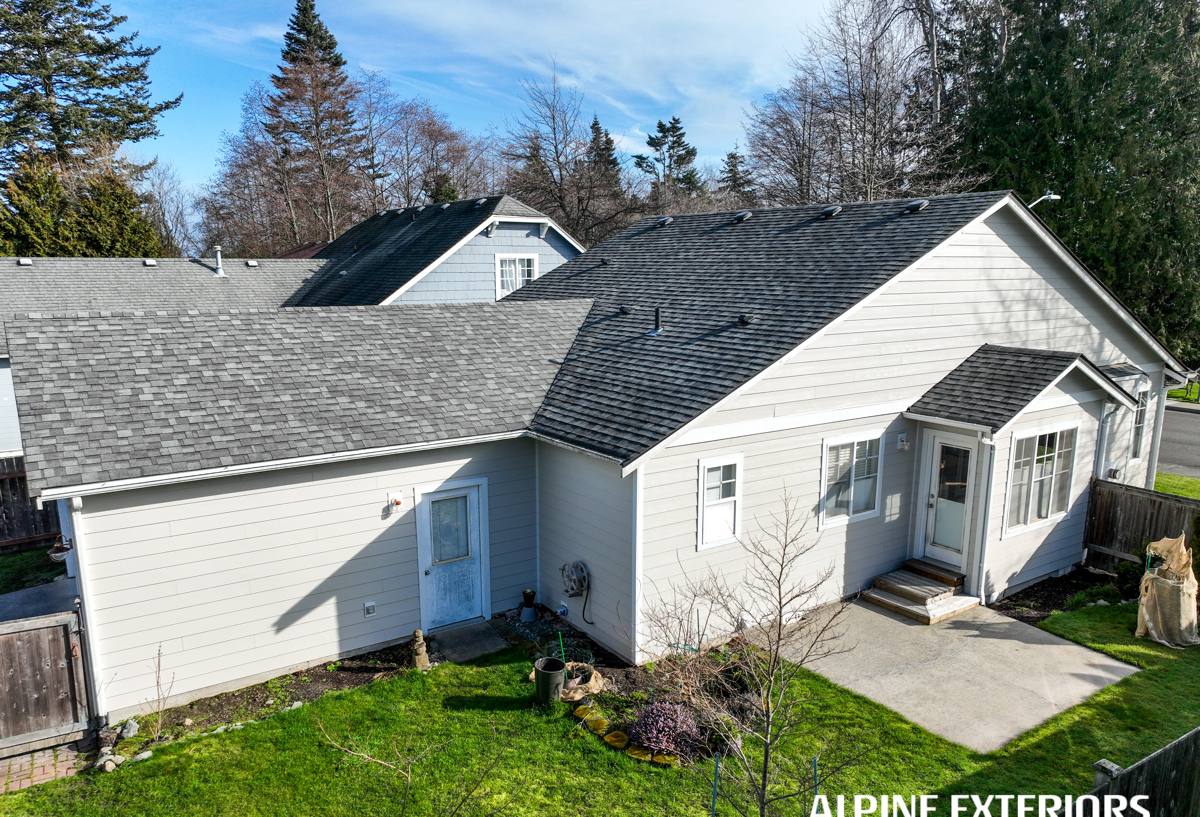
What Skyline Homes Are Up Against
Salt Air
Proximity to Puget Sound and Rosario Strait means airborne salt is a constant, low-grade stressor on exterior materials. It accelerates corrosion on fasteners and hardware, and over years it can degrade paint films and the wood fiber underneath them. Materials that aren't engineered to resist it end up needing more frequent maintenance just to look presentable.
Driving Rain
Wind off the water pushes rain into siding laterally, not just straight down the wall. That matters because a lot of siding failures aren't about water hitting a surface — they're about water finding its way behind that surface through a lap joint, a butt seam, or a fastener hole that's opened up slightly over time. Wind-driven rain finds those weak points a lot faster than a calm, vertical rain does.
Moss and Sustained Moisture
Skagit County's mild, wet fall-through-spring stretch is ideal moss and algae weather. On north-facing walls and shaded elevations — common in a neighborhood with mature trees and varied lot layouts — surfaces can stay damp for extended periods. Materials that absorb moisture rather than shed it are far more prone to staining, swelling, and eventually rot in these conditions.
Signs Your Siding Is Losing the Fight
Most siding problems in this area show up gradually, which is why homeowners often don't notice until the damage has spread past the surface. Here's what we tell Skyline homeowners to walk their exterior and check for:
- Soft or spongy spots when you press on siding near the bottom of walls or under windows
- Paint that's peeling, bubbling, or chalking heavily, especially on north- and west-facing walls
- Persistent green or black staining that pressure washing only knocks back temporarily
- Visible gaps or separation at seams, corners, or where siding meets trim
- Warping, cupping, or boards that no longer sit flat against the wall
- Rust streaks below nail heads or fastener locations
- Higher heating bills that suggest moisture-compromised insulation behind the siding
Any one of these on its own might be cosmetic. Several together usually mean water has been getting behind the siding for a while, and that's a problem that gets more expensive the longer it sits.
Why We Only Install James Hardie Fiber Cement
We install James Hardie fiber cement siding exclusively — not vinyl, not LP SmartSide, not Cemplank or Allura, not primed spruce or cedar. That's a deliberate standard, not a limitation of what we're capable of installing. Here's the honest reasoning behind it.
It's Non-Combustible
Fiber cement is made primarily from cement, sand, and cellulose fiber. It doesn't burn, which matters in a region where wildfire smoke and drier late summers have become a more regular part of the calendar even in western Washington. It's not the reason most Skyline homeowners call us, but it's a real, practical advantage.
It's Engineered for This Exact Climate
James Hardie makes region-specific product formulations under its HZ5 designation for areas that see the freeze-thaw cycles and moisture load of the Pacific Northwest. That's not marketing language we repeat lightly — it reflects real differences in how the board is formulated to resist moisture absorption and hold dimensional stability through wet winters and drier summers.
ColorPlus Factory Finish
Most James Hardie siding we install carries a factory-applied ColorPlus finish, baked on and cured under controlled conditions rather than brushed on at the jobsite. That finish resists fading and chipping far better than field-applied paint, and it comes backed by its own finish warranty separate from the substrate warranty.
The Trade-Offs of the Alternatives
Vinyl is inexpensive and low-maintenance, but it's a thin plastic product that can crack in cold snaps, deform in direct heat, and fade unevenly over time — and it can't be painted to refresh it without voiding its warranty in most cases. Wood products like cedar or primed spruce look great initially but demand a maintenance schedule (recaulking, repainting, moisture monitoring) that most homeowners underestimate, especially in a climate that stays damp this long. Engineered wood siding like LP SmartSide performs reasonably well when installation is flawless, but it's more sensitive to caulking and flashing detail than fiber cement, and any breach in that protective layer lets moisture into the wood-strand core faster than into cement board. We'd rather stand behind one product we trust completely than install several we'd have reservations about.
Comparing Siding Materials for a Skagit County Home
| Material | Moisture Resistance | Maintenance | Finish Durability | Fire Resistance |
|---|---|---|---|---|
| James Hardie Fiber Cement | Excellent, HZ5-engineered | Low | Factory-cured ColorPlus, long-lasting | Non-combustible |
| Vinyl | Good on its own, poor at seams | Low, but not repaintable easily | Fades unevenly, can't refinish | Combustible plastic |
| Cedar / Primed Spruce | Poor without diligent upkeep | High, ongoing painting and sealing | Field-applied, wears faster | Combustible |
| LP SmartSide (Engineered Wood) | Moderate, installation-sensitive | Moderate | Factory or field finish varies | Combustible |
This is a general comparison, not a claim that every product fails in every case — well-maintained wood siding can last a long time, and vinyl has its place on tighter budgets. It's simply why, for the climate Skyline homes sit in, we've chosen to put our labor and our warranty behind fiber cement.
How We Approach Installation
Prep and Moisture Barrier
Correct installation starts before the first board goes up. We check the wall sheathing for existing damage, install a proper weather-resistive barrier, and pay close attention to flashing at windows, doors, and any wall penetration — these are the spots where wind-driven rain actually gets in, far more often than through the field of the siding itself.
Fastening and Clearances
James Hardie has specific fastening patterns and clearance requirements — from grade, from roof lines, from decks — that are there for a reason. Skipping them is one of the most common ways fiber cement siding underperforms its potential lifespan, and it's not something that shows up as a problem until years later. We follow manufacturer installation specs closely because that's what keeps the product warranty valid and the wall behind it dry.
Trim and Sealant Details
Corners, butt joints, and trim transitions get the same attention as the field of the wall. In a climate with this much sustained moisture, a small gap in caulking or a poorly lapped seam is exactly where problems start.
More Than Siding: Roofing, Windows, and Decks
Siding doesn't work in isolation. A roof that's shedding water improperly, windows with failing flashing, or a deck ledger that's trapping moisture against the house can all undermine even well-installed siding. We handle roofing, window replacement, and deck construction alongside siding work, which means we can look at a Skyline home's exterior as one connected system rather than a series of unrelated projects. That matters most at the transitions — where roof meets wall, where a window sits in a wall opening, where a deck attaches to the structure — because that's where most water intrusion actually starts.
Why a Local Crew Matters Here
Anacortes and the surrounding Skagit County communities have their own microclimate quirks — the marine exposure on the west side of Fidalgo Island isn't identical to conditions a few miles inland, and a crew that works this area regularly knows where moss builds up fastest, which elevations take the worst of the weather, and how local permitting and inspection processes actually run. That local familiarity shows up in the details: correct clearances, the right flashing choices, and a install that's built for the specific weather Skyline homes deal with rather than a generic approach.
Cost Factors Worth Understanding
Every siding project is different, but a few factors tend to drive cost on most Skyline homes:
- Total square footage and the complexity of the home's shape (corners, dormers, and rooflines add labor)
- Whether existing siding needs to be removed or there's sheathing damage to repair underneath
- Board profile and finish selection within the James Hardie product lines
- Trim, fascia, and accessory work bundled into the same project
- Access — tight lots, steep grades, or multi-story walls affect labor and equipment needs
We won't quote a number without seeing the house, but we're upfront that fiber cement typically costs more upfront than vinyl and can be comparable to or less than premium wood siding once ongoing maintenance is factored in over the life of the product.
Get a Straightforward Estimate
If you're noticing wear on your home's siding, or you're planning ahead before a problem starts, we're happy to take a look and walk you through what we're seeing — no pressure, no obligation. Use the form below to request a free estimate for your Skyline home.