 Anacortes
 Exterior Work Built for Bow's Coastal Farmland Climate
Bow sits in that stretch of Skagit County where open farmland meets saltwater, and that combination puts real demands on a home's exterior. Properties out here often deal with a mix of conditions in the same year: wide-open exposure to wind and driving rain coming off the water, plus the deep shade and dampness that come with mature tree cover on the wooded lots further inland. Add in the salt-laden air drifting up from Samish Bay and the surrounding tidal flats, and you've got a climate that is genuinely harder on siding, trim, and roofing than what homes fifty miles inland ever have to deal with.
We're based nearby in Anacortes and have worked on homes throughout this part of Skagit County long enough to know that a siding job here isn't just a cosmetic upgrade. It's a decision about what's going to hold up against salt exposure, near-constant moisture, and a moss season that, depending on the year, can run from October clear through May.
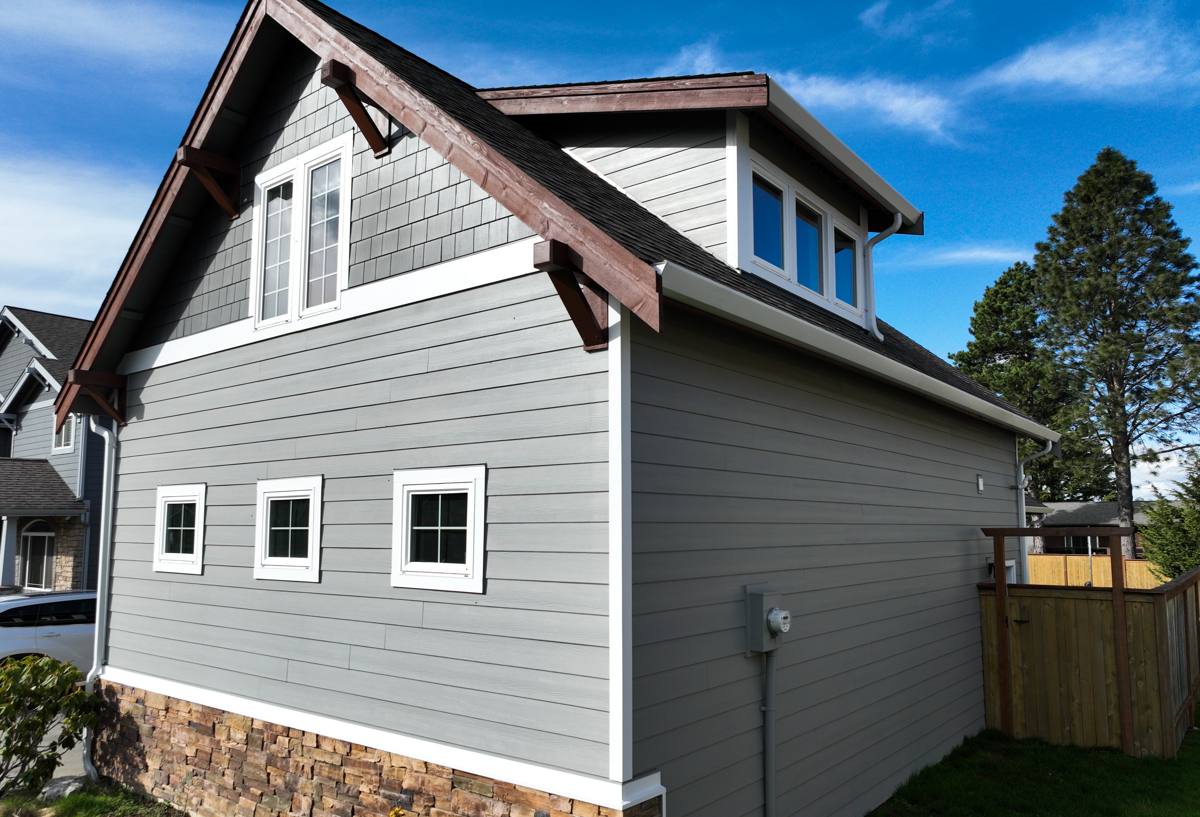
What Salt Air and Driving Rain Actually Do to a House
Salt air doesn't just make things look dingy faster — it accelerates corrosion on fasteners, flashing, and any exposed metal components, and it breaks down cheaper paint finishes well ahead of their rated lifespan. Combine that with driving rain that gets pushed sideways in a stiff wind off the bay, and you end up with moisture finding its way into seams, laps, and butt joints that would stay dry in a calmer inland climate.
Once moisture gets behind or into a siding material, what happens next depends entirely on what that material is made of:
- Wood-based products (cedar, primed spruce) absorb water at the cut edges and panel joints, leading to swelling, cupping, and eventual rot if not maintained aggressively.
- Vinyl siding doesn't rot, but it can warp or crack in temperature swings and does nothing to stop moisture — it just sits over the wall assembly and hopes the water management behind it works.
- Engineered wood products like LP SmartSide use a wood-strand core that's more moisture-resistant than raw wood, but the core is still wood fiber, and any breach in the factory coating is a path for water to start working on that core from the inside out.
- Fiber cement, properly installed and finished, doesn't have an organic core for moisture to feed on, and it isn't vulnerable to the same warping and swelling.
The Long Moss Season
Moss and algae growth is one of the most visible signs of how tough this climate is on a home's exterior. In shaded, damp spots — under eaves, on north-facing walls, along roof valleys — moss can take hold and stay green nearly year-round in a wet stretch. It's not just cosmetic. Moss holds moisture directly against the siding or roofing surface for extended periods, which is exactly the condition that causes the most damage to moisture-sensitive materials. A material that can shrug off sustained dampness without breaking down is worth a lot more here than in a drier climate.
Why We Only Install James Hardie Fiber Cement Here
We made a decision as a company to install James Hardie fiber cement siding exclusively — not vinyl, not LP SmartSide, not Cemplank or Allura, not primed spruce or cedar. That's not a marketing angle; it's a standard we hold because of what we've seen hold up in exactly this kind of maritime climate and what tends to struggle.
James Hardie's fiber cement is engineered from cement, sand, and cellulose fiber, which means there's no wood core to rot and no vinyl to warp in a temperature swing. Hardie also builds region-specific "HZ" formulations — HZ5 for climates with more freeze-thaw cycling, HZ10 tuned for the kind of humid, moisture-heavy conditions we see in western Washington — so the product going on a home here is engineered for this climate rather than a generic version.
The factory-applied ColorPlus finish matters just as much as the substrate. It's baked on under controlled conditions rather than brushed or sprayed on site, which gives it better adhesion and UV resistance than field-applied paint — a real advantage against salt air, which is notoriously hard on finishes. And because it's non-combustible, it adds a layer of fire resistance that none of the wood-based or vinyl alternatives can offer.
None of this means other products are junk. LP SmartSide and cedar both have legitimate uses and loyal customers. But we've chosen to specialize in one system we can install correctly, warranty confidently, and stand behind for a climate that doesn't forgive shortcuts.
Comparing Exterior Siding Options in a Maritime Climate
| Material | Moisture Behavior | Salt Air Durability | Maintenance Burden |
|---|---|---|---|
| James Hardie Fiber Cement | No organic core; resists swelling and rot | Factory finish holds up well; non-combustible | Occasional wash; repaint interval measured in decades |
| Vinyl Siding | Doesn't absorb water, but manages none behind the wall | Can fade and become brittle over time | Low, but limited repair options if damaged |
| LP SmartSide | Engineered wood core, moisture-resistant but not moisture-proof | Coating wear is the failure point | Moderate; edge sealing matters |
| Cedar / Primed Spruce | Absorbs moisture readily; prone to swelling and rot | Finish breaks down faster in salt exposure | High; regular refinishing needed |
Beyond Siding: Roofing, Windows, and Decks for Bow Properties
Siding is only one piece of a home's exterior envelope, and in this climate the other pieces matter just as much. We handle roofing, windows, and decks alongside siding because they all interact — a roof that's shedding water poorly will feed moisture straight down into the siding and trim below it, and a deck built with the wrong fasteners in a salt-air environment will corrode faster than the boards themselves wear out.
Roofing
Roofs out here take the brunt of the driving rain and the moss growth we mentioned earlier. Proper ventilation, underlayment, and flashing details around valleys and penetrations matter more here than in a drier climate, since a marginal install has less margin for error when it's wet more months than not.
Windows
Window flashing and sealing is one of the most common failure points we find on older homes in this area. Even a well-built window will eventually leak if the flashing integration with the siding wasn't done correctly, which is part of why we treat window and siding work as connected rather than separate trades.
Decks
Outdoor living space gets heavy use in this part of Washington when the sun does come out, and a deck exposed to salt air and standing moisture needs the right combination of decking material, fasteners, and structural detailing to hold up over time.
Why a Local Crew Makes a Real Difference
A contractor working out of Anacortes who regularly works the Bow, Edison, and greater Skagit County area understands the specific exposure patterns of this stretch of coastline — which sides of a house typically take the worst weather, how moss tends to establish itself on shaded roof and wall sections, and how salt air changes maintenance timelines compared to a home twenty miles inland. That local knowledge shapes real decisions on a project: where to pay extra attention to flashing, which trim details need upgraded fasteners, and how to sequence a job around a weather window that can close quickly this close to the water.
It also means accountability. A crew that lives and works in this county has a reputation to protect with the neighbors, farms, and small communities it serves — that's a different relationship than a crew that drives in from out of the area for one job and doesn't come back.
How the Installation Process Works
A typical siding project starts with an on-site assessment of the existing exterior, including a look at what's happening underneath the current siding where accessible — sheathing condition, existing moisture damage, and flashing details around windows and doors. From there:
- We evaluate the home's current condition and identify any repair work needed before new siding goes on.
- We review Hardie product lines, profiles, and ColorPlus color options suited to the home's style and the climate exposure of each elevation.
- We handle removal of old siding and any necessary sheathing or moisture-barrier repair.
- Installation follows Hardie's fastening and clearance specifications closely — proper gapping, flashing integration, and fastener placement are what determine whether a fiber cement installation performs for decades or develops problems early.
- We do a final walkthrough to confirm trim, caulking, and finish details meet both our standard and the manufacturer's installation requirements that support the warranty.
A Maintenance Checklist for Bow Homeowners
Even a low-maintenance material benefits from some basic seasonal attention in this climate. A few habits go a long way:
- Rinse siding periodically to clear salt residue and organic buildup, especially on north-facing and shaded walls.
- Keep gutters clear so overflow doesn't run down the siding face during heavy rain events.
- Trim back vegetation and tree limbs that keep a wall section shaded and damp for extended periods.
- Watch for moss establishing on roofing or siding early in the season and address it before it spreads.
- Inspect caulking and trim joints annually, since these are the most common points where water finds a way in over time.
- Have flashing around windows, doors, and roof transitions checked periodically rather than waiting for a visible leak.
Timing a Project Around the Season
Exterior work in this part of Skagit County is generally easiest to schedule during the drier stretch of the year, but siding and roofing projects can be planned and staged around weather windows even outside peak summer months. Waiting until an obvious problem shows up — visible rot, a persistent leak, siding that's noticeably degraded — usually means the underlying moisture damage has already been developing for a while. Addressing exterior wear proactively, especially on a home with the kind of coastal exposure common around Bow, tends to be far less costly than reactive repair after water has gotten into the wall assembly.
If you're weighing a siding, roofing, window, or deck project for a home in the Bow area, we're happy to take a look and talk through what your home's specific exposure calls for. Reach out for a free, no-pressure estimate — there's a form below to get started.