 Anacortes
 Why West Anacortes Homes Wear Out Differently
West Anacortes sits close enough to the water that salt air is simply part of daily life. That's true whether a house looks out at Guemes Channel, sits a few blocks back in a quiet residential pocket, or is tucked into the trees on the west side of town. Salt-laden air behaves differently than inland weather, and it's tougher on a home's exterior than most people expect. It works into fasteners, finds gaps in caulking, and slowly degrades finishes that were never engineered to handle it. Add in the driving rain that comes through Skagit County in the fall and winter, plus the long stretch of damp, low-light months that let moss and algae take hold on north-facing walls and rooflines, and you've got a exterior environment that punishes anything less than a well-built, well-installed system.
We've worked on enough homes in and around West Anacortes to see the pattern clearly: it's rarely one catastrophic failure that gets a homeowner calling. It's the slow accumulation — a soft spot near a window, a shadow line of moss creeping up from the ground, a repaint that didn't hold as long as it should have. Those are signs the exterior is fighting a losing battle against moisture, and they're worth addressing before they become structural.
What Driving Rain and Salt Air Actually Do to Siding
Wind-Driven Moisture
Anacortes doesn't get the heaviest rainfall totals in the state, but it gets plenty of wind alongside the rain, and wind-driven rain behaves very differently than a straight-down shower. It gets pushed sideways into seams, under trim, and behind poorly lapped siding boards. Over years, that moisture intrusion is what rots wood-based siding from the inside out — often long before any problem is visible from the street.
Salt Air and Metal Fasteners
Salt air accelerates corrosion on anything metal — nail heads, flashing, hardware. When a siding system relies on fasteners that aren't rated for a coastal environment, or when flashing details are installed loosely, corrosion starts a slow process of staining, weakening, and eventual failure at exactly the points where water is already trying to get in.
Moss, Algae, and the Shade Problem
West Anacortes has plenty of tree cover and plenty of homes with a shaded north or west side that rarely sees direct sun for months at a time. That combination of shade and moisture is exactly what moss and algae need to establish themselves. On some siding materials that's a cosmetic nuisance you can pressure-wash away. On others, particularly anything with a paint film that's aging or a wood-based product with any exposed grain, trapped moisture underneath that growth can quietly do real damage.
Why We Only Install James Hardie Fiber Cement
We made a decision as a company to install one siding system: James Hardie fiber cement. We don't install vinyl, LP SmartSide, Cemplank, Allura, primed spruce, or cedar, and that's not a marketing position — it's a standard we hold because of what we've seen these products do over time in a climate like ours.
Vinyl siding is inexpensive and easy to install, but it's a thin plastic product that expands and contracts with temperature swings, can crack in cold snaps, and offers essentially no resistance to wind-driven rain at the seams — water gets behind it, and there's rarely a good way to know until damage has already occurred underneath. Wood-based products like primed spruce or cedar look good on day one, but they're organic materials in a wet, shaded climate that's practically designed to break them down; even with excellent maintenance, they're fighting an uphill battle against moisture and rot. Engineered wood products like LP SmartSide improve on solid wood in some ways, but they still rely on a wood-strand core and a factory treatment that has to hold up against edge swelling if water ever finds a cut edge or a fastener point — a real risk in a wind-driven-rain environment. Other fiber cement brands like Cemplank and Allura are chemically similar to Hardie, but we've standardized on Hardie specifically for its ColorPlus factory-applied finish, its climate-engineered HZ5 product line (built for the Pacific Northwest's moisture profile), and a warranty structure we trust to actually mean something years down the road.
Fiber cement itself is a mix of cement, sand, and cellulose fibers — non-combustible, dimensionally stable, and simply not food for moss, algae, or insects the way wood-based products can be. That's the foundation. What separates Hardie is the manufacturing and finish quality layered on top of that foundation.
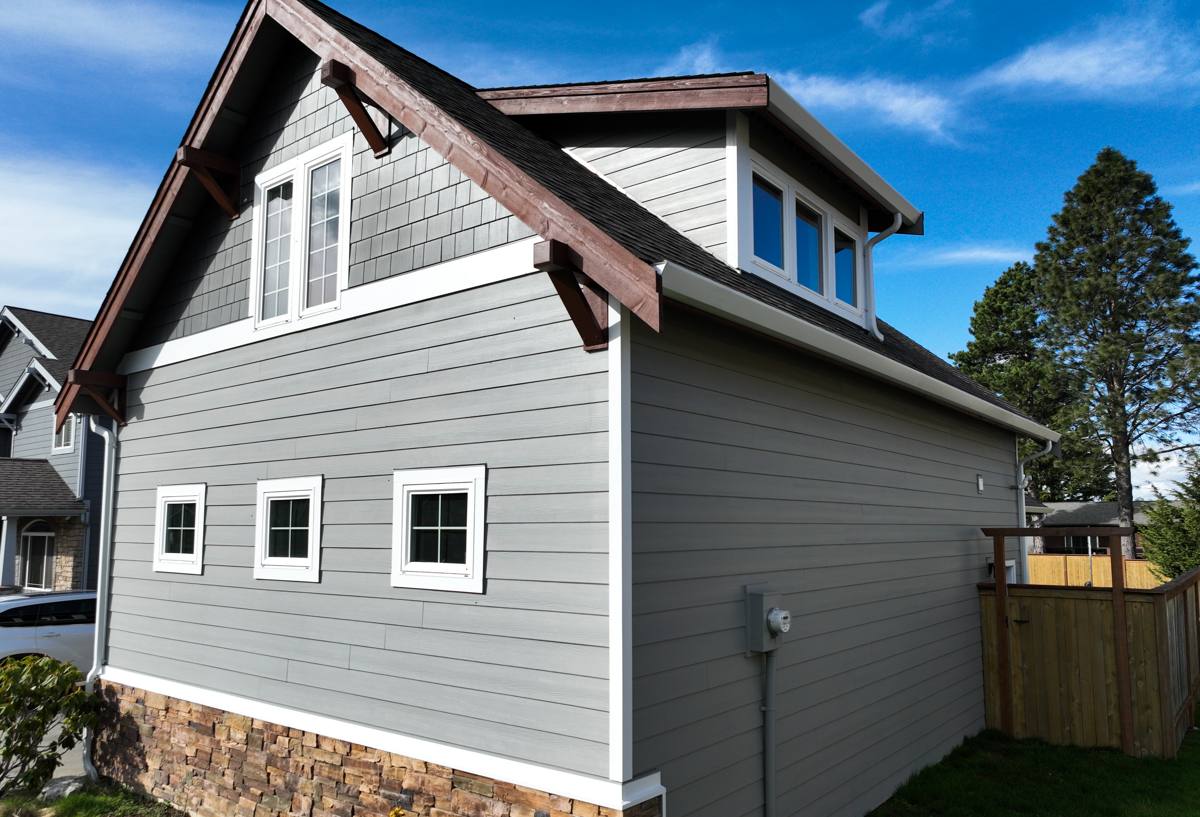
What James Hardie Brings to a West Anacortes Home
- ColorPlus Technology: a baked-on factory finish that's more consistent and more fade- and chip-resistant than field-applied paint, which matters when your siding is facing salt air and UV year-round.
- HZ5 climate engineering: Hardie's HZ product lines are formulated for specific climate zones; our region calls for the moisture- and freeze-thaw-oriented HZ5 formulation.
- Non-combustible core: fiber cement doesn't contribute fuel to a fire the way wood-based siding can.
- Dimensional stability: it doesn't expand and contract the way vinyl does, so seams and caulk lines hold up better over time.
- A warranty built around the whole system: a transferable manufacturer warranty on the boards and finish, backed by installation done to spec.
Our Siding Installation Process
Assessment First
Every job starts with a walk-around of the home — checking existing siding for hidden moisture damage, evaluating trim and window flashing, and looking at how the house's specific exposure (sun, shade, prevailing wind direction) will affect the install plan.
Moisture Barrier and Flashing Details
This is where most siding failures actually originate, regardless of the siding brand on top. We install a proper weather-resistant barrier, and we pay close attention to flashing at windows, doors, and any roof-to-wall intersections — the exact spots where wind-driven rain finds its way in if the details are rushed.
Installation to Manufacturer Spec
James Hardie publishes specific fastening patterns, clearances, and caulking requirements, and a huge share of the siding problems we get called out to inspect on other companies' work trace back to skipped or shortcut installation steps — not a failure of the material itself. We follow Hardie's installation requirements because that's what keeps the warranty valid and what actually keeps water out.
Final Detailing
Trim, caulking, and touch-up work get finished with the same coastal-durability mindset — sealants and fasteners chosen to hold up against salt air, not just to look clean on installation day.
Beyond Siding: Roofing, Windows, and Decks
Siding doesn't work in isolation — it's one piece of a home's overall building envelope, and West Anacortes' climate stresses all of it. We handle roofing, windows, and decks alongside siding because problems in one area frequently show up as symptoms in another. A roof with failing flashing at a wall intersection will feed moisture straight into the siding below it. Old, poorly sealed windows create the same wind-driven-rain vulnerability at every rough opening. Decks facing years of rain and shade deal with their own moss and rot pressures, especially where deck ledgers attach to the house.
Approaching a home's exterior as one connected system, rather than four separate trades, is how problems actually get caught and fixed instead of just moved from one component to another.
Comparing Siding Options for a Coastal Skagit County Home
| Material | Moisture Resistance | Salt Air Durability | Typical Maintenance |
|---|---|---|---|
| Vinyl | Weak at seams; water can get behind panels | Can become brittle over time; fasteners corrode | Low, but replacement often needed sooner |
| Primed Spruce / Cedar | Poor without constant upkeep; prone to rot | Salt accelerates finish breakdown | High — regular repainting and sealing |
| LP SmartSide | Vulnerable at cut edges and fastener points | Moderate; depends on finish integrity | Moderate — finish inspection and touch-up |
| Other Fiber Cement (Cemplank, Allura) | Good — cement-based core | Good, similar composition to Hardie | Low — periodic caulk and finish checks |
| James Hardie Fiber Cement | Excellent — HZ5 climate-engineered | Excellent — ColorPlus factory finish | Low — occasional cleaning and caulk checks |
What a Realistic Siding Project Costs to Think Through
Every home is different, and an accurate number only comes from an in-person assessment, but a few factors consistently drive the cost of a fiber cement siding project up or down:
- Total square footage of siding and the complexity of the home's shape (dormers, gables, and multiple stories add labor time)
- Condition of the existing wall assembly — whether sheathing or framing needs repair before new siding goes on
- Trim and detail work, including window and door casings, corner boards, and fascia
- Whether roofing, window, or deck work is being bundled into the same project
- Product selection within the Hardie lineup — lap siding, shingle-style panels, and board-and-batten each price differently
Why a Local Crew Matters Here
A crew that works Skagit County regularly understands things that don't show up in a spec sheet — which sides of a house in West Anacortes typically take the worst weather, how far moss creeps up a wall in a given winter, and what flashing details actually hold up against a real Anacortes storm versus a mild one somewhere inland. That local knowledge shapes decisions on-site: where to add extra flashing attention, which details need reinforcing given a specific lot's sun and wind exposure, and how to sequence work around our wetter months. It's the difference between an installation that meets code on paper and one that's actually built for the conditions it will face for the next several decades.
Simple Ways to Check Your Home's Exterior Health
- Look for moss or algae streaking on north- or west-facing walls, especially near the ground or under overhangs
- Press gently on siding near window and door trim — any give or softness suggests trapped moisture
- Check caulk lines at trim and corner boards for cracking or gaps
- Look at paint or finish condition on south- and west-facing walls, which take the most UV and weather exposure
- Note any staining below windows or roof-to-wall intersections, a common sign of flashing problems
If you're noticing any of these signs on a home in West Anacortes, or you're simply planning ahead for a siding, roofing, window, or deck project, we're happy to take a look and walk you through what we're seeing — no pressure, no obligation. A free estimate is a good first step toward understanding what your home actually needs.