 Anacortes
 Why La Conner Decks Wear Out Faster Than the Rest of the House
La Conner sits right on the water, and that changes how a deck ages compared to a deck twenty miles inland. Salt-laden air corrodes fasteners and hardware faster than a normal marine-adjacent climate would suggest. Driving rain off the Sound doesn't just fall straight down — it blows sideways into ledger boards, stair stringers, and the gaps between deck boards where water isn't supposed to sit. And Skagit County's long, wet moss season means anything horizontal and shaded stays damp for months at a time. Put those three together and you get the pattern we see over and over on La Conner decks: rot starting at the ledger connection, corroded joist hangers, slick moss-covered boards, and railing posts that feel solid until you push on them and find the base has gone soft.
None of that means a deck can't last. It means the deck has to be built for this specific environment, not for a generic weather zone. That's the difference between a deck that needs replacing again in eight years and one that holds up for decades.
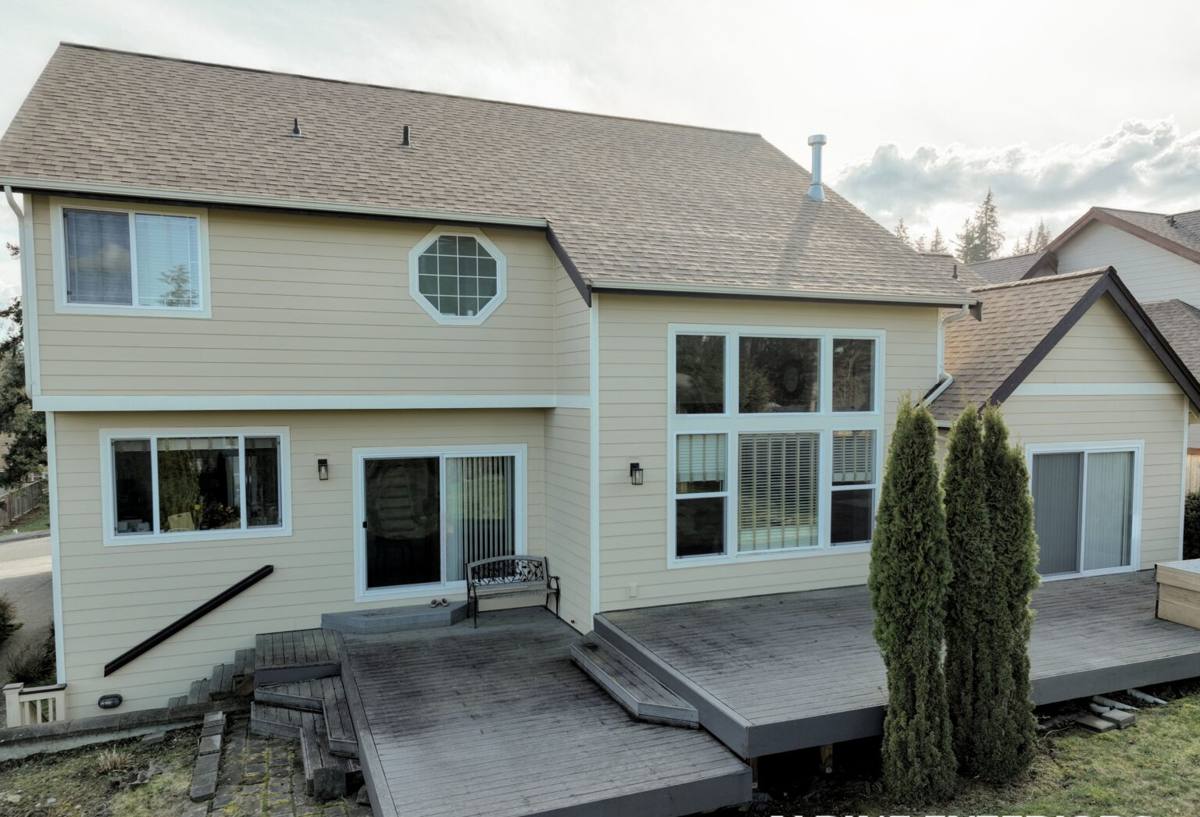
What "Correct" Deck Replacement Actually Involves
A lot of deck work in this area is really just deck board swaps — pull the old decking, screw down new boards, call it done. That's not a replacement, and on a La Conner property it's not enough. A proper replacement addresses the structure underneath, because that's almost always where the real damage is hiding.
The Structural Layer
- Ledger board flashing — the single most common failure point on coastal decks, where water gets behind the ledger and rots the rim joist or sill plate it's attached to
- Joist hangers and structural hardware — swapped to hot-dip galvanized or stainless fasteners rated for coastal/salt-air exposure, not standard zinc-coated hardware that corrodes within a few seasons
- Post bases and footings — checked for movement, cracking, or rot at the post-to-footing connection, which takes on more water than people expect
- Framing lumber — any joist or beam showing soft spots, checking, or fungal staining gets replaced, not sistered over and hoped for
The Surface Layer
- Decking material chosen for how it actually performs wet and shaded, not just how it looks in a showroom
- Proper board spacing and airflow underneath so moisture and moss don't get a place to sit
- Railing systems rebuilt to current code, since older La Conner homes often have railings that predate present-day height and baluster spacing requirements
- Stairs and landings graded to shed water rather than pool it
Skip the structural layer and you've just installed nice-looking boards over a frame that's already failing. We won't do that kind of job, because it doesn't hold up and it isn't honest work.
Decking Material Choices for a Waterfront-Adjacent Climate
There's no single "best" decking material — there's a best material for your budget, your maintenance appetite, and how exposed your deck is to weather. Here's how the common options actually compare once you factor in Skagit County conditions.
| Material | How It Handles Salt Air & Moisture | Maintenance | Typical Lifespan Here |
|---|---|---|---|
| Pressure-treated wood | Needs consistent sealing; end grain and fastener holes are entry points for rot if neglected | Annual cleaning and re-sealing recommended | 10-15 years with upkeep, less without |
| Cedar | Naturally rot-resistant but still needs sealing in a wet, shaded climate; grays and softens faster near salt air | Regular sealing, moss treatment | 15-20 years with upkeep |
| Composite decking | Doesn't absorb water or rot; some boards can trap moss/algae on the surface if not textured for drainage | Periodic washing, no sealing | 25-30+ years, manufacturer-warrantied |
| PVC/capped polymer | Fully sealed surface, best resistance to moisture and salt exposure of the common options | Occasional washing | 25-30+ years, manufacturer-warrantied |
We'll walk through this with you honestly rather than push whatever has the best margin. If budget points you to pressure-treated wood, we'll tell you straight what the maintenance schedule needs to look like to get a fair lifespan out of it in this climate. If you want to stop dealing with moss and sealing altogether, composite or capped polymer is where that conversation goes.
The Moss Problem, Specifically
Moss on a deck isn't just cosmetic — it holds moisture against the board surface, and on wood decking that moisture is what starts rot underneath the growth. Skagit County's damp winters and shaded lots (common on wooded La Conner properties) create ideal moss conditions for a good part of the year. A few things matter more than people expect:
- Board spacing and airflow underneath the deck reduce how long moisture sits after rain
- Grooved or heavily textured composite boards can actually hold moss longer than a smoother board — texture isn't automatically better in a wet climate
- Areas under overhangs or tree cover need more frequent cleaning regardless of material, since sun exposure is the real moss deterrent and those spots don't get much of it
- Pressure washing wood decking too aggressively raises the grain and accelerates wear — a stiff brush and appropriate cleaner does less damage over time
We factor moss exposure into the material and layout recommendation up front rather than treating it as an afterthought you deal with after the deck is built.
Our Deck Replacement Process
1. On-Site Assessment
We inspect the existing deck from the ground up — ledger connection, framing, post bases, and the decking surface — and tell you plainly what's structural versus cosmetic. We also look at drainage, sun exposure, and how sheltered or exposed the deck is to weather off the water, since that shapes the material recommendation.
2. Straightforward Proposal
You get a written scope covering structure, material, hardware grade, and railing work, with pricing that reflects what your specific deck needs — not a generic per-square-foot number that ignores what we find underneath.
3. Permitting
Deck replacement involving structural framing or railing changes typically requires a permit through Skagit County or the relevant local jurisdiction. We handle that process so it's not something you have to chase down yourself.
4. Demolition & Structural Repair
Old decking and any compromised framing comes out. Ledger flashing, hangers, and posts get addressed before a single new board goes down — this is the step that gets skipped on rushed jobs and it's the one that determines how long the deck actually lasts.
5. Decking, Railing, and Finish Work
New decking installed to spec, railings brought up to current code, stairs finished, and hardware checked for proper fastening and corrosion resistance throughout.
6. Final Walkthrough
We walk the finished deck with you, point out anything you should know about care and maintenance for the material you chose, and make sure you're satisfied before we call the job done.
Cost Factors Worth Understanding Before You Get Quotes
Deck replacement pricing swings widely, and the swing usually comes down to a handful of factors rather than the contractor simply charging more or less. Knowing these up front helps you evaluate any quote you get, including ours.
| Factor | Why It Moves the Price |
|---|---|
| Extent of structural damage | Rotted framing, compromised ledgers, and failed footings add labor and material that isn't visible until demo starts |
| Decking material | Pressure-treated wood costs less upfront than composite or PVC, but the lifetime cost gap narrows once maintenance is factored in |
| Deck size and layout | Multi-level decks, angled framing, and built-in features (benches, planters) add complexity beyond square footage alone |
| Railing scope | Bringing older railings up to current code can be a meaningful part of the budget on older La Conner homes |
| Height and access | Elevated decks with limited access for equipment or material staging take longer and cost more than a low ground-level deck |
Broadly, a straightforward wood deck replacement tends to land at the lower end of the range, while composite or PVC decking with railing upgrades sits higher — but the honest answer is that we can't give you a real number without seeing the deck. Anyone who quotes sight-unseen is guessing.
Why Hire a Crew That Already Works in La Conner
A contractor who works across Skagit County regularly already knows what to check for on a coastal deck before they pull the first board — the ledger flashing pattern that tends to fail here, the hardware grade that actually holds up to salt air, the drainage details that matter under the shade of mature trees common on La Conner lots. That's not something you get from a crew that mostly builds decks in a dry inland climate and treats this job the same way.
We also understand the permitting expectations for Skagit County and the practical realities of scheduling around this region's wet season, so the work gets sequenced sensibly instead of getting rained out mid-project or rushed to beat weather.
Signs Your Deck Needs Replacement, Not Just Repair
- Soft or spongy spots anywhere on the decking surface, especially near the house
- Visible gaps, staining, or soft wood at the ledger board where the deck meets the house
- Railing posts that flex or move when pushed — a code and safety issue, not just cosmetic
- Rust streaking from fasteners or visibly corroded joist hangers underneath
- Persistent moss or algae that comes back within weeks of cleaning
- Stairs that feel uneven, bouncy, or have visibly separating stringers
- A deck older than 15-20 years that has never had structural hardware inspected or replaced
If you're only seeing one or two of these, repair may still be reasonable. If you're seeing several at once, that's usually a sign the structure has been compromised long enough that a full replacement is the more honest recommendation — and we'll tell you that directly rather than sell you a patch job that won't hold.
If your La Conner deck is showing its age, we're happy to take a look and give you a straight assessment — no pressure, no upsell, just what we actually find. Use the form below to request a free estimate.