 Anacortes
 Composite Decking Built for Mount Vernon's Weather
Mount Vernon sits inland along the Skagit River, but it still gets the full weather pattern that defines this part of Skagit County: long stretches of wet fall and winter weather, heavy dew and fog off the river bottom, and short, intense summer sun that dries everything out fast before the rain comes back. A deck here doesn't fail because of one bad storm. It fails slowly, from moisture that never fully leaves the wood, from moss and algae that get a foothold in shaded corners, and from the freeze-thaw cycling that happens even in a mild coastal winter. Composite decking was built to shrug off exactly that kind of slow, repeated exposure, which is why it's become the default choice for homeowners in this area who want a deck they're not re-treating every spring.
This page is specifically about composite decking installation for homes in and around Mount Vernon. It's not a generic decking overview — it's what actually matters when you're building or replacing a deck in this climate, on this kind of ground, with this kind of rain pattern.
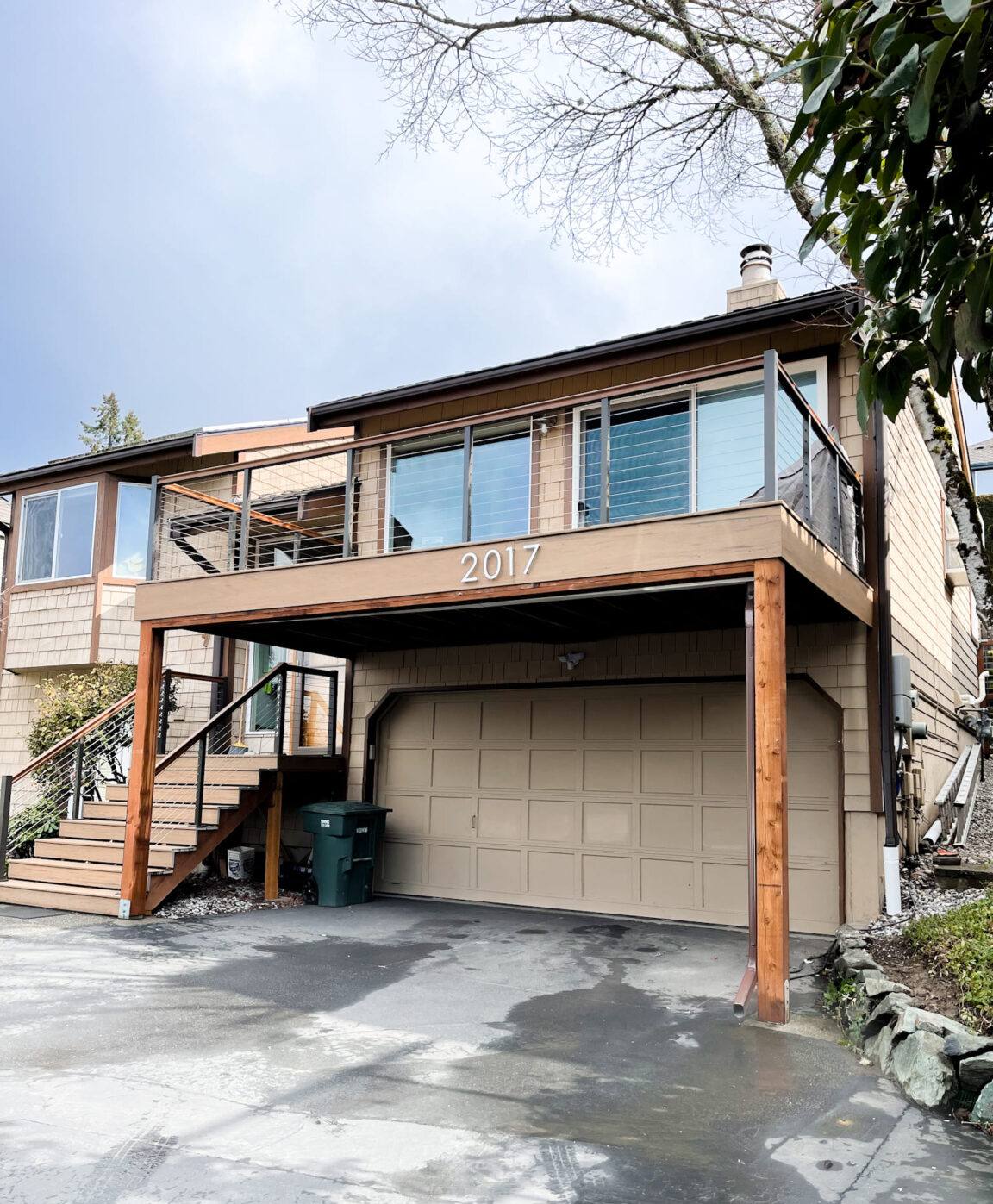
What Skagit County Weather Actually Does to a Deck
Understanding the failure pattern is the first step to avoiding it. A few things are consistent across Mount Vernon and the surrounding Skagit Valley:
- Moss and algae season runs long. Shaded decks, north-facing decks, and anything under overhangs or trees stay damp for weeks at a stretch, and untreated wood surfaces give moss spores something to grip.
- Driving rain gets under things. Wind-driven rain during fall and winter storms doesn't just fall straight down — it pushes moisture into board gaps, fastener holes, and ledger connections that a calm-weather install might not account for.
- Humidity off the river and delta keeps wood swelling and shrinking. That cycle is what splits boards, pops nails, and loosens screws over a few seasons.
- Salt-tinged marine air still reaches inland. It's lighter here than right on Anacortes's waterfront, but Skagit County's proximity to Puget Sound means hardware and fasteners still need to be rated for it, not just standard interior-grade fittings.
None of this is dramatic. It's cumulative. A deck built without these factors in mind usually looks fine for the first year or two, then starts showing problems right when the homeowner assumed it was past the "settling in" period.
Composite vs. Wood vs. PVC: The Honest Comparison
We install composite most often in this market, but it's not the only option, and it's not automatically right for every project. Here's how the three common choices actually compare for a Mount Vernon deck:
| Material | Upfront Cost | Maintenance | Moisture/Moss Resistance | Typical Lifespan |
|---|---|---|---|---|
| Pressure-treated wood | Lowest | Annual cleaning, periodic sealing/staining | Fair — needs upkeep to hold up to this climate | 10–15 years before major repair |
| Composite (capped) | Mid-to-upper | Occasional wash, no sealing or staining | Strong — engineered to resist moisture and staining | 25–30 years, often manufacturer-warrantied |
| PVC / cellular vinyl | Highest | Very low | Excellent moisture resistance, but can be less forgiving of installation error in expansion/contraction | 25–30+ years |
Uncapped or older-generation composite products exist at a lower price point, but we generally steer homeowners away from them in this climate. Without a fully capped shell, they can absorb moisture at the edges over time, which is precisely the failure mode Mount Vernon's wet season is hardest on. That's not a knock on composite as a category — it's why we specify capped boards as our standard, not the cheapest composite on the shelf.
Where Wood Still Makes Sense
If budget is the primary driver and the homeowner is genuinely willing to clean and reseal on a yearly schedule, treated wood is still a legitimate choice. We'll say so plainly during the estimate rather than push composite on every job — but we'll also be honest that most homeowners underestimate how much upkeep that yearly schedule actually takes once life gets busy.
What a Correct Composite Deck Installation Involves
The board itself is only part of the job. Most composite deck problems we get called out to repair in this area trace back to the substructure or the details underneath, not the decking material itself.
Framing and Substructure
Composite boards are heavier than wood and behave differently under load, so joist spacing has to match the manufacturer's specification for that specific product — not just "what worked on the last wood deck." We use joist tape or an equivalent moisture barrier on top of the framing to keep standing water off the joists themselves, which matters more here than in a drier climate because framing lumber under a deck skin rarely gets a chance to fully dry out between storms.
Fastening and Board Spacing
Hidden fastener systems give a cleaner look and avoid the face-screw holes that collect moisture and grime, but they have to be installed with the correct gap tolerances for thermal movement — composite expands and contracts with temperature more than people expect. Get the spacing wrong and boards either buckle in summer heat or open unsightly gaps in winter cold.
Drainage and Ventilation
Any deck attached to the house needs proper flashing at the ledger board so water is directed away from the structure, not into it. Underneath, airflow matters — a low-clearance deck with no ventilation traps humidity against the joists and framing, which is exactly the environment that breeds rot and moss in a place like Mount Vernon.
Our Process, Start to Finish
- On-site assessment. We look at drainage, sun/shade exposure, existing framing condition (if it's a replacement), and how the deck ties into the house.
- Material walkthrough. We go over composite board options, color/finish choices, and what fits the budget honestly — including telling you if wood is the more sensible call for your situation.
- Permitting. Deck projects above certain heights or attached to the structure typically require a permit through the local building department; we handle that paperwork rather than leaving it to the homeowner.
- Demo and framing. Old decking is removed, framing is inspected and reinforced or rebuilt as needed, and ledger flashing is installed or corrected.
- Decking installation. Boards are laid with the correct fastening system and expansion gaps, along with any fascia, stair, or railing components.
- Final walkthrough. We check the finished deck with you before we consider the job done — fastener lines, edge finishing, and drainage all get a look.
Choosing the Right Composite Board for This Climate
Not every composite product is built the same way, and the differences matter more here than in a dry climate. A few things worth weighing:
| Factor | Why It Matters in Mount Vernon |
|---|---|
| Fully capped vs. partially capped board | Full capping resists moisture absorption at cut ends and edges — the spot most exposed to the region's rain and humidity |
| Color and finish | Lighter, streaked, or variegated finishes hide pollen, mildew shadowing, and moss residue better than solid dark tones in shaded yards |
| Texture | A slip-resistant texture matters on a deck that stays damp for days after a fall storm |
| Manufacturer warranty terms | Look for warranties that explicitly cover moisture-related staining and mold, not just structural fading |
Maintenance Checklist for Mount Vernon Composite Decks
Composite is low-maintenance, not no-maintenance. A simple seasonal routine keeps it looking and performing the way it should:
- Sweep off fallen leaves and debris regularly in fall — trapped organic matter is what feeds moss and mildew on any deck surface
- Rinse the deck with a garden hose and mild soap a couple of times a year; avoid pressure washers on composite unless used on a low setting from a distance
- Check and clear gaps between boards so water keeps draining through rather than pooling
- Inspect railing posts and stair connections annually for looseness — fastener movement shows up here first
- Keep planters and furniture feet from sitting directly on the surface for months at a time, which can trap moisture underneath them
- Confirm gutters and downspouts near the deck are directing water away, not onto the deck surface
Why a Crew That Already Works Mount Vernon Matters
Composite decking installation isn't exotic work, but the details that separate a deck that lasts twenty-five years from one that needs framing repairs in year five are almost all local: knowing how this area's rain pattern loads up a north-facing deck, knowing what the local permitting process actually requires before a shovel goes in the ground, and knowing which fastener and flashing details matter given how long this region stays wet each year. A crew that works Skagit County regularly has already seen what happens when those details get skipped, and builds accordingly from the first board down.
If you're planning a new deck or replacing one that's showing its age, we're happy to come take a look and give you a straightforward assessment — no pressure, no upsell, just what your project actually needs. Reach out through the form below for a free estimate.