 Anacortes
 Sedro-Woolley sits far enough up the Skagit Valley that its weather isn't identical to the coast, but it still gets the same long, wet Pacific Northwest winters, heavy fall rain, and the humidity that keeps moss and mildew active on north-facing walls for much of the year. Add in tree cover on a lot of Sedro-Woolley properties — shade that keeps siding damp longer after a storm — and you have a climate that's genuinely hard on exterior materials. Siding repair here isn't a cosmetic errand. It's about catching moisture problems before they become framing problems.
We work on siding across Skagit County, and Sedro-Woolley calls come in with a recognizable pattern: cracked or buckled panels near ground level, rot at butt joints and corner trim, and paint failure on walls that don't get much sun. Knowing that pattern before we get out of the truck is part of what makes a repair fast and correctly scoped instead of a guessing game.
Why Sedro-Woolley Homes Wear Differently
Sedro-Woolley isn't right on the water, but it's still squarely in a maritime climate — rain totals build up over the winter, humidity stays elevated for months, and drying windows between storms can be short. A few things specific to this area matter for siding:
- Tree cover and shade: Many lots have mature trees close to the house, which means siding under that canopy dries slower and holds moisture and moss longer than an open, sun-exposed wall.
- Valley humidity: Being inland doesn't mean dry. Morning fog and dew are common in the valley, and that moisture sits on siding surfaces, especially on shaded or north-facing elevations.
- Seasonal moss and algae growth: A long damp season gives moss and algae time to establish on siding, trim, and roof edges, and moss holds water against the surface longer than the surface would hold on its own.
- Older housing stock: A fair number of homes in and around Sedro-Woolley have wood or older composite siding that's now decades past its original finish life, which is exactly the kind of siding that shows rot first.
None of that means Sedro-Woolley siding fails faster than anywhere else in the county. It means the failure points are predictable, and a repair crew that already understands them can diagnose a problem correctly on the first visit.
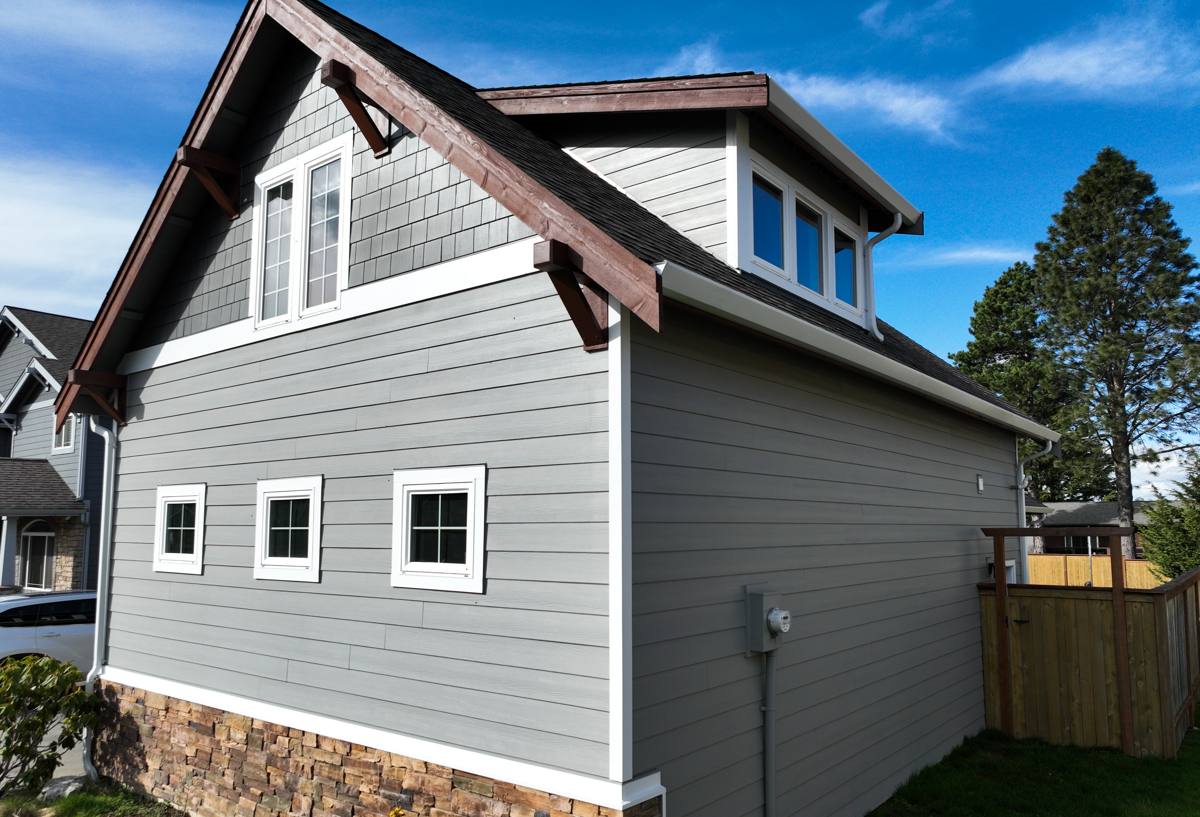
What Actually Fails, and Why
Rot at Joints, Corners, and Bottom Courses
Water finds the seams. Butt joints where two siding pieces meet, inside and outside corners, and the bottom course closest to grade or a deck are the most common rot locations we find on repair calls. Once water gets behind the siding at one of these points, it doesn't dry out — it sits against the wall sheathing and starts breaking down wood fiber, whether the siding itself is wood, composite, or an older fiber cement product that was caulked instead of properly flashed.
Cracked and Buckled Panels
Panels crack from impact, from age-related brittleness, or from being installed too tight with no room to expand and contract. Buckling usually points to a moisture or fastening issue underneath — the panel is reacting to something happening behind it, not just on the surface. That distinction matters, because replacing the visible panel without addressing what's behind it just buys a year or two before the same spot fails again.
Moss, Algae, and Finish Breakdown
Moss holds water against the siding surface far longer than the surface would otherwise stay wet, which accelerates paint failure, wood softening, and gap-sealant breakdown underneath it. On shaded Sedro-Woolley lots, this is often the earliest visible sign that a wall needs attention, well before there's structural rot.
Failed Caulking and Trim Gaps
Caulk is not a permanent seal. It shrinks, cracks, and pulls away from siding and trim over years of temperature swings and UV exposure. Gaps around windows, doors, and trim boards are a direct path for water intrusion, and they're one of the easiest things to miss on a casual look at the house.
What a Correct Siding Repair Involves
A repair that actually holds up starts with finding out why the damage happened, not just patching what's visible. Our process on a repair call:
- Inspect beyond the visible damage. We check the sheathing and framing behind damaged panels, not just the panels themselves. Surface damage is often the smallest part of the problem.
- Identify the moisture path. Failed flashing, missing kick-out flashing at roof-wall intersections, bad caulk joints, or grade that's too close to the bottom of the siding — we trace it back to the source instead of just replacing the panel.
- Remove and assess damaged material. Rotted sheathing or framing gets replaced, not covered up. Covering rot with new siding is a repair that fails again within a few years.
- Correct the underlying detail. That might mean adding or repairing flashing, adjusting a caulk joint, or changing how a panel was fastened — whatever caused the original failure.
- Replace with matched material. When we're repairing a home that already has James Hardie siding, we match the profile, exposure, and color so the repair is not a visible patch. When we're repairing older wood or composite siding, we'll talk through whether a spot repair makes sense or whether the wall (or the whole house) has reached the point where full replacement is the more honest recommendation.
- Confirm the fix. We check the repaired area and its surroundings before we call the job done — not just the panel that was replaced.
Repair vs. Replacement: How We Help You Decide
Not every siding problem needs a full re-side, and we're not going to tell a homeowner they need one when a targeted repair will hold. But there's a point where repeated spot repairs cost more over time than doing the job once. Here's how we think about it:
| Situation | Usually a Repair | Usually Points to Replacement |
|---|---|---|
| Damage location | Isolated to one or two areas (a corner, a section near a downspout) | Recurring damage across multiple walls or elevations |
| Underlying material | Sheathing and framing are sound once dried out | Rot has spread into structural framing in more than one spot |
| Siding age and material | Newer fiber cement, or wood/composite still within a reasonable service life | Original wood or older composite siding well past its expected lifespan |
| Match quality | Replacement panels can be closely matched to existing siding | Discontinued profile or faded color means a patch will always look like a patch |
| Root cause | A single fixable detail (one bad flashing point, one gap) | Systemic issues — original installation lacked proper water management |
We'll always give you the honest read on which side of that line your home is on, with the reasoning behind it — not just a recommendation.
Why We Only Use James Hardie for Repairs and Replacement Panels
When a repair calls for new siding material — whether it's a few replacement boards or a full wall — we use James Hardie fiber cement, and that's a deliberate standard, not a default. Fiber cement doesn't rot, doesn't feed moss and algae the way wood fibers can, and holds up to the freeze-thaw and constant damp cycling that Skagit County winters bring. Hardie's ColorPlus factory finish also means a color-matched repair actually looks right against existing siding instead of standing out as an obvious patch, and it holds its color far longer than a field-applied paint job on a repair section.
We don't install LP SmartSide, vinyl, Cemplank, Allura, or primed wood siding, including as repair material. That's a standard we hold across every job, repair or replacement, because it's the product we trust to actually solve the problem instead of needing to be fixed again in a few years.
Signs You Should Have Sedro-Woolley Siding Checked
- Soft or spongy siding when you press on it, especially near the bottom courses or under windows
- Visible cracking, buckling, or gaps between panels
- Paint peeling or bubbling in a localized area rather than evenly across the whole house
- Persistent moss or dark staining that keeps coming back after cleaning
- Soft trim boards or corner boards, particularly where they meet the roofline or a deck
- Visible daylight or a draft at a siding seam or corner from inside the house
- Warped or discolored siding near downspouts, hose bibs, or anywhere water regularly runs down the wall
Why a Crew That Already Works Sedro-Woolley Matters
A repair crew that's worked in Sedro-Woolley and the surrounding Skagit Valley isn't guessing at what caused the damage — they've seen the same rot patterns on the same wall orientations on other homes nearby. That means less time spent diagnosing and more time spent actually fixing the problem correctly. It also means we know what to expect from local permitting and how to sequence a repair around this area's rain patterns, so a section of wall isn't left open to weather longer than it needs to be.
We also carry James Hardie product knowledge that a general handyman or a crew that dabbles in siding won't have — matching HZ5 versus HZ10 formulations, panel profiles, and ColorPlus finishes so a repair blends in rather than standing out.
Get an Honest Look at Your Siding
If you're seeing soft spots, cracked panels, or moss that keeps coming back on your Sedro-Woolley home, it's worth having someone look before the damage spreads into the framing. We offer free, no-pressure estimates — we'll tell you straight whether you're looking at a repair or something bigger, and why.