 Anacortes
 Bow's Roofs Take a Different Kind of Beating
Bow sits close enough to Samish Bay and the open water of Puget Sound that its roofs deal with a mix of weather most inland Skagit County homes don't see as often: salt-laden wind off the water, long stretches of driving rain, and a moss season that can run nine or ten months out of the year under the fir and cedar canopy common to the area. None of that shows up in a roof's warranty paperwork, but it shows up on the roof itself — in curled shingle edges, streaked moss lines, and flashing that's started to lift a season or two before you'd expect.
Storm damage repair here isn't just patching a hole after a windstorm. It's understanding how salt air accelerates corrosion on metal flashing and fasteners, how sustained rain finds the smallest gap in a valley or a pipe boot, and how moss holds moisture against shingles long after a storm has passed. A repair that doesn't account for those conditions tends to fail again within a year or two — which is why so many Bow homeowners end up calling a second contractor after the first "quick fix" doesn't hold.
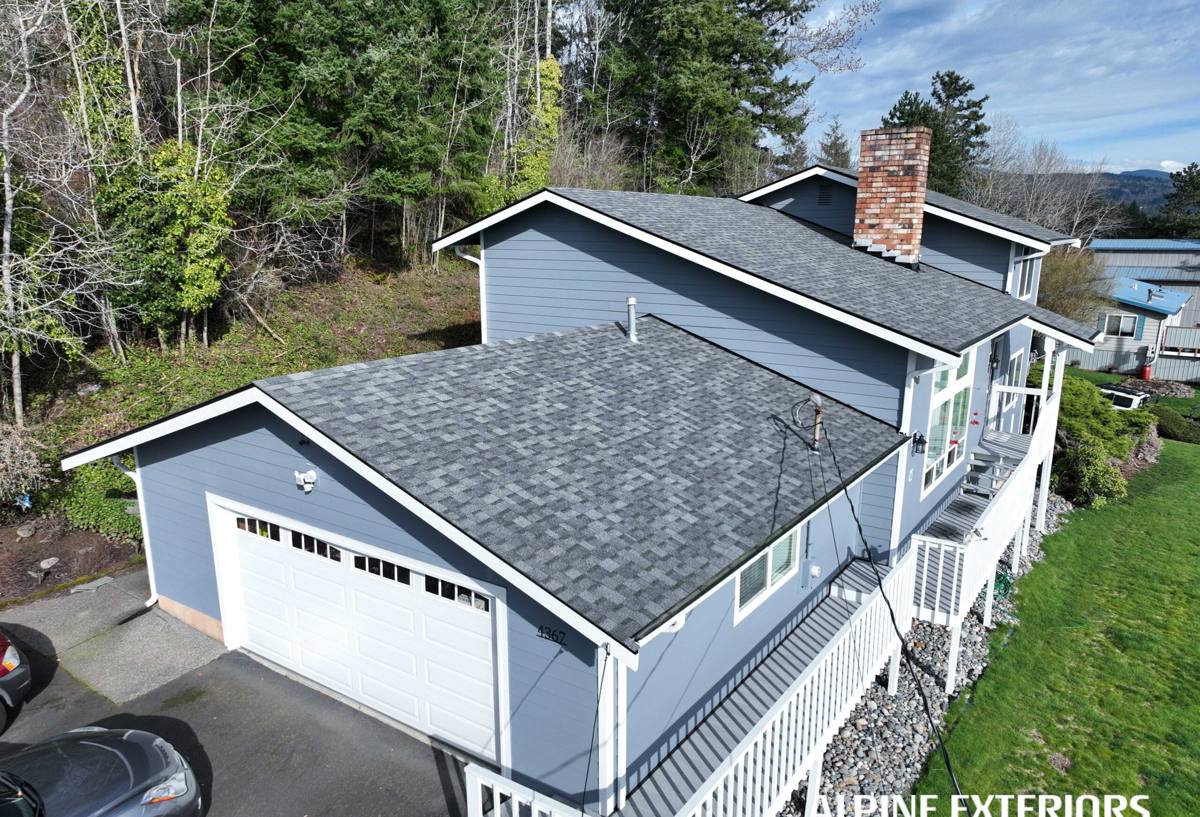
Recognizing Storm Damage on a Bow Roof
Storm damage isn't always obvious from the ground, and it isn't always dramatic. After a windstorm or a hard rain event, it's worth checking for a few specific signs before assuming everything is fine.
Wind and Impact Damage
Wind coming off the water tends to lift shingles from the edges and corners first. Look for shingles that are creased, torn, or simply missing, and for a scatter of dark granules in gutters or at the base of downspouts — that's the protective coating wearing off, and it's often the first visible sign of wind stress even when the shingle itself still looks intact.
Flashing and Valley Failures
Flashing around chimneys, skylights, and roof valleys is where most active leaks actually start, not in the middle of a shingle field. Driving rain pushes water sideways under flashing that's even slightly separated, and in a valley, a small gap can funnel a surprising amount of water into the attic during a heavy storm.
Moss and Trapped Moisture
Moss doesn't just look bad — it holds water against the roof surface, works its way under shingle tabs, and keeps sections of the roof damp long after the rest has dried. On a shaded Bow lot, moss can mask early wind or storm damage entirely, which is one reason a post-storm check should include a look at moss-heavy areas specifically, not just the parts of the roof that are easiest to see.
Why Waiting Costs More Here Than It Would Elsewhere
In a drier climate, a small storm-damaged spot might sit for months without consequence. In this part of Skagit County, that same gap is exposed to rain on a large share of the days between October and April. Water that gets under a shingle or past a flashing seam doesn't just sit there — it works into the decking, saturates insulation, and can start growing mold in the attic space well before it ever shows up as a stain on a ceiling inside the house.
There's also a practical, dollars-and-cents reason to move quickly: most homeowners insurance policies require damage to be reported and documented within a specific window after a storm event, and the longer a roof sits unrepaired, the harder it becomes to prove the damage was storm-caused rather than the result of ordinary wear. A repair scheduled soon after a storm is almost always cheaper, and cleaner to document, than one scheduled months later.
What a Correct Storm Repair Actually Involves
A storm repair done right is more than swapping out the shingles that are visibly torn. It starts with a full inspection of the surrounding area — decking, flashing, and fasteners — because storm damage rarely stays confined to the exact spot that looks worst from the ground.
- Removing and inspecting decking under the damaged area for soft spots, rot, or hidden water staining
- Replacing damaged shingles with a matching product where possible, or the closest available match when the original has been discontinued
- Re-bedding or replacing flashing at valleys, chimneys, and penetrations — not just caulking over a gap
- Installing or repairing ice-and-water shield membrane in valleys and eaves, which matters more here given how much of the year involves sustained rain
- Clearing and treating moss in the repair area so it isn't trapping moisture against new work within the first season
- Checking fastener corrosion nearby, since salt air accelerates rust on exposed nail heads and metal flashing faster than most manufacturers' spec sheets assume
Skipping any one of these steps is how a "repaired" roof ends up leaking again at the next storm — usually a few feet from where the original repair was done, once the homeowner has already assumed the problem is solved.
Repair or Replace? How We Help You Decide
Not every storm-damaged roof needs full replacement, and not every roof can be reasonably patched. The right call depends on the roof's age, how widespread the damage is, and how much moss and moisture exposure the roof has already absorbed over its life. The table below covers the general factors we weigh during an inspection.
| Factor | Favors Repair | Favors Replacement |
|---|---|---|
| Roof age | Under 12-15 years, in otherwise good condition | Nearing or past expected shingle lifespan |
| Extent of damage | Isolated to one section or slope | Spread across multiple slopes or the whole roof |
| Decking condition | Solid, no rot found on inspection | Soft spots or rot found in more than one area |
| Moss history | Light, recently treated | Long-term moss growth with visible shingle degradation |
| Shingle match availability | Current product still manufactured | Discontinued color or profile, poor visual match |
We'll walk you through where your roof falls on each of these before recommending either option — our goal is an honest answer, not the more expensive one.
Our Process, Start to Finish
Inspection and Documentation
Every storm repair starts with a full inspection, including photos of the damage that you can use for an insurance claim if you're pursuing one. We'll point out anything we find beyond the obvious damage — a soft spot in the decking, corroded flashing nearby, moss that's been left untreated — so there are no surprises once work begins.
The Repair Itself
We match materials as closely as possible, replace flashing rather than patch it where it's failed, and treat any moss in and around the work area. Work is sequenced to keep the roof weathertight at the end of every single day, which matters on a job site that's exposed to Skagit County's rain on short notice.
Cleanup and Follow-Up
We clear debris, old shingle material, and displaced granules from gutters and downspouts before we consider a job finished — leftover debris in gutters is a common cause of the "second leak" homeowners see a few months after a repair that otherwise looked complete.
Post-Storm Roof Checklist for Bow Homeowners
After any significant wind or rain event, a quick check can catch problems before they become expensive ones. From the ground, with binoculars if you have them, look for:
- Missing, torn, or visibly lifted shingles, especially at roof edges and corners
- Granules collecting in gutters or at the bottom of downspouts
- Visible gaps or lifted metal at chimney and skylight flashing
- Sagging or discoloration in ceilings and around light fixtures inside the house
- Musty odor in the attic, which often shows up before any visible staining does
- Heavy moss buildup in valleys or on north-facing slopes that hasn't been addressed in a while
If you notice any of these, it's worth getting an inspection sooner rather than later — especially if you plan to file an insurance claim, since most policies have a reporting window that starts from the date of the storm.
Why It Matters That We Already Work in Bow
A crew that only sees Bow occasionally doesn't have the same working knowledge of how this specific stretch of Skagit County behaves in a storm — which slopes tend to take the worst of the wind off the water, how long moss really takes to become a problem under the local tree cover, or what a typical roof age and material looks like on homes built in this area. We do. That familiarity shows up in faster, more accurate inspections and repairs that are built for the conditions your roof will actually face next winter, not just for the damage that's visible today.
It also means a faster response. Storm damage doesn't wait for a convenient time, and having a crew that already knows the area — rather than one driving in from farther afield after every regional storm — usually means a shorter wait between your call and a tarp or a repair being done.
If your roof has taken storm damage — or you're just not sure and want a second set of eyes before the next system rolls in off the water — we're happy to take a look. Reach out for a free, no-pressure estimate using the form below.