 Anacortes
 Why Conway Homes Need Siding That's Built for This Exact Climate
Conway sits in the lower Skagit Valley, close enough to Puget Sound and the surrounding wetlands that homes here take on a specific combination of punishment: salt-tinged air moving in off the water, long stretches of driving rain through fall and winter, and a moss season that can run most of the year on shaded north and west walls. None of these things alone is unusual for Western Washington. Together, on a home that isn't sited in a dense urban core, they add up to siding conditions that are noticeably harder than what a contractor sees on a typical inland suburban job.
Salt air accelerates corrosion on fasteners, flashing, and any exposed metal trim. Driving rain finds every gap in a poorly lapped joint or under-flashed window, and it does so sideways, not just falling straight down, which means standard "good enough" flashing details in drier climates aren't good enough here. Moss and algae need shade, moisture, and time to establish, and low-lying, tree-lined properties around Conway offer exactly that. A siding system and installation approach that doesn't specifically account for all three will show it within a few years, not decades.
What James Hardie Fiber Cement Solves for This Environment
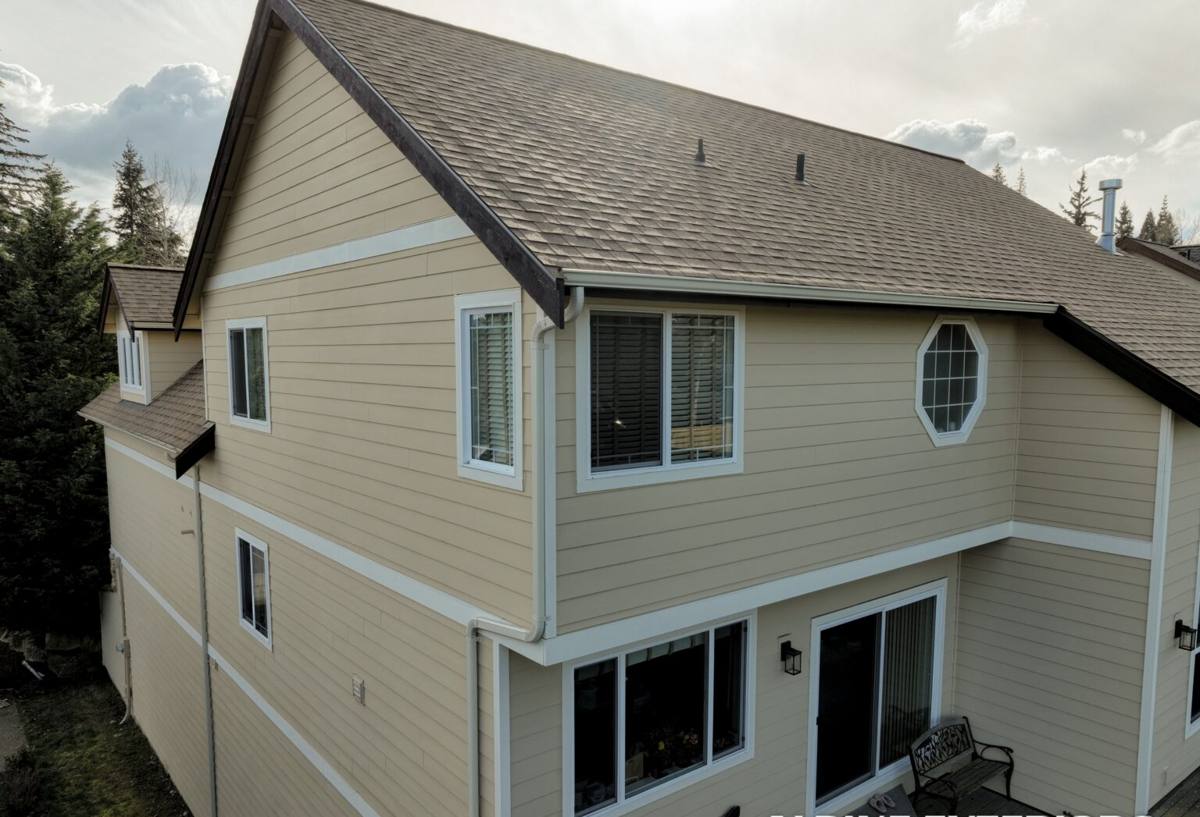
We install James Hardie exclusively, and on a property like Conway's, the reasons are practical rather than theoretical. Fiber cement is dimensionally stable — it doesn't swell, cup, or rot the way wood-based products can when they take on repeated moisture cycling. It's also non-combustible, which matters given how much of the surrounding Skagit Valley is agricultural and wooded land where dry-season fire risk is a real consideration.
Two things matter more specifically for a coastal, moss-prone site like this:
- ColorPlus factory finish resists the kind of paint failure — peeling, bubbling, cracking — that shows up fastest on walls that stay damp longer, which describes a lot of shaded Conway elevations.
- HZ5 engineered formulation is built for the freeze-thaw and moisture-cycling conditions common in the Pacific Northwest, giving the board itself better resistance to the swelling and cracking that plague less climate-matched products in wet regions.
Fiber cement also gives moss and algae less to hold onto than wood grain or certain textured composites, and it holds up to the occasional exterior wash-down needed to keep growth in check without degrading the substrate underneath.
What a Correct James Hardie Installation Actually Involves
The board itself is only part of the equation. Most siding failures we get called out to inspect — regardless of brand — trace back to installation shortcuts, not product defects. On a Conway home, where wind-driven rain is a regular event, these details aren't optional extras:
Water Management Comes First
Before a single piece of siding goes up, the wall needs a correctly lapped weather-resistant barrier, properly integrated window and door flashing, and rainscreen or drainage-gap detailing where the wall assembly calls for it. Siding is the visible layer; the water management behind it is what actually keeps a house dry over 30 years.
Fastening and Clearances to Spec
James Hardie publishes specific fastener types, spacing, and penetration requirements, along with minimum clearances from grade, roofing, and decking. Skipping these — over-driving nailers, closing up clearances to save a few inches of reveal — is exactly the kind of shortcut that turns a 30-year product into a 10-year problem.
Caulking and Joint Treatment
Butt joints, trim intersections, and penetrations all need the right sealant, applied correctly, not just smeared over a gap. In a high-rain environment, a single bad joint can let water track behind the wall assembly for years before it's visible from outside.
Installation Checklist We Follow on Every Conway Job
- Weather-resistant barrier inspected and lapped correctly before siding starts
- Flashing integrated at every window, door, and penetration — not just caulked over
- Rainscreen/drainage gap installed where the wall assembly requires it
- Fasteners matched to Hardie's published spec for type, spacing, and depth
- Minimum clearances held from grade, roofline, and decking
- Butt joints and trim seams sealed with appropriate sealant, not just caulk-and-hope
- Factory-cut edges used wherever possible to preserve the ColorPlus finish warranty
- Final walk-through against manufacturer install checklist before the job is called done
Why We Don't Install Vinyl, LP SmartSide, or Cedar Here
We get asked why we've standardized on one product instead of offering the usual menu. The honest answer is that we've made a professional call based on what holds up in this exact climate, not because the alternatives are worthless everywhere.
Vinyl siding is affordable and low-maintenance in the sense that it doesn't need repainting, but it's a poor match for a coastal, wind-exposed site: it can warp or distort in temperature swings, its seams and J-channels give wind-driven rain more entry points, and it doesn't offer the fire resistance fiber cement does. LP SmartSide is a legitimate engineered wood product, but it's still wood-based at its core — it depends on flawless caulking and field-applied paint maintenance to keep moisture out, and in a high-moisture, moss-prone area that maintenance burden compounds fast. Cedar and primed spruce have real appeal for their look, but they need the most active maintenance of any option here — regular refinishing, vigilant moisture monitoring, and real vulnerability to the same wet, shaded conditions that make moss thrive on Conway walls in the first place.
James Hardie isn't maintenance-free, but between the factory-cured ColorPlus finish, the non-combustible composition, and a formulation built for exactly this climate zone, it's the product that best matches what this specific environment demands.
Cost Factors on a Conway Job
Every home is different, but the line items that actually move a Conway siding estimate are fairly consistent. We'll walk through all of these in a real quote rather than giving a number that doesn't reflect your house.
| Factor | Why It Matters Here |
|---|---|
| Existing siding removal & disposal | Tear-off complexity varies with layers, sheathing condition, and any hidden moisture damage found underneath |
| Sheathing/substrate repair | Rot or water damage found once old siding is off is common on older Skagit Valley homes and must be corrected before new siding goes on |
| Water-resistant barrier & flashing detail | Full flashing integration at every opening takes more labor than a shortcut job, but it's what actually keeps rain out |
| Hardie product line & profile | Lap, shingle, and panel profiles carry different material and labor costs |
| ColorPlus vs. field-painted | Factory finish costs more upfront but removes a repaint cycle and carries a stronger finish warranty |
| Trim, corners, and architectural detail | Homes with more elevation changes, dormers, or trim work take longer to detail correctly |
| Site access | Tree cover, slope, and setback from the road affect staging and scaffolding time |
Why a Crew That Already Works Conway Matters
Siding installation isn't just a product — it's a set of field judgment calls specific to the site. A crew that already works around Conway and the broader Skagit County area knows which elevations tend to hold moisture longest, how far wind-driven rain typically travels under an eave in this microclimate, and where moss pressure is severe enough to warrant extra attention to drainage detailing. That local pattern recognition shows up in small decisions — an extra flashing lap here, a wider drainage gap there — that a crew unfamiliar with the area might not think to make.
It also means faster response if something needs a look after the job is done, and a crew that's accountable to a reputation in a community they keep coming back to, not a one-time drive-by job.
What to Expect From Our Process
We start with an on-site inspection of the existing siding, sheathing, and any problem areas — not a drive-by estimate. From there we walk you through the Hardie product line and profile that fits your home, give you a written scope that spells out the water-management detailing we'll use, and schedule the work around Skagit County's weather windows rather than rushing it into a wet stretch. Once the job is complete, we do a final walk-through against the manufacturer's installation checklist before we call it finished.
If you're weighing a siding replacement in Conway and want a straight answer about what your home actually needs, we're glad to come take a look. The estimate is free, there's no pressure, and you'll get a clear explanation of what we see and why — just fill out the form below to get started.