 Anacortes
 Building a Deck That Belongs in Flounder Bay
Flounder Bay sits close enough to the water that every outdoor structure on a property has to answer to it. A deck here isn't just an outdoor living space — it's an exposed assembly of wood, metal, and fasteners that gets salt-laden air, wind-driven rain, and long stretches of shade and moss pressure that inland Anacortes lots don't see nearly as much. A deck built to a generic spec sheet will look fine for a season or two, then start showing the same failure points: rusted fastener heads, soft spots where boards meet the ledger, and a green film that never quite goes away no matter how often it's scrubbed.
Building correctly for this specific pocket of Skagit County means treating the marine exposure as the starting assumption, not an afterthought. That changes fastener choice, ledger flashing, board spacing, and even how the substructure is framed underneath. None of it is exotic — it's just detail work that gets skipped when a crew is used to building decks fifty miles from salt water.
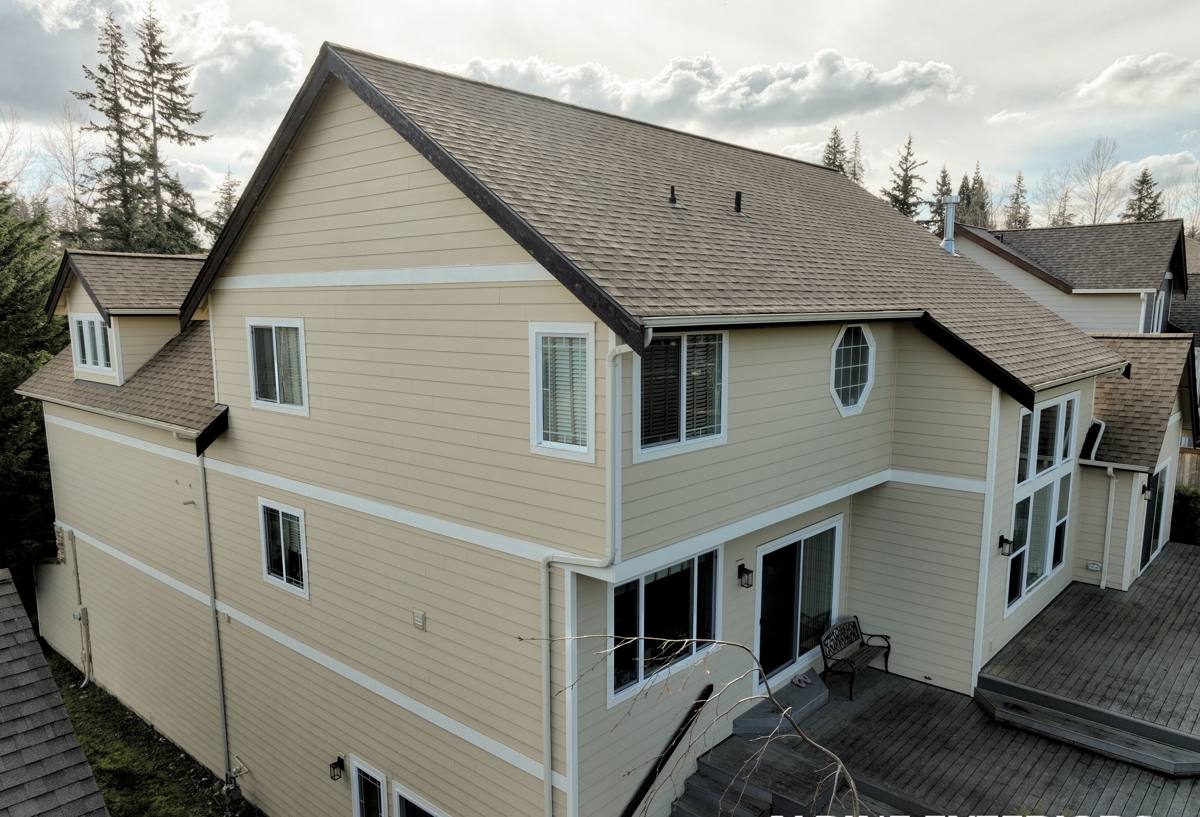
What Flounder Bay's Climate Actually Does to a Deck
Salt Air
Airborne salt doesn't need direct wave contact to do damage — it travels on the wind and settles on any exposed metal. Standard galvanized fasteners and connectors will pit and rust in a few seasons this close to the bay. Stainless steel costs more up front but is the only real answer for hardware that has to last as long as the decking itself.
Driving Rain
Rain here rarely falls straight down — wind pushes it sideways, which means it gets up under rail caps, into end-grain cuts, and behind ledger boards if the flashing isn't detailed correctly. A deck that would stay dry in a calmer inland yard can take on water at every horizontal-to-vertical transition in a spot exposed to Flounder Bay's wind pattern.
Moss Season
Between fall and late spring, shaded decks under tree cover or on the north side of a house stay damp for days at a time. Moss and algae take hold fastest on boards with tight grain patterns, low airflow underneath, or finishes that trap moisture instead of shedding it. Left alone, that surface moisture works its way into the wood fiber and accelerates rot from the top down, not just from underneath.
What a Correctly Built Deck Includes
A deck built for this environment isn't a different product — it's the same deck, built with the exposure accounted for at every stage instead of patched later. The details that matter most:
- Stainless steel or marine-grade coated fasteners and structural connectors throughout, not just at visible surfaces
- Ledger flashing that sheds water outward and down, installed before any decking goes on, not caulked in after the fact
- Joist tape or a comparable moisture barrier on top of every joist, so the structural lumber underneath isn't sitting in standing water
- Board spacing set for airflow and drainage, not just visual tightness
- Ventilated substructure — enough clearance and airflow underneath that the joists and beams can actually dry between rain events
- Decking material matched to the site's sun and shade pattern, since a shaded, damp corner of the yard has different needs than an open, sun-exposed section
- Railing and post connections detailed to shed water rather than pocket it at the base
Decking Material Choices for a Marine-Exposed Yard
There's no single right answer for every Flounder Bay property — the right material depends on budget, how much shade the deck sits in, and how much upkeep the homeowner actually wants to do. Here's how the common options hold up against salt air, rain, and moss specifically:
| Material | Salt Air Resistance | Moss/Algae Behavior | Maintenance |
|---|---|---|---|
| Pressure-treated wood | Good if fasteners and flashing are correct | Needs regular cleaning and sealing in shaded areas | Annual inspection, periodic sealing |
| Cedar | Naturally decent, but surface finish still weathers | Prone to graying and moss in damp, shaded spots without upkeep | Periodic cleaning and oil/sealant |
| Composite decking | Excellent — doesn't corrode or absorb salt | Can still grow surface algae in constant shade; cleans off easily | Low — occasional washing |
| PVC decking | Excellent — fully synthetic, no fiber to break down | Sheds moisture well; least prone to sustained moss growth | Lowest — occasional washing |
Composite and PVC products cost more per square foot than wood, but in a shaded, salt-exposed yard the maintenance savings and longer service life usually make the difference back over time. For sunnier, more open sections of a property, a well-detailed wood deck can still be the right call — the framing and hardware matter more than the surface material in that case.
Framing and Substructure: Where Most Deck Failures Actually Start
Homeowners tend to focus on the decking surface because that's what they see, but the substructure is where marine exposure does the most damage first. Joists and beams that sit low to the ground, in shade, with poor airflow, stay wet far longer after a storm than the same lumber would in an open, sunny yard elsewhere in Anacortes. Over a few seasons that constant damp cycle rots connections from the inside, well before the surface boards show any obvious wear.
A correctly framed deck for this kind of site accounts for grade, drainage, and airflow underneath as deliberately as it accounts for the decking on top. That includes keeping the structure elevated enough for air to move, sloping the ground beneath the deck so water doesn't pool against footings, and using ledger and post connections rated for the exposure rather than whatever is cheapest at the yard.
Our Process for a Flounder Bay Deck Project
1. Site Walk and Exposure Assessment
We look at sun and shade patterns across the day, wind exposure, proximity to the water, drainage across the yard, and how the deck will tie into the existing structure. This tells us which material and hardware choices actually make sense for that specific lot rather than a one-size answer.
2. Design and Material Selection
We walk through decking, railing, and fastener options with the homeowner, including honest tradeoffs on upfront cost versus long-term maintenance for that particular spot on the property.
3. Permitting
Decks tied to the home or built above a certain height typically require a permit through the City of Anacortes. We handle that process as part of the project so nothing gets built that has to be redone later.
4. Build
Framing first, with flashing, joist protection, and fastener details handled before decking goes down — not corrected afterward. Every connection point gets the same standard, not just the visible ones.
5. Final Walkthrough
We go over drainage, railing, and finish details with the homeowner, along with a straightforward rundown of what upkeep — if any — the chosen material actually needs going forward.
Why Local Experience in This Specific Bay Matters
A contractor who mostly builds decks inland can still build a structurally sound deck — but they're often making material and hardware calls based on assumptions that don't hold up a few hundred feet from Flounder Bay. Fastener corrosion, moss buildup in shaded corners, and wind-driven rain at the ledger are the kind of problems that show up eighteen months to three years after a project, long after the crew has moved on. Building for those conditions from day one, instead of reacting to them later, is the difference between a deck that needs real attention every few years and one that just holds up.
We've built and repaired decks across Anacortes and the surrounding Skagit County waterfront, and the properties closest to the water are consistently the ones where cutting corners on hardware or flashing shows up fastest. That's the standard we build to on every project in this area, not just the ones where it's obviously called for.
Maintenance Expectations After the Build
Even a well-built deck in Flounder Bay needs some seasonal attention — the goal of correct construction is to reduce that burden, not eliminate it entirely. A reasonable maintenance checklist for a marine-exposed deck:
- Clear leaves and debris from between boards and off railings before fall rains set in
- Rinse or lightly scrub shaded areas prone to moss buildup once or twice during the wet season
- Check fastener heads and connectors annually for early signs of corrosion, especially near the water-facing side
- Inspect ledger flashing and any caulked joints for gaps opening up over time
- Reapply sealant or finish on wood decking on the schedule the product calls for — don't wait for visible graying
- Confirm underneath the deck stays ventilated — trim back vegetation that blocks airflow to the substructure
If you're planning a new deck or replacing one that hasn't held up to Flounder Bay's exposure, we're happy to take a look at your property and talk through what actually makes sense for your site. Reach out for a free, no-pressure estimate using the form below.