 Anacortes
 Bow doesn't get talked about the way Anacortes proper does, but the exterior conditions here are, if anything, more demanding. The mix of open farmland, tidal shoreline near Samish Bay and Padilla Bay, and fewer neighboring rooflines to break the wind leaves houses in Bow more exposed than a comparable home tucked into a denser part of Skagit County. Fiber cement siding gets specified on a lot of homes in this area for good reason, but "fiber cement" isn't one interchangeable product — the formulation, the finish, and the installation details all matter. This page covers what a Bow home actually needs from its siding given the local climate, what a correct fiber cement installation involves from the framing out, and why we install James Hardie exclusively rather than offering a menu of competing products.
What Bow's Climate Actually Demands From Siding
Three things define exterior wear in Bow, and none of them are unique to this address, but the combination is harder here than in a more sheltered part of the county. Salt-laden air drifts in off the bay and works its way further inland than most homeowners expect, especially during winter storms, and it accelerates corrosion at exposed fasteners, flashing, and any lower-grade metal on a house. Driving rain — wind-pushed rain that hits a wall at an angle instead of falling straight down — is a regular event here rather than an occasional one, and it finds any seam, gap, or fastener hole that would never get tested in calmer weather. On top of both of those, a long moss season settles into shaded and north-facing wall sections for a good stretch of the year, holding moisture against the cladding far longer than a drier climate ever would.
None of that makes siding in Bow a losing proposition — plenty of homes here have held up for decades. It does mean the material and the installation details matter more than they would somewhere milder, and that a generic, whatever's-cheapest approach tends to show its weaknesses earlier here than it would elsewhere.
Why Exposure Varies Even Within Bow
Not every property in Bow takes the same beating. Older farmhouses and outbuildings sitting close to open water or on unsheltered rural lots catch salt air and wind-driven rain more directly than newer construction set back with more tree cover or a more protected orientation. That's worth knowing before a siding project starts, because a wall facing the prevailing weather off the bay may need more attention to flashing and clearance detail than a wall on the sheltered side of the same house — the material can be identical and still need to be installed with different care depending on which side of the house it's going on.
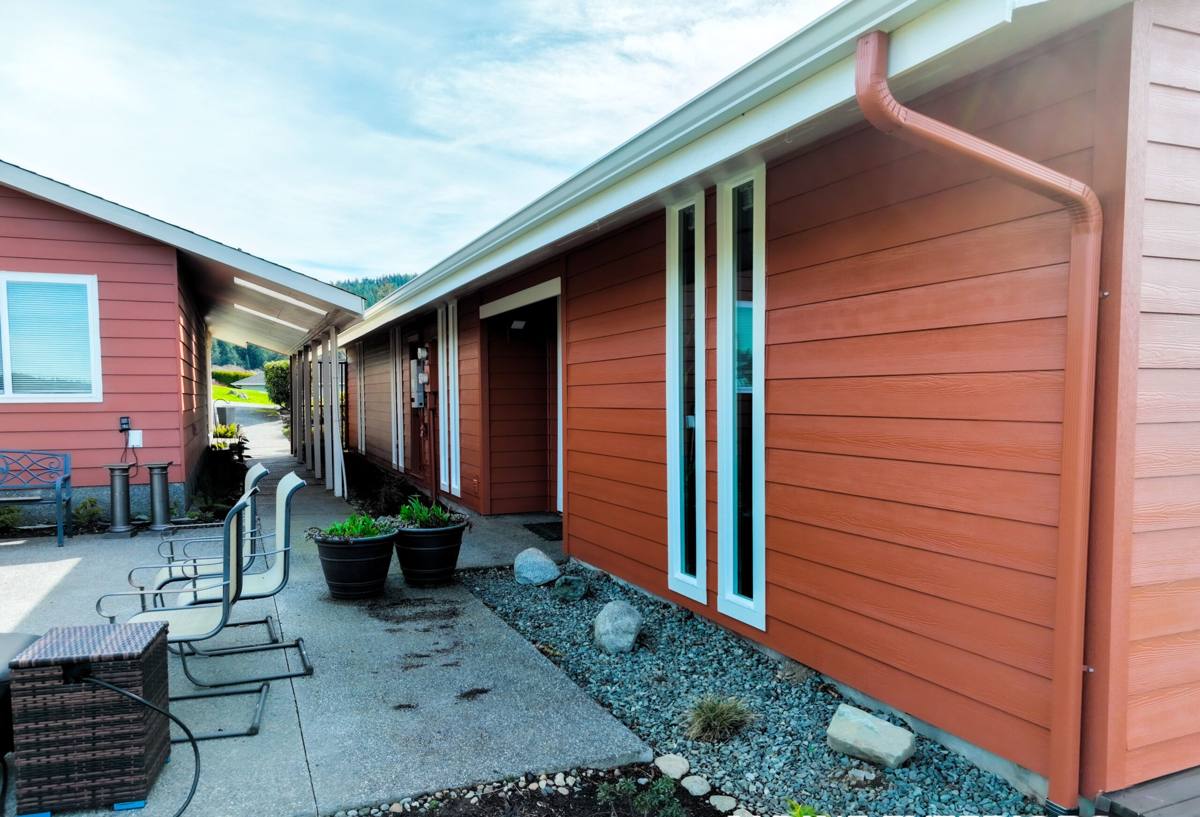
Why We Install Only James Hardie Fiber Cement Here
We made the call years ago to install one siding system rather than carry a menu of products with very different long-term outcomes, and Bow's climate is exactly the kind of environment that decision was made for. Wood-based products — primed spruce, cedar, engineered wood siding — have an organic core or wood-strand structure that absorbs and releases moisture, which means they swell, cup, and eventually rot if that moss-season dampness sits against them long enough, especially at cut edges and fastener penetrations. Vinyl doesn't absorb water the same way, but it depends entirely on the barrier behind it staying intact, and it can go brittle over years of UV and salt exposure, particularly at the more exposed elevations common on Bow's open lots. Fiber cement has neither weakness. It's dimensionally stable, it doesn't have an organic core for moisture to work into, and it holds its shape and its finish through the wet-dry cycling this climate puts it through year after year. It's also non-combustible, which isn't the primary driver for a coastal property like most in Bow but is a genuine, practical difference from wood-based cladding regardless.
The Hardie System Built for This Climate
James Hardie manufactures fiber cement in climate-specific formulations rather than one generic product sold everywhere, and homes throughout western Washington — Bow included — fall into the HZ5 line, engineered for regions with sustained moisture exposure and freeze-thaw cycling. That's a real manufacturing specification, not a marketing label: it's a different mix and cure than the versions Hardie sells into drier, hotter climate zones. Paired with that formulation is ColorPlus, Hardie's factory-applied finish. Instead of being sprayed or brushed on at the job site — where temperature, humidity, and dust all affect how well a coating cures — ColorPlus is baked on in a controlled factory environment through multiple coats. That matters most on the elevations catching direct salt spray and driving rain, where a field-applied paint film gets stressed hardest and fails soonest.
Choosing the Right Profile for a Bow Home
Hardie's product lines cover most of what shows up on homes in this area. HardiePlank lap siding is the standard horizontal profile and the right fit for the farmhouses and traditional builds common around Bow. HardiePanel, installed with HardieTrim battens, gives a vertical board-and-batten look that works well as a full treatment or an accent on gables and entries on newer construction. HardieShingle offers a shingle-style profile for homes designed with that more traditional coastal look in mind. All three integrate with the same HardieTrim system for corners, fascia, and window and door casing, so a house doesn't end up with mismatched trim details from different manufacturers. Which profile makes sense depends on the home's existing architecture and how exposed each elevation is — something we walk through on-site rather than defaulting to one look for every project.
What a Correct Installation Involves
Fiber cement is only as good as the installation behind it. Hardie's own warranty and performance depend on the product being installed to its published specifications, and in a climate like Bow's, shortcuts on any of the following show up faster than they would in a milder market.
Moisture Management Behind the Cladding
Every installation starts with a continuous, properly lapped weather-resistant barrier — not house wrap stapled up and left as an afterthought. Seams get taped or lapped shingle-style so water sheds outward rather than working its way behind the barrier at a gap. This layer is what actually keeps a wall dry if wind-driven rain gets past the siding itself, which it eventually will at some point over a multi-decade service life.
Fastening and Clearances
Hardie specifies exact nail spacing, penetration depth, and minimum clearances at the bottom of the wall, at roof lines, and at any horizontal surface — decks, patios, grade — where the siding could otherwise sit in standing water or trapped moisture. Getting clearance wrong is one of the most common shortcuts on a rushed job, and it's also one of the hardest problems to fix after the fact without pulling siding back off.
Flashing at Penetrations and Transitions
Windows, doors, roof-to-wall intersections, and any point where a fixture penetrates the cladding are where the real risk lives, regardless of what siding material is involved. Each of those spots needs its own flashing detail sequenced correctly with the weather barrier underneath — head flashing that sheds water outward, sill flashing that directs anything that gets past the window back out rather than into the wall cavity, and step flashing wherever a roofline meets a wall. Caulk gets used where Hardie specifies it, not as a substitute for proper flashing everywhere else.
Fiber Cement vs Other Siding Options for a Bow Home
| Factor | James Hardie Fiber Cement | Vinyl | Primed Wood / Cedar | Engineered Wood (e.g. LP SmartSide) |
|---|---|---|---|---|
| Moisture behavior | Dimensionally stable, no organic core to absorb water | Doesn't absorb water, but relies on an intact barrier behind it | Absorbs and releases moisture readily; prone to swelling and rot | Wood-strand core vulnerable at cut edges and fastener holes |
| Finish durability | Factory-baked ColorPlus finish, resists fade and chip | Color molded through, but can fade and go brittle with UV/salt age | Fully dependent on a repainting maintenance cycle | Factory or field coatings with shorter typical service life |
| Combustibility | Non-combustible | Combustible | Combustible | Combustible |
| Typical maintenance | Occasional rinse; no recoating cycle | Periodic cleaning; panels can crack and need replacement | Recoating, caulk renewal, moss treatment on a recurring schedule | Manufacturer-specific maintenance to protect the wood-strand core |
| Fit for Bow's climate | Engineered specifically for this moisture and exposure profile | Workable, but ages faster under sustained salt and UV exposure | Highest ongoing maintenance burden in this climate | Moisture sensitivity is a real concern given the exposure here |
This isn't a claim that every alternative fails on every house — it's why, for the specific demands of Bow's setting, we've standardized on one product rather than installing whatever a homeowner happens to ask for.
What Drives Cost on a Fiber Cement Project Here
We won't quote a number without seeing the house, but the factors that move price are consistent from project to project.
| Factor | Why It Matters |
|---|---|
| Existing wall condition | Rot, old flashing failures, or a compromised weather barrier add repair work before new siding goes on |
| Profile and coverage | Lap siding, board-and-batten panels, and shingle profiles differ in material and labor per square foot |
| Exposure and elevation count | Walls facing open water or prevailing weather often warrant extra flashing attention, which affects labor time |
| Trim and detail work | Corner boards, window and door casing, and fascia integration add material and labor beyond the flat wall area |
| Tear-off vs. overlay | Full removal of old siding costs more up front but avoids trapping moisture behind a new layer |
| Access and site conditions | Rural lots, steep grades, or limited equipment access can add time to a project |
Our Installation Process
- On-site assessment — we walk the property, check the existing siding and wall condition, and note which elevations take the worst of the local weather
- Honest scope and product recommendation — full replacement, targeted repair, or a specific Hardie profile suited to the home's architecture, explained with the reasoning behind it
- Removal and wall inspection — old siding comes off carefully, and any hidden rot, old flashing failures, or barrier damage gets addressed before new material goes up
- Weather barrier and flashing installation — a continuous, properly lapped barrier and correctly sequenced flashing at every window, door, and transition
- Siding installation — Hardie panels or planks installed to the manufacturer's fastening pattern and clearance specifications
- Trim, finish, and final inspection — corner boards and casing integrated cleanly, with a final walkthrough before we call the job done
Why a Crew That Already Works Bow Matters
Manufacturer installation guides are written for average, generic conditions. Bow's mix of open farmland, tidal shoreline, and rural exposure rarely matches that description. A crew that has actually installed siding on homes catching wind off Samish Bay and Padilla Bay, in this same moss season, on this same stretch of Skagit County, develops a feel for which elevations need extra flashing attention and which clearance details are worth double-checking even when they're technically code minimum. That judgment doesn't come from reading a spec sheet once — it comes from doing the work here, repeatedly, and seeing which shortcuts show up as problems a few years later.
Before hiring anyone for a fiber cement project in Bow, it's worth asking a few direct questions.
- Ask whether they're a certified James Hardie installer and can show fastening and clearance specs, not just a general contractor license
- Ask how they handle flashing at windows, doors, and roof-to-wall transitions specifically, since that's where most long-term leaks start
- Confirm both the manufacturer's material warranty and the contractor's own workmanship warranty, in writing
- Ask how they sequence the weather-resistant barrier and whether they inspect the wall condition before covering it back up
- Verify they're licensed, bonded, and insured to perform exterior work in Washington State
- Ask for a realistic project timeline, including how weather and moss-season conditions might affect scheduling
If you're weighing a siding project for a home in Bow — a full replacement, a repair, or just an honest read on what your current siding looks like underneath — we're glad to take a look. We offer free, no-pressure estimates, and the form below is the fastest way to get a time on the schedule.