 Anacortes
 Building Decks for a Marine Climate, Not a Catalog Photo
Fidalgo Island sits surrounded by saltwater — Guemes Channel, Rosario Strait, Fidalgo Bay — and that changes what a deck actually has to survive. It's not just rain, though Anacortes gets plenty of that in a long, damp shoulder season. It's salt-laden air that finds its way into every mechanical fastener, every hinge, every screw head. It's shaded lots under fir and cedar canopy where moss and algae get a head start every fall and never fully let go until late spring. A deck built the way a big-box crew builds decks in a drier inland climate will show problems here faster than it would twenty miles east.
Composite decking is a good answer to a lot of this — it doesn't rot, it doesn't need annual staining, and modern capped boards resist moisture absorption far better than early-generation composite ever did. But composite is not maintenance-free just because the marketing says so, and it is absolutely not install-anywhere-the-same. The board is only as good as the frame underneath it, the fasteners holding it down, and the drainage path underneath the whole structure. That's where most of the decks we get called to fix on this island went wrong — not the decking material, but everything beneath it.
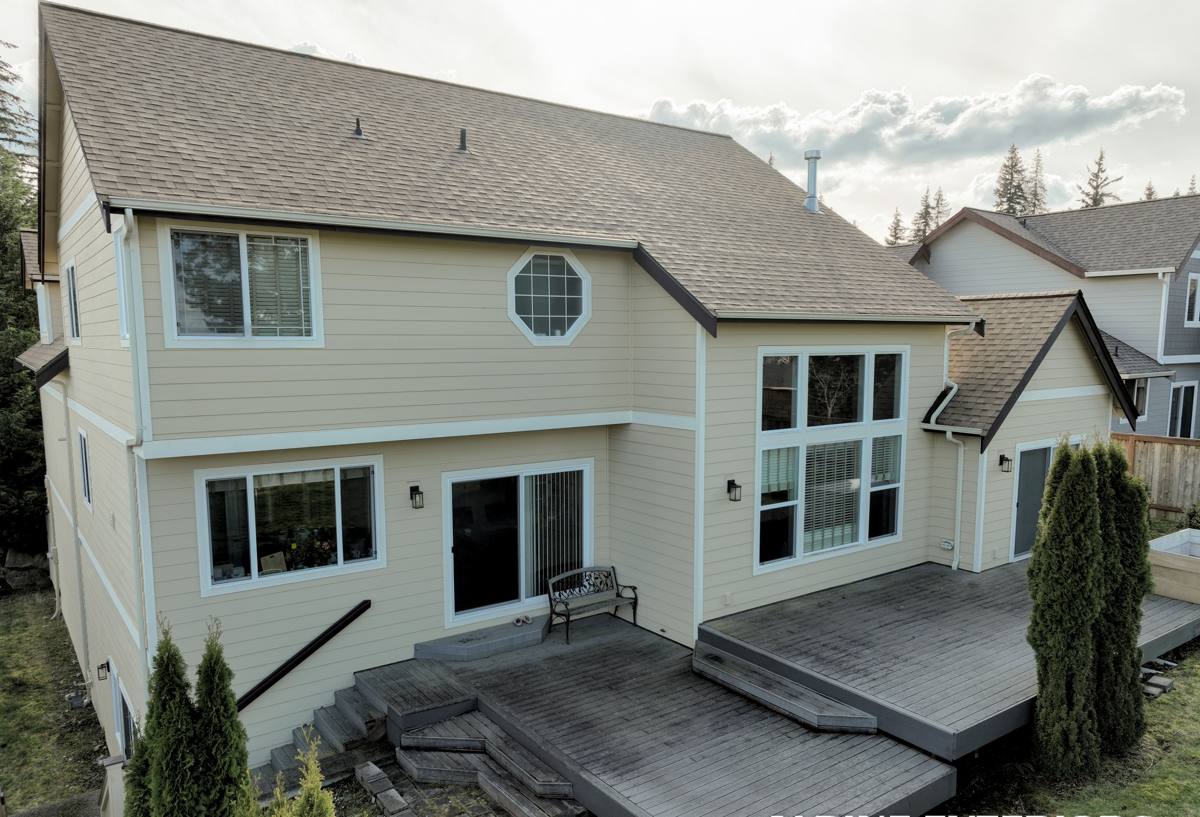
What Salt Air and Moss Actually Do to a Deck
These aren't abstract climate talking points — they're specific failure modes we see repeatedly on Fidalgo Island homes, especially ones close to the water or tucked under tree cover.
Corrosion at the Hardware, Not the Boards
Composite decking itself doesn't corrode. The screws, joist hangers, post bases, and structural connectors holding the deck together do. Standard zinc-coated hardware degrades noticeably faster within a mile or two of saltwater than it does inland. Once a fastener starts to rust, it weakens its grip on the board and can bleed a rust stain right through the composite surface — a cosmetic problem that's actually a structural warning sign.
Moss and Algae on Shaded and North-Facing Decks
Composite surfaces are more resistant to organic growth than raw wood, but they're not immune, especially in perpetually damp, low-sun spots common on wooded Fidalgo Island lots. Moss and algae need standing moisture and shade to take hold, and they will find both if a deck doesn't drain well or gets buried under fir needles all winter. Once established, moss holds moisture against the board surface, which is exactly the condition you don't want under any decking material.
Driving Rain and Water Intrusion at the House
Anacortes rain doesn't always fall straight down — winter storms off the Strait push it sideways. That matters most at the point where the deck ledger board attaches to the house. A poorly flashed ledger connection is the single most common source of hidden rot damage behind a deck, composite surface or not, because water gets behind the decking entirely and works on the framing where nobody's looking.
What a Correct Composite Deck Build Involves Here
A composite deck that holds up on Fidalgo Island isn't a different product — it's the same boards installed with attention to the details that matter in this climate.
- Stainless or coated marine-grade fasteners anywhere within reach of salt air, not standard zinc hardware
- Proper ledger flashing where the deck meets the house, with a drainage gap and flashing tape that actually sheds water away from the wall assembly
- Joist tape over every framing member the decking or hardware contacts, protecting the substructure even though the composite itself won't rot
- Correct board gapping for drainage and seasonal expansion — composite still moves with temperature, and gapping it too tight traps water at the joints
- Hidden fastener systems installed to spec so boards stay flat and don't develop the gaps or lifts that catch debris and moisture
- Ventilated substructure so airflow underneath the deck can actually dry things out between rain events instead of holding damp air against the framing
- Footings sized and set for our soil — much of Fidalgo Island has thin soil over rock or heavy clay, and undersized or shallow footings shift over time
Skip any one of these and the composite boards on top will look fine for a couple of seasons while the real problems — rust bleed, soft framing, standing water — develop underneath.
Composite vs. the Alternatives, Honestly
We install composite because for most Fidalgo Island homeowners it's the best long-term balance of appearance, maintenance, and durability in a wet marine climate — not because it's the only option or because other materials are bad. Here's how it actually compares for a deck in this specific environment.
| Material | Maintenance | Moisture Behavior Here | Typical Lifespan |
|---|---|---|---|
| Capped composite | Occasional wash-down; no staining or sealing | Resists absorption well; doesn't rot; surface can still grow algae if shaded and dirty | 25–30+ years, manufacturer warranty backed |
| Pressure-treated wood | Annual or biennial staining/sealing required | Absorbs moisture readily; prone to splitting, cupping, and rot at fastener points in our rain | 10–15 years before major repair or replacement |
| Cedar decking | Regular sealing to hold color and resist weathering | Naturally rot-resistant but still absorbs moisture; grays and softens faster near saltwater | 15–20 years with consistent upkeep |
| Uncapped early-generation composite | Low, but surface can absorb moisture at cut edges | Older formulations can swell or mold at exposed edges over time | 15–20 years, more variable |
Wood decking isn't a bad choice on principle — some homeowners genuinely prefer the look and don't mind the upkeep. But if low maintenance in a wet climate is the priority, capped composite is the more honest long-term recommendation, and it's what we lead with.
Our Process on Fidalgo Island Projects
Every deck job starts with what's already there, not a generic template.
1. On-Site Assessment
We look at sun exposure, tree cover, proximity to saltwater, existing framing condition if this is a replacement, and drainage across the site. A shaded, north-facing lot under conifers gets different recommendations on board color, gapping, and cleaning schedule than an open, south-facing yard.
2. Framing and Structure First
If we're replacing old decking over existing framing, we inspect every joist, the ledger connection, and all footings before a single composite board goes down. Framing that's soft, undersized, or improperly flashed gets addressed — putting new composite boards over compromised framing just hides the problem for a season or two.
3. Material Selection
We walk homeowners through board profiles, color options, and hardware finishes with the specific site conditions in mind — including which colors show less dirt and pollen buildup in a shaded, damp spot versus an open one.
4. Installation to Manufacturer Spec
Gapping, fastening pattern, joist protection, and expansion allowances are all installed to the manufacturer's published specifications, which is also what keeps the product warranty valid. Deviating from spec to save time is the fastest way to void coverage on a deck that's supposed to last decades.
5. Walkthrough and Care Guidance
We show the homeowner what routine care actually looks like for their specific deck — realistically just periodic washing, not sealing or staining — and flag any spots likely to need extra attention, like shaded corners prone to algae.
Why Hiring a Crew That Already Works This Island Matters
Skagit County building requirements, typical soil conditions, and the practical realities of building this close to saltwater aren't things you learn from a manual — they're things you learn by doing the work here repeatedly. A crew that mostly builds decks in a drier, inland climate isn't going to instinctively reach for stainless hardware or think twice about ledger flashing in a way that accounts for wind-driven rain off the Strait. Local experience shows up in the details that don't make it into a sales pitch but absolutely show up five years later.
A Simple Pre-Project Checklist for Fidalgo Island Homeowners
- Is the deck within view or reach of salt spray, or fully inland and sheltered?
- Is the site mostly shaded by trees, or does it get regular direct sun to help it dry out?
- Is this a full rebuild, a resurface over existing framing, or new construction?
- Do you want low-maintenance board colors, or are you open to more frequent cleaning for a specific look?
- Is there an existing moss or algae problem on the current deck, patio, or nearby surfaces that suggests a persistently damp microclimate?
- Are there structural concerns already — soft spots, visible rust stains, sagging boards — worth flagging before we even quote the composite work?
Answering these ahead of time helps us scope the job accurately instead of discovering framing issues mid-project.
Cost Factors Worth Understanding Up Front
Composite decking costs more per square foot than pressure-treated wood up front, and less over a 20-plus year ownership period once you factor in the staining and repairs wood typically needs. Beyond the board material itself, a few things move the price on a specific Fidalgo Island project:
| Factor | Why It Matters Here |
|---|---|
| Framing condition | Replacing rotted joists or a poorly flashed ledger adds cost but prevents early failure of the new decking |
| Deck height and railing requirements | Elevated decks need code-compliant guardrails, which add material and labor |
| Site access | Sloped or wooded lots common on this island can complicate material staging and footing work |
| Hardware grade | Marine-grade fasteners cost more than standard but are the right call within reach of salt air |
| Board profile and brand | Premium capped composite lines cost more but typically carry stronger fade and stain warranties |
We'll always walk through these specifics for your actual site rather than quoting off a generic per-square-foot number that doesn't account for what's underneath your existing deck or what your lot demands.
Ready to Talk About Your Deck
If you're planning a new composite deck or replacing one that's showing its age on Fidalgo Island, we're happy to take a look and give you a straight assessment — what your framing needs, what board and hardware makes sense for your specific spot, and a real cost range. Reach out for a free, no-pressure estimate using the form below.