 Anacortes
 Why Flounder Bay's Setting Puts Extra Demands on a Roof
Flounder Bay sits close enough to the water that homes here take a different kind of weathering than roofs a few miles inland. Salt-laden air moves off the water and settles on every exposed surface, wind-driven rain finds its way into laps and seams that would stay dry elsewhere, and the shade from surrounding trees combined with our long wet season gives moss months at a time to get established. None of this is unusual for coastal Skagit County, but it does mean a roof that's simply "installed to code" often underperforms here. A roof that's installed with this specific environment in mind lasts a lot longer and needs a lot less attention.
Metal roofing is a strong fit for this kind of exposure when it's the right metal, the right coating, and the right detailing. It's also a poor fit when any of those three things get skipped to save money or time. This page covers what actually matters for a metal roof on a Flounder Bay home, not metal roofing in general.
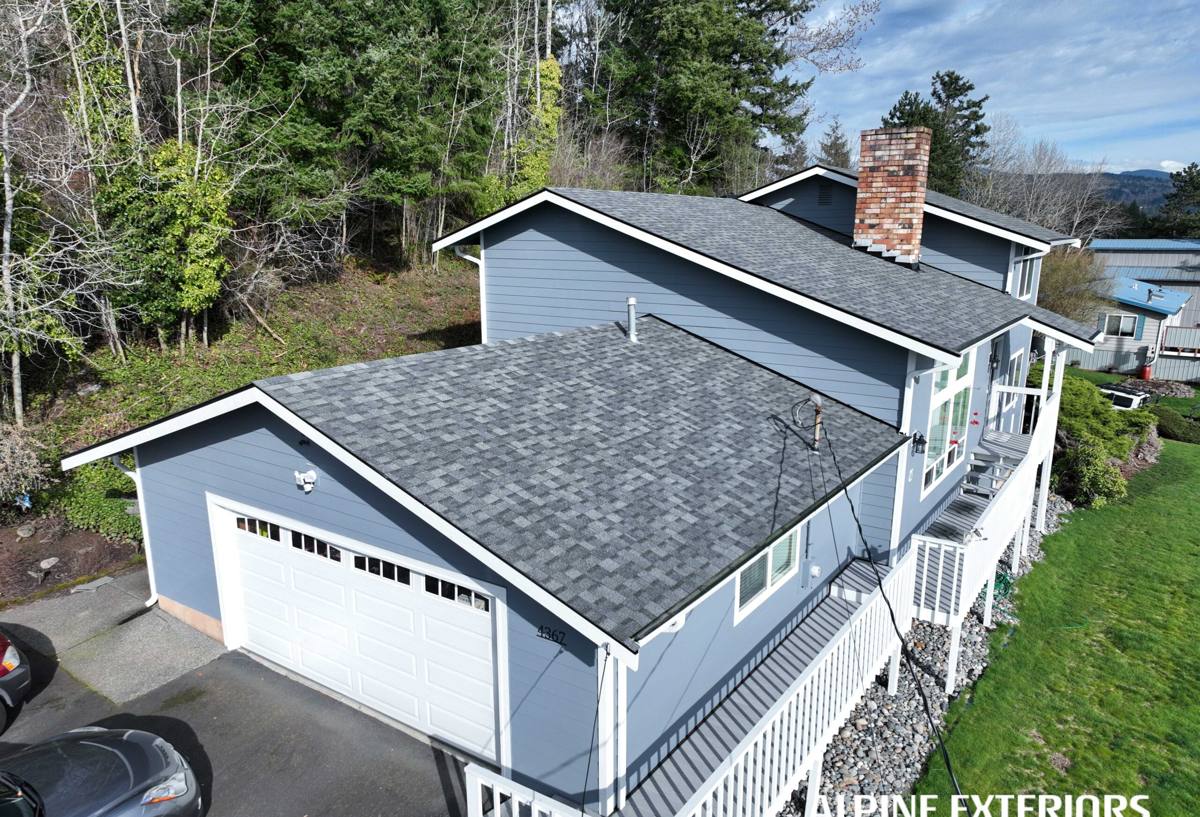
What Salt Air Actually Does to a Roof Over Time
Salt air isn't just a nuisance — it's a slow, steady corrosive process. Airborne salt settles on metal surfaces, fasteners, and flashing, and every time it gets wet and dries again it leaves behind a thin residue that speeds up oxidation. On an untreated or poorly coated panel, this shows up first as chalking and dulling, then as pitting, then eventually as rust at cut edges, fastener heads, and any spot where the protective coating has been scratched or worn through.
Where corrosion starts first
- Field-cut panel edges that weren't re-coated or properly sealed
- Exposed fastener heads, especially if the wrong fastener type was used
- Low-slope sections and valleys where water and salt spray sit longer before draining
- Areas facing the water directly, which take more direct salt exposure than the landward side of the same roof
This is why the specific metal alloy and coating system matter more here than they would on a home set back from the water. It's also why we pay close attention to fastener choice and edge treatment on every Flounder Bay job — those are the details that determine whether a roof looks tired at year eight or still looks sharp at year twenty-five.
Metal Roofing Options and How They Hold Up in a Salt-Air Environment
Not every metal roofing product is a good match for waterfront exposure. The table below reflects how the common options actually perform under sustained salt air and driving rain, not just their general reputation.
| Roofing Type | Salt-Air Performance | Maintenance Considerations |
|---|---|---|
| Standing seam steel, quality coating (Kynar/PVDF-class finish) | Strong — concealed fasteners and a durable coating resist salt exposure well | Low; periodic rinse and gutter checks |
| Standing seam aluminum | Very strong — aluminum doesn't rust the way steel can, a real advantage this close to the water | Low; slightly softer metal, so care during install matters |
| Exposed-fastener steel panels (budget-grade) | Weaker — every fastener penetration is a future corrosion point | Higher; fasteners often need monitoring and eventual replacement |
| Uncoated or thin galvanized panels | Poor for direct waterfront exposure | Higher; early rust and coating failure are common |
For most Flounder Bay homes, we steer clients toward standing seam steel with a premium coating or standing seam aluminum. Both use concealed fastener systems, which removes the single most common failure point on cheaper metal roofs — exposed screws that loosen, back out, or corrode over the years. We're honest with clients that exposed-fastener panels cost less upfront; the trade-off is more maintenance and a shorter realistic service life in a salt-air setting, and we'd rather explain that trade-off clearly than sell a product that's a poor match for the site.
Getting the Details Right: Where Metal Roofs Actually Fail
Metal roofing rarely fails because the panel material itself gave out. It fails at the details — flashing, penetrations, fastener choice, and underlayment — and those are exactly the details that driving rain off the water will find if they're not done correctly.
Flashing and transitions
Every valley, wall transition, chimney, and vent penetration needs flashing sized and installed for wind-driven rain, not just vertical rainfall. On an exposed waterfront lot, wind can push water sideways and even slightly uphill along a panel seam, so flashing details that would be fine on a sheltered inland roof can leak here if they're undersized or under-lapped.
Fasteners and hardware
Stainless steel or coated fasteners matched to the panel metal are non-negotiable this close to the water. Mismatched metals in contact with each other can set up galvanic corrosion, which will eat away at the weaker metal even faster than salt air alone. This is a detail that's invisible on install day and very visible five years later if it's gotten wrong.
Underlayment and ventilation
A quality synthetic or self-adhered underlayment gives a second line of defense under the panels, which matters when wind-driven rain gets past the surface layer during a storm. Proper attic and roof ventilation also keeps moisture from condensing on the underside of the panels — a real risk in our damp climate if a roof system isn't allowed to breathe.
Moss, Debris, and What Long-Term Maintenance Actually Looks Like
Metal roofing resists moss far better than shingles or wood roofing, since there's no porous surface for spores to root into. That said, "resists" isn't "immune" — moss and organic debris can still build up in valleys, at the roof-to-wall transitions, and anywhere leaves and needles collect and stay damp through our long wet season.
- Keep gutters and valleys clear of needles and leaf debris, especially heading into fall and winter
- Trim back overhanging branches where practical to reduce shade and debris buildup
- Rinse the roof surface periodically to clear salt residue and organic buildup rather than letting it accumulate
- Have flashing and sealant checked every couple of years, since these age faster than the panel metal itself
- Address any scratched or exposed coating promptly — a small touch-up now prevents a corrosion point later
This is meaningfully less work than a shingle or wood roof needs in the same setting, but it isn't zero maintenance, and any contractor who tells you a metal roof needs no attention at all in a salt-air environment isn't being straight with you.
Our Process for a Flounder Bay Metal Roof
Assessment and material selection
We start by walking the roof and the site — exposure direction, tree cover, existing drainage, and how close the home sits to open water. That assessment drives the metal and coating recommendation, not a one-size-fits-all default.
Tear-off and deck inspection
We remove the existing roofing and inspect the deck for any moisture damage before anything new goes down. In a wet coastal climate, this step catches problems that would otherwise get sealed up under a new roof and cause trouble later.
Underlayment, flashing, and panel installation
We install underlayment rated for our region, then flashing at every transition and penetration before the panels go on, sized generously for wind-driven rain rather than the bare minimum. Panels are installed with fastener and edge treatment matched to the salt-air conditions specific to this location.
Final walkthrough
We walk the finished roof with the homeowner, cover what maintenance actually looks like for their specific property, and make sure everything is documented for warranty purposes.
Why It Matters That We Already Work in Flounder Bay
A crew that's worked waterfront properties in this specific area already knows how the wind typically hits a given orientation, which flashing details tend to get tested hardest by driving rain here, and how fast moss and salt residue build up on a shaded, water-facing roof versus a sunnier inland one. That experience shows up in decisions you won't necessarily see on the day of installation — extra flashing at a vulnerable valley, a fastener upgrade at a fully exposed elevation, underlayment choices suited to our specific rainfall pattern — but you'll feel the benefit of it for the next twenty-plus years.
We also stand behind the work with a crew that isn't going anywhere. If a detail needs a look years down the road, we're still here in Anacortes and still working in Skagit County.
What Drives the Cost of a Metal Roof in This Setting
| Cost Factor | Why It Matters Here |
|---|---|
| Metal and coating grade | A coating built for salt-air exposure costs more upfront but avoids early degradation |
| Roof complexity (valleys, dormers, transitions) | More transitions mean more flashing detail, which takes more labor to do correctly |
| Fastener and flashing hardware | Marine-grade or coated hardware costs more than standard hardware but resists corrosion far longer |
| Deck condition | Moisture damage found during tear-off adds repair cost but prevents bigger problems later |
| Ventilation upgrades | Improving attic airflow during a re-roof adds cost but reduces condensation risk long-term |
Broadly, homeowners should expect metal roofing to cost more upfront than asphalt shingles, with the trade-off being a much longer service life and far less maintenance over that lifespan — especially valuable in a setting like Flounder Bay where a lower-grade roof simply won't hold up as long. We'll walk through actual numbers for your specific roof rather than quoting a generic range that doesn't reflect your home.
Questions Worth Asking Before You Hire
- What metal and coating are you specifying, and why is it suited to a waterfront property?
- Are you using concealed or exposed fasteners, and what hardware grade?
- How are you detailing flashing at valleys and wall transitions for wind-driven rain?
- What underlayment are you using, and is it rated for our climate?
- What does the warranty actually cover, and does it distinguish coating failure from panel defects?
- Have you worked on homes in this specific area before?
If you're weighing a metal roof for a home in Flounder Bay, we're glad to come take a look and give you a straightforward, no-pressure estimate — what your roof actually needs, what it'll cost, and why. Use the form below to get started.