 Anacortes
 Siding on March Point Has to Work Harder Than Siding Inland
March Point sits out on its own peninsula, with Fidalgo Bay and the surrounding waterways wrapping around most of it. That location is part of what makes the area desirable, but it also means the siding on these homes takes a beating that a house a few miles inland in Anacortes simply doesn't see. Wind off the water carries salt spray onto exterior walls, driving rain hits siding at angles that push moisture into seams and laps, and the tree cover common to this part of Skagit County keeps north- and shade-facing walls damp for long stretches of the year. That combination — salt, wind-driven moisture, and shade — is a tough environment for any exterior material, and it's the reason we're picky about what we put on a wall out here.
We're not describing a hypothetical. It's the everyday reality of siding installed on this peninsula, and it shapes every recommendation in this page: the product, the prep work, and how the job gets installed matter more here than they would on a drier, more sheltered lot.
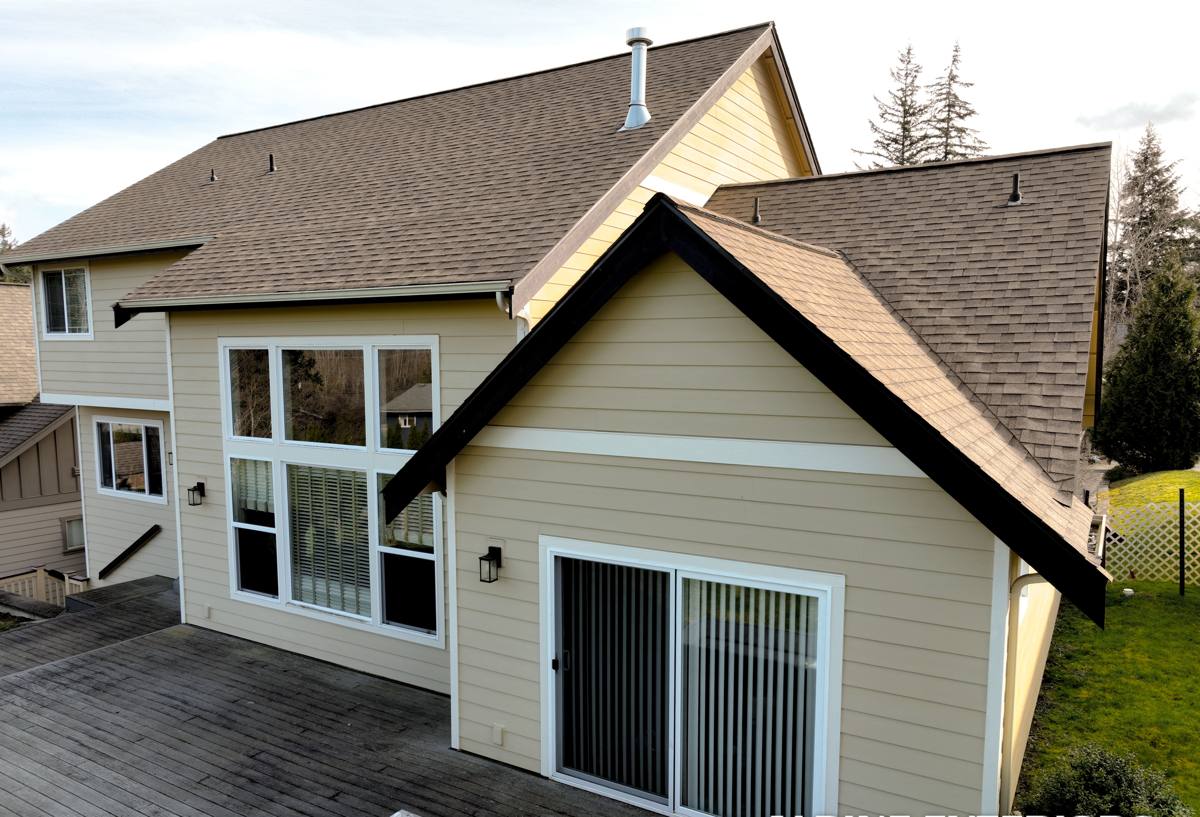
What Salt Air, Rain, and Moss Actually Do to Siding
Salt Air
Airborne salt from Fidalgo Bay settles on exterior surfaces and accelerates corrosion of exposed metal fasteners, flashing, and hardware. It also tends to hold moisture against a surface longer than plain rainwater would, which matters for any siding material that isn't fully stable when wet.
Driving Rain
Western Washington's rain isn't just frequent — a lot of it arrives sideways during winter storms. Siding on exposed or water-facing walls needs laps, flashing, and butt joints that are installed correctly the first time, because wind-driven rain will find any gap that was left loose or caulked instead of properly flashed.
The Long Moss Season
Shade, moisture, and mild temperatures are exactly what moss and algae need to establish themselves, and this region gives them most of the year to do it. Moss on siding isn't just cosmetic — it holds water against the surface, and on materials that swell, delaminate, or rot when saturated, that's a slow path to real damage.
What Correct Fiber Cement Siding Looks Like on a March Point Home
Fiber cement is a good fit for this climate because it's dimensionally stable — it doesn't swell, warp, or rot the way wood-based products can when they stay damp. But the material is only half the equation. A correct installation on a home exposed to salt air and driving rain includes:
- Proper clearance between the bottom edge of the siding and grade, decks, or roof lines, so splash-back and standing water don't sit against the board
- Correctly lapped and sealed house wrap or weather-resistive barrier behind the siding, giving the wall a real drainage plane
- Flashing at every window, door, and horizontal transition — not caulk used as a substitute for flashing
- Stainless or coated corrosion-resistant fasteners, since standard fasteners degrade faster in salt-exposed air
- Factory-finished panels and trim installed per the manufacturer's fastening and gapping specifications, so the finish stays sealed at the edges
Skip any one of those steps and you can end up with a wall that looks fine for a year or two before moisture starts working its way in behind the cladding — which defeats the purpose of choosing a durable material in the first place.
Why We Install Only James Hardie Fiber Cement
Fiber cement is a category, not a single product, and the brands in that category are not interchangeable. We standardized on James Hardie for homes in Anacortes and across Skagit County, including March Point, for a specific set of reasons:
- Climate-engineered product lines. Hardie makes region-specific formulations (its HZ5 line, for example) designed for wetter, harsher climates rather than a single one-size-fits-all mix.
- Factory-applied ColorPlus finish. The color is baked on under controlled conditions rather than field-painted, which holds up better against UV and moisture cycling and reduces how soon the home will need repainting.
- Non-combustible core. Fiber cement itself doesn't support flame spread the way wood-based siding products can, which matters for insurance conversations as well as safety.
- A warranty structure we can stand behind. Hardie's warranty is well established and transferable, which protects the investment for the current owner and whoever buys the home next.
- A long, verifiable track record. Hardie has been manufacturing fiber cement at scale for decades, so we know how it performs over time rather than guessing.
We don't install LP SmartSide, vinyl, or other fiber cement brands, and that's a deliberate standard, not an oversight. If you're comparing products, we're happy to talk through the honest trade-offs of alternatives — we just won't put them on your home.
Our Process for a March Point Siding Job
1. On-Site Assessment
We walk the exterior and look specifically at the walls taking the most exposure — usually whichever face gets the most wind and rain off the water — along with any areas already showing moss growth, staining, or soft spots that suggest moisture has gotten behind the current siding.
2. Tear-Off and Sheathing Check
Once the old siding is off, we inspect the sheathing underneath. This is the point where hidden rot or water damage from a previous installation shows up, and it needs to be addressed before anything new goes on the wall — new siding over damaged sheathing just hides the problem again.
3. Weather Barrier and Flashing
We install a continuous weather-resistive barrier with correctly lapped seams, then flash every penetration and transition point before a single piece of Hardie siding goes up. This is the step that determines whether the wall actually sheds water the way it's supposed to.
4. Installation to Manufacturer Spec
Fastener spacing, board overlap, gapping at butt joints, and clearance at the bottom edge all follow James Hardie's published installation requirements. This isn't a place to eyeball measurements — spec-compliant installation is also what keeps the manufacturer's warranty valid.
5. Trim, Caulking, and Final Walkthrough
Trim and corner details get finished, caulking is used only where it belongs — as a supplement to flashing, never a replacement for it — and we walk the finished job with the homeowner before calling it done.
Cost Factors for a March Point Fiber Cement Project
Every home is different, but the factors that move a project's cost up or down are consistent. This isn't a price list — it's meant to help you understand what you're actually paying for.
| Factor | Why It Affects Cost |
|---|---|
| Extent of tear-off and sheathing repair | Hidden rot found once old siding is removed adds labor and material beyond the original scope |
| Wall exposure and access | Water-facing or hard-to-access walls take longer to flash and finish correctly |
| Siding profile chosen | Lap siding, panel siding, and shingle-style Hardie products differ in material and install time |
| Trim and detail work | Corner boards, window trim, and fascia detailing add labor beyond the flat wall area |
| Home size and story count | Multi-story homes require more scaffolding, staging, and safety setup |
Signs a March Point Home May Need New Siding
Because of the added moisture exposure out here, siding problems on this peninsula can progress faster than they would on a more sheltered inland lot. Watch for:
- Persistent moss or algae growth that returns soon after cleaning
- Soft, spongy, or bubbling spots when you press on the siding
- Visible warping, cupping, or separation at seams and corners
- Paint that's peeling or bubbling rather than just fading
- Musty smells or staining on interior walls near exterior corners
- Rust streaks running from fasteners or trim hardware
Any one of these on its own might be minor. Several together, especially on a wall that faces the water or sits in shade most of the day, usually means it's worth having someone look at what's happening behind the surface.
Why Hiring a Crew That Already Works This Peninsula Matters
General exterior experience doesn't automatically translate to knowing how a specific site behaves. A crew that's worked on March Point before already knows which walls tend to take the worst of the wind and rain, how fast moss reestablishes itself in the shaded spots common here, and how the salt-air exposure factors into fastener and flashing choices. That's the difference between a crew installing siding by a generic spec sheet and a crew installing it for the conditions actually present on your lot. It's also why we treat the prep work — sheathing inspection, weather barrier, flashing — as seriously as the visible siding itself: on a peninsula like this, that hidden work is what determines whether the job still looks and performs well a decade from now.
If you're weighing siding options for a home on March Point or elsewhere around Anacortes, we're glad to take a look and talk through what your specific walls need. Reach out for a free, no-pressure estimate using the form below.