 Anacortes
 Decks in Old Town Anacortes Take a Different Kind of Beating
Old Town Anacortes sits close enough to the water that its decks live a harder life than decks twenty miles inland. Salt-laden air off Fidalgo Bay and the surrounding waterways settles on wood, fasteners, and railings year-round, not just during storms. Add in Skagit County's long stretch of driving rain from fall through spring, and then the shoulder seasons where damp shade turns into moss and algae growth on any surface that doesn't get a lot of direct sun, and you have a structure that's fighting three different fronts at once: corrosion, moisture intrusion, and biological growth. A deck built without those three specifically in mind will show it within a few years, even if it looked fine on install day.
We replace decks in this neighborhood regularly enough to know which parts of a typical Old Town lot dry out fast and which stay shaded and damp most of the year. That distinction matters more here than in a lot of other Anacortes-area yards, because older Old Town lots often have mature trees, tight side yards, and homes built close together — all of which limit airflow and sun exposure under and around a deck.
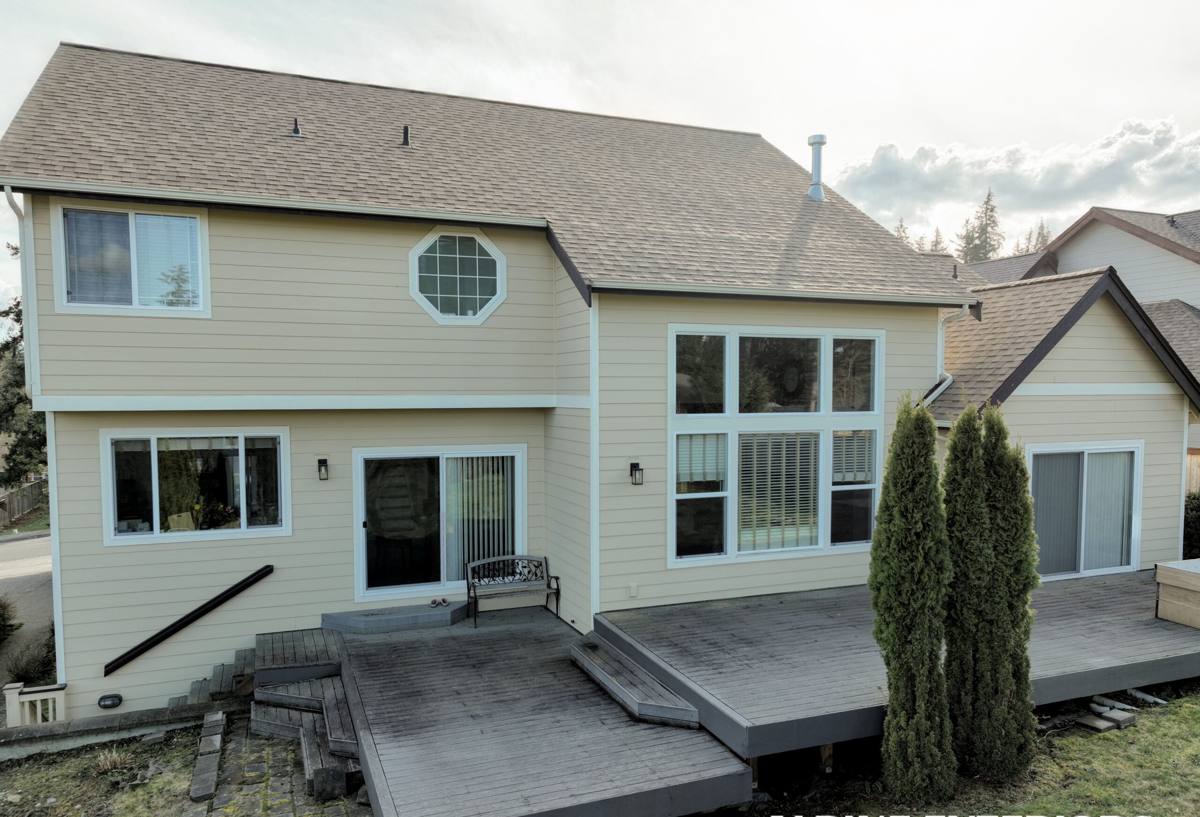
What "Correct" Looks Like for a Deck Replacement Here
A deck replacement isn't just tearing off old boards and screwing down new ones. Done right, it's a chance to fix the structural and moisture issues that shortened the life of the last deck in the first place. For homes in this part of Anacortes, that means paying close attention to a handful of things that get skipped on cheaper jobs:
Framing and Fasteners
Salt air accelerates corrosion on standard fasteners and connectors faster than most homeowners expect. We use fasteners and structural hardware rated for coastal/high-corrosion exposure, not the standard interior-grade hardware that's fine for inland builds but starts rusting and staining decking within a season or two out here.
Ledger Attachment and Flashing
The ledger board — where the deck attaches to the house — is the single most common failure point on older decks in wet climates. Water gets behind it, the framing rots from the inside, and nobody sees it until the deck feels spongy or a board fails. A correct replacement includes proper flashing at the ledger, a water-resistant barrier between the ledger and the house sheathing, and fastening that accounts for the additional load and moisture exposure typical of this climate.
Drainage and Airflow Underneath
Standing water and trapped moisture under a deck is what feeds moss, mildew, and rot. We grade and detail the substructure so water has somewhere to go, and we leave enough clearance and airflow underneath that the framing actually gets a chance to dry out between rain events — which, in this climate, isn't as often as anyone would like.
Decking Material Choice
Every decking material has trade-offs in a marine, moss-prone climate. We'll walk through the honest pros and cons for your specific lot — how much sun it gets, how close it is to the water, and how much maintenance you actually want to do — rather than pushing one product as a universal answer.
Comparing Decking Materials for a Salt-Air, High-Moisture Yard
| Material | Moisture/Salt Behavior | Maintenance | Typical Trade-Off |
|---|---|---|---|
| Pressure-treated wood | Resists rot when properly sealed; fasteners need corrosion-rated hardware | Requires periodic sealing/staining, more in shaded or damp spots | Lower upfront cost, more ongoing upkeep |
| Cedar | Naturally decay-resistant but still needs sealing near salt air | Regular staining/sealing to hold color and resist moss | Attractive natural look, higher maintenance than composites |
| Composite decking | Doesn't rot, but board and fastener quality still matter at the substructure | Occasional cleaning to prevent surface moss/algae buildup | Higher upfront cost, less hands-on upkeep long-term |
| PVC decking | Fully moisture-resistant surface | Low; mainly periodic cleaning | Highest material cost, very low maintenance burden |
None of these materials solve moss and algae growth on their own — that's a function of sun exposure, airflow, and how often the surface gets cleaned, not just the material underneath. We'll be straight with you about what your specific yard actually needs rather than assuming the most expensive option is automatically the right one.
Moss, Algae, and the Shoulder-Season Problem
Anacortes gets a genuinely long moss season compared to drier parts of Washington, and Old Town's mix of mature landscaping and closer-set homes means some decks get filtered or partial shade most of the day. That combination — consistent moisture plus limited direct sun — is exactly what moss and algae need to take hold. A slick, moss-covered deck surface isn't just an appearance issue; it's a fall hazard, especially on stairs and near entry points.
A well-built replacement won't eliminate moss risk entirely if your lot is shaded, but it reduces it: proper board spacing for drainage, a surface material suited to your sun exposure, and substructure detailing that lets things dry out all help. We'll also talk through realistic maintenance expectations up front, since the honest answer for a shaded Old Town lot is different from the answer for a full-sun deck closer to open water.
Signs Your Deck Is a Replacement Candidate, Not a Repair Candidate
- Soft, spongy, or springy spots in the decking or framing when you walk across it
- Visible rot, discoloration, or crumbling wood at the ledger board or support posts
- Rust staining running down from fasteners or metal connectors
- Persistent moss or algae that returns quickly no matter how often it's cleaned
- Railings that feel loose or flex under normal pressure
- Gaps, cracks, or splitting concentrated on the shaded or north-facing side of the structure
- A deck older than 15-20 years that has never had structural hardware upgraded
If you're only seeing one or two of these and they're isolated, a repair might still make sense. Once you're seeing several at once, or the ledger and framing are involved, replacement is usually the more cost-effective path — patching a structurally compromised deck tends to just delay the same problems.
How We Approach a Replacement Project
1. On-Site Assessment
We walk the existing deck and the surrounding lot with you — checking framing condition, ledger attachment, sun/shade exposure, and drainage — and talk through what's actually driving the deck's condition before recommending anything.
2. Material and Design Conversation
Based on that assessment, we go over realistic material options for your specific site conditions, including maintenance expectations, so you're choosing with full information rather than guessing.
3. Removal and Structural Correction
We remove the old deck down to whatever's sound, inspect and correct framing and ledger issues as we go, and don't cover up problems that should be fixed while everything's already open.
4. Build and Detailing
Framing, flashing, fastening, and decking install follow specs suited to a coastal, high-rainfall climate — not generic inland defaults.
5. Final Walkthrough
We go over the finished deck with you, including basic care guidance specific to your lot's sun and moisture exposure, before calling the job done.
What a Deck Replacement Typically Involves Cost-Wise
Costs for a deck replacement vary widely based on size, material choice, height off the ground, railing style, and how much structural correction is needed at the ledger and framing. Rather than quote a number that doesn't apply to your specific deck, we'll give you a real, itemized estimate after seeing the site — that's the only way to account for the framing condition and material decisions that actually drive the price.
| Cost Factor | Why It Matters |
|---|---|
| Deck size and shape | More square footage and more cuts/angles increase material and labor |
| Decking material | Pressure-treated, cedar, composite, and PVC span a wide price range |
| Substructure condition | Rotted framing or a failed ledger adds structural correction work |
| Height and railings | Elevated decks need code-compliant railing and stair systems |
| Site access | Tight Old Town lots can affect equipment access and demo/haul-off logistics |
Why a Crew That Already Works Old Town Anacortes Matters
Deck replacement isn't a one-size-fits-all product — it's a structure that has to hold up against the specific conditions of the lot it's built on. A crew that regularly works this neighborhood already has a working sense of which streets sit in more shade, which lots catch more wind and salt off the water, and which older homes tend to have outdated ledger connections or undersized framing from an earlier building era. That local pattern recognition means fewer surprises once demo starts and a more accurate estimate up front, because we're not guessing at conditions we've never dealt with before.
It also means we're a known, findable crew if you ever have a question about the deck down the road — not a company that did one job in Anacortes and moved on. For a coastal, moss-prone climate like this one, that kind of continuity is worth something.
Maintaining Your New Deck in This Climate
Whatever material you choose, a few habits go a long way in Skagit County's climate:
- Sweep debris and standing leaves off the surface regularly, especially in fall
- Clean moss and algae buildup promptly rather than letting it establish, particularly on stairs
- Check railings and fastener points annually for looseness or corrosion staining
- Keep gutters and downspouts near the deck clear so runoff isn't draining onto or under it
- Reseal wood decking on the schedule recommended for your specific product — shaded areas typically need it more often
None of this replaces a well-built structure, but it does extend the life of one significantly, especially in a yard that gets a lot of shade or salt exposure.
Get a Straight Answer About Your Deck
If your deck in Old Town Anacortes is showing soft spots, rust staining, persistent moss, or is simply old enough that you're wondering whether it's worth repairing, we're happy to take a look and give you an honest read — repair or replace — along with a free, no-pressure estimate. Use the form below to get started.