 Anacortes
 Building New in Old Town Anacortes: A Different Set of Rules
Old Town Anacortes sits close to the water, on some of the oldest platted lots on Fidalgo Island, and that combination shapes what a new-construction window job actually needs to survive. Salt air off the surrounding marine waters is corrosive to the wrong hardware and fasteners. Wind-driven rain off the water doesn't fall straight down — it hits windows sideways, which means flashing details that would be fine in a sheltered inland lot can fail here. And the long gray, damp stretch of the year that Skagit County gets every fall through spring keeps trim, sills, and siding wet for weeks at a time, which is exactly the environment moss and algae need to take hold.
None of that is a reason to over-build or overspend. It's a reason to get the ordinary parts of the job — flashing sequence, fastener choice, window selection, sealant — right the first time, because a new build only gets one chance at a correct install before everything is closed in behind siding and trim.
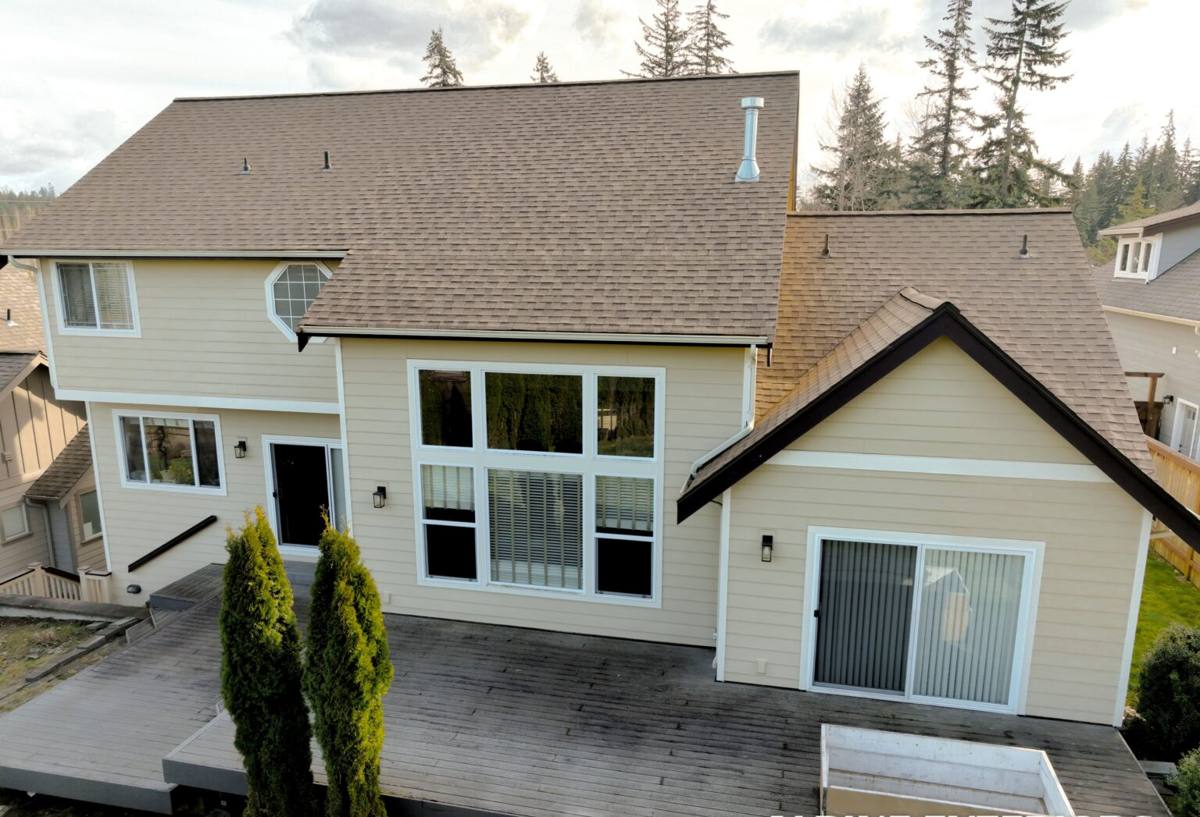
New-Construction Windows vs. Replacement Windows: Why the Difference Matters
People sometimes assume "new windows" is one job. It isn't. New-construction windows have a nailing fin around the perimeter of the frame that gets integrated directly into the wall's weather-resistive barrier (WRB) and flashing system before siding goes on. Replacement or retrofit windows are built to drop into an existing rough opening without disturbing the siding, using a different flange or block-frame design.
On a new build or an addition in Old Town Anacortes, you want a true new-construction window installed the new-construction way — fin fastened to sheathing, flashing lapped correctly with the WRB, and sill pan in place before the window ever goes in. Trying to save a step by using a retrofit-style window on new framing, or skipping the flashing sequence because "it's new construction, it'll be fine," is one of the more common ways a brand-new house ends up with a wet wall cavity a few years down the road.
Where This Trips Up Otherwise Good Framing Crews
Framers and general trades are focused on structure and schedule. Window flashing is a moisture-management detail, not a structural one, and it's easy for it to get rushed or handed to whoever is available that day. On a site exposed to driving rain off the water, that's the wrong place to cut a corner.
What a Correct New-Construction Window Install Actually Involves
Done right, a new-construction window install follows a specific order. Skipping or reversing steps is how leaks happen — often not immediately, but two or three winters later.
- Rough opening checked for square, level, and correct dimensions before the window ever shows up on site.
- Sill pan flashing installed at the bottom of the opening, sloped to shed any water that gets past the window back to the exterior — not into the wall.
- Weather-resistive barrier prepped and cut so the flashing can be shingle-lapped correctly (each layer overlapping the one below it, never the reverse).
- Window set, shimmed level and plumb, and fastened through the nailing fin per the manufacturer's schedule.
- Jamb and head flashing installed over the fin, integrated with the WRB above the window so water is directed out and down, around the opening.
- Interior and exterior sealant applied at the specified points only — sealing every gap sounds thorough but can actually trap moisture that needs a path to escape.
- Final check for operation, square, and a clean reveal before siding crews close in around it.
That sequence doesn't change because the house is in a nicer neighborhood or the budget is tight. It's the same physics whether the lot is a block from the water or five miles inland — it just matters more here, because there's more water to manage.
Choosing Windows for a Salt-Air, High-Rain Site
Frame material matters more on a coastal-adjacent lot than most people expect. Our standard is to steer new-construction clients toward materials and hardware with a track record in marine and high-moisture climates, and to be upfront about the trade-offs of each option rather than pushing whatever has the best margin.
| Frame Material | Salt Air / Corrosion | Moisture Behavior | Maintenance |
|---|---|---|---|
| Vinyl | Good — won't corrode | Doesn't absorb water; seams need quality welds | Low; occasional cleaning |
| Fiberglass | Excellent — dimensionally stable, low corrosion risk | Very stable through wet/dry cycles | Low |
| Aluminum-clad wood | Fair — clad exterior helps, but cladding seams and fasteners need attention near salt air | Wood core can be vulnerable if the seal at joints fails | Moderate; watch cladding seams |
| Bare wood | Poor without diligent upkeep | Absorbs moisture readily; needs regular refinishing | High |
We're not against wood-look aesthetics — plenty of clad options give you that look with a lower maintenance burden. Our concern is matching the product to the site: a bare wood window on a waterfront-facing new build is asking for a maintenance schedule most owners don't want to keep up with. We'll walk through options honestly, including where a lower-cost frame material is genuinely fine for a given exposure and where it isn't.
Glazing and Coatings Worth Asking About
Low-E coatings and argon or krypton gas fills are standard on most quality new-construction windows now, and they're worth having regardless of exposure — they help with both winter heat retention and the low-angle glare common in Skagit County's gray-sky months. On south- and west-facing units that catch more direct rain, we also pay attention to weep hole design and drainage, since a window that can't clear water out of its own frame will hold moisture against the sill over time.
Our Process for a New-Construction Window Install
Whether we're working directly with a homeowner building new in Old Town Anacortes or coordinating as a sub with a general contractor, the process looks the same:
- Plan review: we look at window schedules and rough opening sizes before framing is even finished, to catch sizing mismatches early.
- Site walk: we confirm exposure — which elevations take the most wind-driven rain — and flag anywhere that warrants extra flashing attention.
- Material selection: we help choose frame material, glazing package, and hardware finish based on the site, not a default spec sheet.
- Install: our crew follows the flashing-first sequence on every opening, documented as we go.
- Coordination: we time the install with siding and trim crews so the WRB and flashing lap correctly with what comes next, instead of siding crews having to work around a shortcut.
- Walkthrough: before we leave, every window gets operated and checked, and we go over care basics with the owner.
What Drives Cost on a New-Construction Window Package
New-construction pricing depends on the whole window package for the house, not one window at a time. These are the factors that move the number most:
| Factor | Why It Affects Cost |
|---|---|
| Number and size of openings | More glass and larger units mean more material and labor |
| Frame material | Fiberglass and higher-end clad options cost more upfront than standard vinyl |
| Glazing package | Upgraded Low-E coatings, gas fills, or impact-resistant glass add cost |
| Site exposure | Elevations facing prevailing wind-driven rain may warrant upgraded flashing details |
| Access and lot conditions | Tight infill lots common in older platted areas can slow staging and install |
| Coordination complexity | Working around other trades' schedules can affect labor efficiency |
We'll give you a straightforward estimate based on your actual plans and site, not a rough per-window guess — and we'll tell you plainly if a spec seems mismatched to the exposure your lot actually has.
Living With New-Construction Windows in a Moss-Prone, Salt-Air Climate
A correctly installed window still needs a little upkeep in this climate. Most of it is simple and doesn't take long if it's done on a regular schedule rather than after something's already gone wrong.
- Rinse salt residue and grime off exterior frames a couple times a year, especially on elevations closest to open water.
- Check and clear weep holes at the base of each window so drainage paths don't clog with debris or moss buildup.
- Inspect exterior sealant lines annually — caulking is a wear item, and catching a cracked bead early is far cheaper than dealing with water intrusion later.
- Keep gutters and downspouts near window openings clear, since overflow during heavy rain events is a common source of water reaching window heads.
- Trim back vegetation or anything holding moisture against the wall near a window, which slows the moss and algae growth this climate encourages.
- Operate and lubricate hardware occasionally, since salt air can stiffen mechanisms that sit unused.
Why Hiring a Crew That Already Works Old Town Anacortes Matters
New-construction window installation isn't exotic work, but doing it well on a lot exposed to Skagit County's wind-driven rain and salt air takes attention to details that don't show up on a spec sheet. A crew that already works in and around Old Town Anacortes has seen how the local exposure plays out on real jobs — which elevations take the worst weather, how quickly moss establishes on north-facing trim, and what flashing details actually hold up over a few wet seasons here rather than just on paper. That local pattern recognition is worth more than any brand name on the window itself.
If you're planning new construction or an addition in Old Town Anacortes and want windows installed correctly the first time, we're happy to walk the plans or the site with you and put together a straightforward, no-pressure estimate using the form below.