 Anacortes
 Siding Built for the Flounder Bay Waterfront
Flounder Bay sits close enough to the water that homes here live with weather most inland Skagit County neighborhoods never see. Salt-laden air off the bay, wind-driven rain that finds every gap in a wall assembly, and a moss season that can run most of the year all put real stress on exterior siding. A siding job that looks fine on day one but wasn't built for this specific exposure will show it within a few years — fading, swelling seams, soft spots at the bottom courses, and moss creeping up from the ground line. We install James Hardie fiber cement siding on Flounder Bay homes because it's the one product system engineered to hold up to marine exposure without the maintenance treadmill that comes with wood or vinyl alternatives.
This page is specifically about siding installation for the Flounder Bay area — not a general overview of siding options. If you live in this pocket of Anacortes and your siding is aging, failing, or you're planning new construction, here's what actually matters for your home.
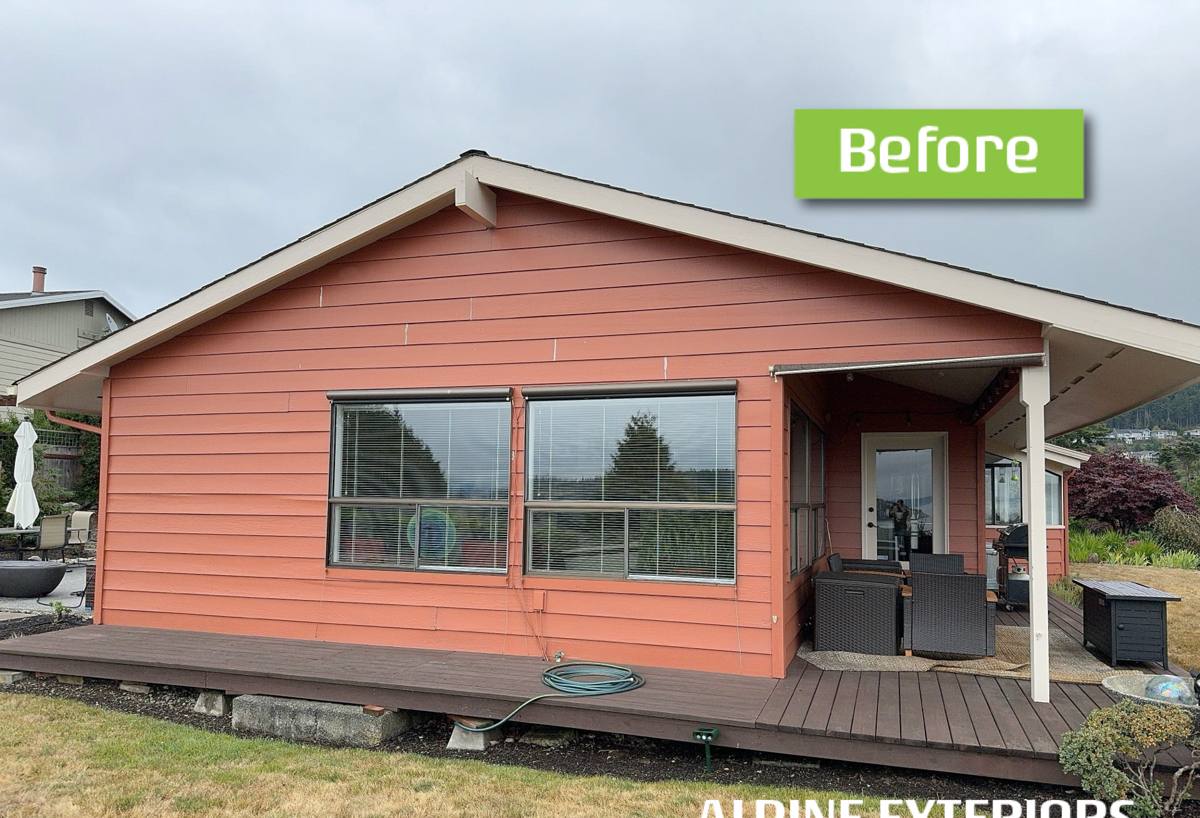
What Flounder Bay's Climate Does to Siding
Salt Air
Proximity to saltwater means airborne salt settles on every exterior surface, including siding. Salt is corrosive to exposed metal fasteners and trim, and it accelerates the breakdown of finishes that weren't formulated to resist it. Paint on wood or engineered wood siding chalks and fades faster near the water than it does even a few miles inland. Untreated or poorly coated fastener heads can streak with rust within a couple of seasons.
Driving Rain
Wind off the water doesn't just bring rain — it drives it sideways into walls, forcing water into laps, seams, and butt joints that would stay dry in a calmer setting. Siding installed with standard clearances and standard fastening patterns, without attention to how wind-driven rain actually moves across a wall, is siding that will eventually take on moisture where it shouldn't.
Moss Season
Fidalgo Island's damp, shaded conditions support moss and algae growth for a large part of the year, especially on north-facing walls, under eaves, and near landscaping that keeps siding shaded and moist. Moss holds moisture against the surface it grows on. On a product that can absorb or swell from sustained dampness, that's a slow path to rot or delamination. On a product that doesn't absorb moisture, it's a surface-cleaning issue instead of a structural one.
Why James Hardie Fiber Cement Is the Right Fit Here
James Hardie siding is fiber cement — a mix of cement, sand, and cellulose fibers that doesn't absorb water the way wood-based products do and won't rot, warp, or support insect damage. For a waterfront-adjacent property like the ones around Flounder Bay, that's the difference between siding that shrugs off the marine environment and siding that's fighting it every season.
- Non-combustible: Fiber cement doesn't burn, which matters given regional wildfire smoke and ember exposure concerns in late summer.
- Moisture-resistant core: Won't swell, cup, or delaminate from repeated wetting the way engineered wood or untreated wood products can.
- Factory-applied ColorPlus finish: A baked-on finish that resists fading and chalking far better than field-applied paint, which matters when salt air is already working against your topcoat.
- HZ5 product engineering: Hardie's HZ5 line is formulated for wetter, harsher climate zones like the Pacific Northwest coast, as opposed to the HZ10 line built for hot, dry regions.
- Doesn't feed moss the way wood does: Moss and algae still land on any exterior surface, but they don't root into or degrade fiber cement the way they can soften untreated wood over time.
We install James Hardie exclusively. We don't offer LP SmartSide, vinyl, Cemplank, Allura, primed spruce, or cedar, and we're upfront about why: in an environment like Flounder Bay's, the trade-offs of those products — moisture sensitivity, maintenance burden, or finish durability — are trade-offs we'd rather not build into a home we're putting our name on.
What a Correct Installation Actually Involves
Fiber cement siding is only as good as the installation behind it. Hardie's own warranty is tied to installation following their published specifications — not just "siding on a wall." For a marine-exposed property, a handful of details matter more than they would inland:
Water Management Behind the Siding
A correctly installed water-resistive barrier and drainage plane behind the siding gives any moisture that does get past the cladding a path to escape instead of sitting against the wall sheathing. This is invisible once the job is done, but it's the layer doing the real work during a wind-driven rain event.
Proper Clearances
Hardie specifies minimum clearances between siding and grade, roof lines, decks, and other transitions. Skipping these clearances to save a course of siding or match an existing reveal is one of the most common ways installations fail early — and it's exactly the kind of shortcut that shows up first in a wet, waterfront setting.
Fastening and Flashing
Corrosion-resistant fasteners, correctly set (not overdriven, not underdriven), paired with proper flashing at windows, doors, and penetrations, keep water from tracking behind the siding at the points where wall assemblies are naturally most vulnerable.
Joint and Seam Treatment
Butt joints and seams need to be treated per manufacturer spec — caulked or flashed as designed, not left to rely on paint alone to shed water. In driving rain, an under-treated seam is a direct path for moisture intrusion.
Installation Quality Checklist
- Water-resistive barrier installed continuously, lapped correctly, with no gaps at penetrations
- Manufacturer-specified clearances maintained at grade, roofs, decks, and walkways
- Corrosion-resistant fasteners set flush, not overdriven
- Flashing installed at every window, door, and wall penetration before siding goes on
- Butt joints and seams treated per James Hardie specification
- Factory-cut edges properly sealed where field cuts expose the substrate
- Ventilation and drainage paths left clear, not blocked by trim or landscaping details
Our Process for Flounder Bay Projects
1. On-Site Assessment
We walk the property and look specifically at the sides most exposed to prevailing wind and rain, the areas holding moisture or moss, and the current condition of the existing wall assembly underneath the siding where it's failing.
2. Scope and Product Plan
We put together a plan that specifies the Hardie product line, profile, and color, along with what needs to happen with the water-resistive barrier, flashing, and trim details given what we found in the assessment.
3. Installation to Manufacturer Spec
Installation follows James Hardie's published fastening, clearance, and joint-treatment requirements — not a generic siding install, and not shortcuts to save time on a job that has to hold up to this specific climate.
4. Final Walkthrough
We go over the finished work, the maintenance a Hardie system realistically needs (which is minimal compared to wood or vinyl), and what the warranty covers.
Cost Factors for a Flounder Bay Siding Job
Every home is different, but the factors that move a siding installation estimate up or down tend to be the same. We don't publish fixed pricing because wall condition and scope vary too much house to house, but here's what typically drives the number:
| Factor | Why It Matters |
|---|---|
| Existing wall condition | Rotted or water-damaged sheathing behind old siding needs repair before new siding goes on |
| Home size and wall complexity | More corners, dormers, and roof intersections mean more flashing and trim detail work |
| Siding profile and accessories | Lap siding, shingle-style panels, and trim/soffit packages price differently |
| Removal and disposal | Stripping old siding down to sheathing adds labor and disposal cost versus new construction |
| Access and site conditions | Waterfront lots with steep grades or limited staging area can affect labor time |
Why Hire a Crew That Already Works This Area
Siding installers who haven't worked waterfront-adjacent properties in Skagit County tend to install to a generic standard — fine for a sheltered inland lot, not adequate for a home taking direct salt air and driving rain off the bay. A crew that already knows what Flounder Bay's exposure does to a wall assembly builds in the clearances, flashing details, and drainage planning up front instead of learning it the hard way on a callback. That local experience is also why we standardized on one product system instead of offering several: we've seen which one actually holds up here, and we'd rather install that correctly than offer a menu of options with different failure points.
If your Flounder Bay home needs new siding, a full replacement, or you're planning new construction and want it done right the first time, we're happy to take a look and give you a straightforward, no-pressure estimate using the form below.