 Anacortes
 Windows in Flounder Bay Work Harder Than Windows Inland
Flounder Bay sits close enough to the water that the air itself is different from what you'd find a few miles inland in Skagit County. Salt-laden moisture, near-constant humidity, and wind-driven rain off the Strait all put extra load on the weakest point of any home's building envelope: the windows. A window that performs fine in a dry, sheltered lot in Mount Vernon can fail years earlier on a lot near Flounder Bay simply because of what it's exposed to every day.
That's not a sales pitch — it's just how marine-adjacent construction works. Salt air accelerates corrosion of hardware and fasteners. Persistent moisture keeps wood trim and sills damp longer between dry spells, which is exactly what wood-decay fungi and moss need to get established. And driving rain, especially in fall and winter storms, tests window flashing and seals in ways that a still, dry day never will. Replacing windows in this neighborhood isn't just a cosmetic upgrade — it's a chance to correct details that were never built for this specific exposure in the first place.
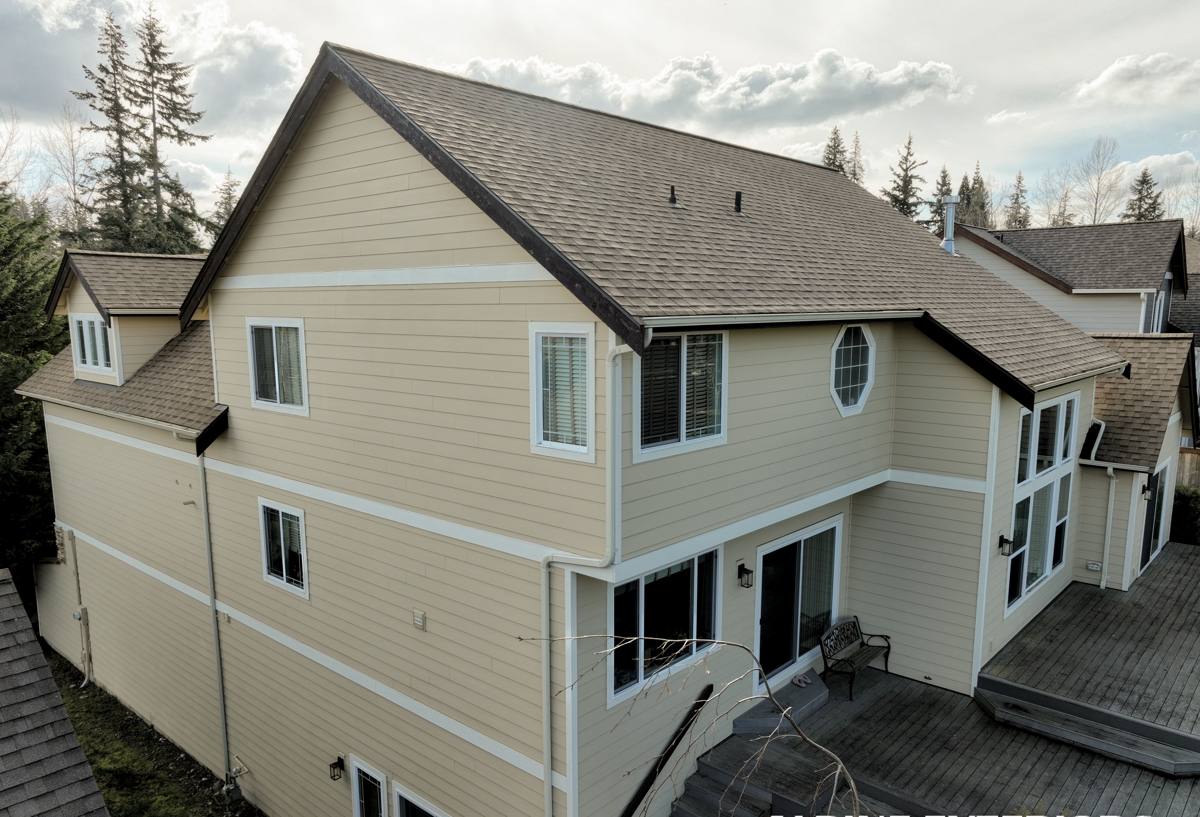
The Local Climate Factor: Salt Air, Driving Rain, and Moss Season
Anacortes and the surrounding Fidalgo Island area get a long wet season, and homes near the water catch it worse than most. A few specific effects show up again and again in older windows around Flounder Bay:
- Corroded hardware: Latches, balances, and screws made from lower-grade metal pit and seize up faster in salt air, making windows harder to open, close, or lock properly.
- Failed seals and fogging: Insulated glass units rely on a sealed edge to keep argon or air trapped between panes. Constant moisture cycling stresses that seal, and once it fails you get fogging between the panes that can't be cleaned away.
- Moss and algae on sills and frames: Anacortes's long moss season means anything that holds moisture — a poorly sloped sill, a cracked caulk line, a shaded north-facing frame — becomes a growth surface. Moss holds water against wood and paint far longer than open air would.
- Wood rot at corners and sills: This is usually the real cost driver. Once water gets behind trim or under a sill through a gap in old caulking, it doesn't dry out quickly in our climate, and rot can spread inside the wall before it's visible from outside.
None of this means Flounder Bay is a bad place to own a home with wood or vinyl windows — it just means the installation details that get skipped or rushed on an easier job matter more here.
Signs Your Windows Are Ready for Replacement
Not every issue means a full replacement. Some are repairable. But a few signs consistently point to windows that are past the point of patching, especially in a marine-exposed location like this one:
- Visible fogging or a milky haze between panes of double-pane glass that doesn't wipe away
- Windows that are difficult to open, close, or lock, especially if the difficulty is new or worsening
- Soft, spongy, or visibly rotted wood at the sill, jamb, or exterior trim
- Noticeable draft or cold air near the window frame during winter storms
- Paint that keeps failing on the frame or trim no matter how often it's touched up
- Visible daylight or gaps around the frame from outside
- A noticeable jump in heating costs without another clear explanation
If you're seeing one or two of these, it's worth having someone look before assuming the whole window needs to go. If you're seeing several at once, especially rot combined with hardware failure, replacement is usually the more honest recommendation than repair.
What a Correct Window Replacement Job Actually Involves
The window unit itself only gets part of the credit for how well a replacement performs. The installation details are what actually determine whether a home stays dry through its next twenty winters of Pacific Northwest storms.
Removal and Inspection
Before a new window goes in, the old one comes out carefully enough to expose the rough opening. This is the point where hidden damage — soft framing, old rot, missing or degraded flashing — gets found. A crew that rushes this step is the crew most likely to seal a new window over an existing problem.
Flashing and Water Management
This is the single most important part of the job and the part homeowners can't see once it's done. Proper flashing directs any water that gets past the exterior cladding down and out, away from the framing, rather than letting it pool at the sill. In a location that takes as much driving rain as Flounder Bay does, flashing done wrong is the most common reason a "new" window still leaks a few years later.
Air Sealing and Insulation
The gap between the window frame and the rough opening needs to be sealed and insulated correctly — not overpacked with expanding foam, which can bow a frame, and not left loose, which invites drafts and moisture. This step is where energy performance is actually won or lost, more than the glass rating alone.
Exterior Trim and Caulking
The visible caulk line is the last line of defense, not the first. It needs to be a compatible, paintable, exterior-grade sealant applied to clean, dry surfaces — done at the wrong time of year or over damp wood, it fails fast.
A Quick Reference: What to Expect at Each Stage
| Stage | What Happens | Why It Matters Here |
|---|---|---|
| Removal | Old window and trim carefully removed | Exposes hidden rot or flashing failures common near the water |
| Inspection | Framing and sheathing checked before new unit goes in | Catches moisture damage before it's sealed behind a new window |
| Flashing | New flashing installed to direct water out and down | Directly addresses driving rain off the Strait |
| Set and Level | New window shimmed, leveled, and fastened | Ensures proper operation and even weight distribution |
| Insulate and Seal | Gap filled correctly, interior and exterior sealed | Controls drafts and moisture intrusion |
| Trim and Finish | Exterior trim reinstalled or replaced, caulked, painted as needed | Final barrier against salt air and moisture |
Choosing Window Materials for a Marine-Exposed Location
There's no single "best" window material for every home — the right choice depends on the home's style, budget, and how directly it's exposed to weather off the water. Here's how the common options generally compare for a location like Flounder Bay:
| Material | Strengths | Trade-offs in This Climate |
|---|---|---|
| Vinyl | Low maintenance, good value, resists moisture and corrosion well | Frame color and finish options are more limited than wood or fiberglass |
| Fiberglass | Very stable in temperature swings, strong, holds paint well | Higher upfront cost than vinyl |
| Wood | Classic look, works well on period or traditional homes | Needs consistent maintenance to hold up against salt air and moss; the highest-upkeep option here |
| Wood-clad (wood interior, metal or composite exterior) | Interior warmth of wood with more weather-resistant exterior | Exterior cladding still needs to be detailed and sealed correctly at the frame |
For homes with direct wind and salt exposure, we generally steer homeowners toward vinyl or fiberglass on the exterior-facing side of the decision — not because wood windows are a bad product, but because the maintenance commitment they require is higher in this specific environment, and a missed maintenance cycle shows up faster here than it would a few miles inland.
Our Process, Start to Finish
1. On-Site Assessment
We walk the exterior with you, look at existing window condition, note any signs of moisture damage, and talk through what's actually needed versus what can wait.
2. Straightforward Estimate
You get a written estimate that explains what's included — removal, disposal, materials, flashing, trim work — so there's no guessing about what's covered.
3. Scheduling Around Weather
Window replacement is weather-sensitive work. We plan installation days around the forecast where possible, since setting a window into an open wall during driving rain is exactly the wrong way to do this job.
4. The Install
Each opening is treated individually — removal, inspection, flashing, setting, sealing, and trim, in that order, with no step skipped to save time.
5. Walkthrough and Cleanup
We walk the finished work with you, operate each window, and clean up the site before we consider the job done.
What Affects the Cost
Every home is different, so we won't quote a number without seeing the job, but these are the factors that typically move the price up or down:
| Factor | Effect on Cost |
|---|---|
| Window material (vinyl vs. fiberglass vs. wood) | Vinyl is typically the most affordable; fiberglass and wood cost more |
| Number of windows replaced at once | Bundling windows into one project usually lowers the per-window cost |
| Condition of existing framing | Rot or moisture damage found during removal adds repair time and cost |
| Window size and configuration | Larger units, bays, or custom shapes cost more than standard sizes |
| Trim and siding work required | Matching existing trim or siding can add labor and material cost |
Why Hiring a Crew That Already Works Flounder Bay Matters
Anyone can install a window on a calm, dry day. The real test is whether it still performs correctly after its first real winter storm off the water. A crew that regularly works homes in and around Flounder Bay has already seen where flashing details tend to fail in this specific exposure, which framing types are common in the neighborhood's older housing stock, and how quickly moss and moisture problems show up when a detail is skipped. That local pattern recognition doesn't replace good installation practices, but it does mean fewer surprises once the framing is opened up.
It also matters for accountability. A contractor working in Skagit County and the greater Anacortes area day after day has a reputation to protect in a community where word travels. That's a different incentive structure than a crew passing through for a one-off job.
Maintaining New Windows in a Salt-Air, High-Moisture Climate
A correctly installed window still benefits from basic upkeep in this environment. A short annual routine goes a long way:
- Rinse frames and glass periodically to clear salt residue, especially on wind-exposed sides of the home
- Check and clear weep holes on vinyl and fiberglass frames so water can drain instead of pooling
- Inspect exterior caulk lines each fall before the wet season sets in, and touch up any cracking
- Keep gutters and downspouts clear so roof runoff isn't sheeting down over window heads
- Trim back vegetation or moss buildup near sills and sightlines so moisture doesn't sit against the frame
None of this is difficult, but it's the kind of small maintenance that determines whether a window replacement lasts its full expected lifespan or starts showing problems early because of this location's particular climate demands.
Ready to Talk About Your Windows?
If your windows near Flounder Bay are fogging, sticking, drafty, or showing rot at the sill, we're happy to take a look and give you an honest read on what's needed — repair, partial replacement, or a full window replacement — with no pressure either way. Use the form below to request a free estimate and we'll go from there.