 Anacortes
 Building Decks That Hold Up in Old Town Anacortes
Old Town Anacortes sits close to the water, and that proximity is part of what makes the neighborhood special — and part of what makes deck building here different from an inland project. Homes in this part of Anacortes deal with salt-laden air moving off the water, long stretches of driving rain through the fall and winter, and a moss season that can stretch on for months if a deck isn't built and finished with that reality in mind. A deck that looks great going in but wasn't built for this specific environment will show its age fast: soft spots in the boards, rust bleeding from fasteners, slick green film on the walking surface, and rot working in from the underside where nobody's looking.
We build decks for this neighborhood the way the site actually demands, not the way a generic build sheet says to. That means paying close attention to material selection, fastener hardware, drainage, and airflow underneath the structure — the details that determine whether a deck is still solid and safe in ten years or turning into a maintenance headache in three.
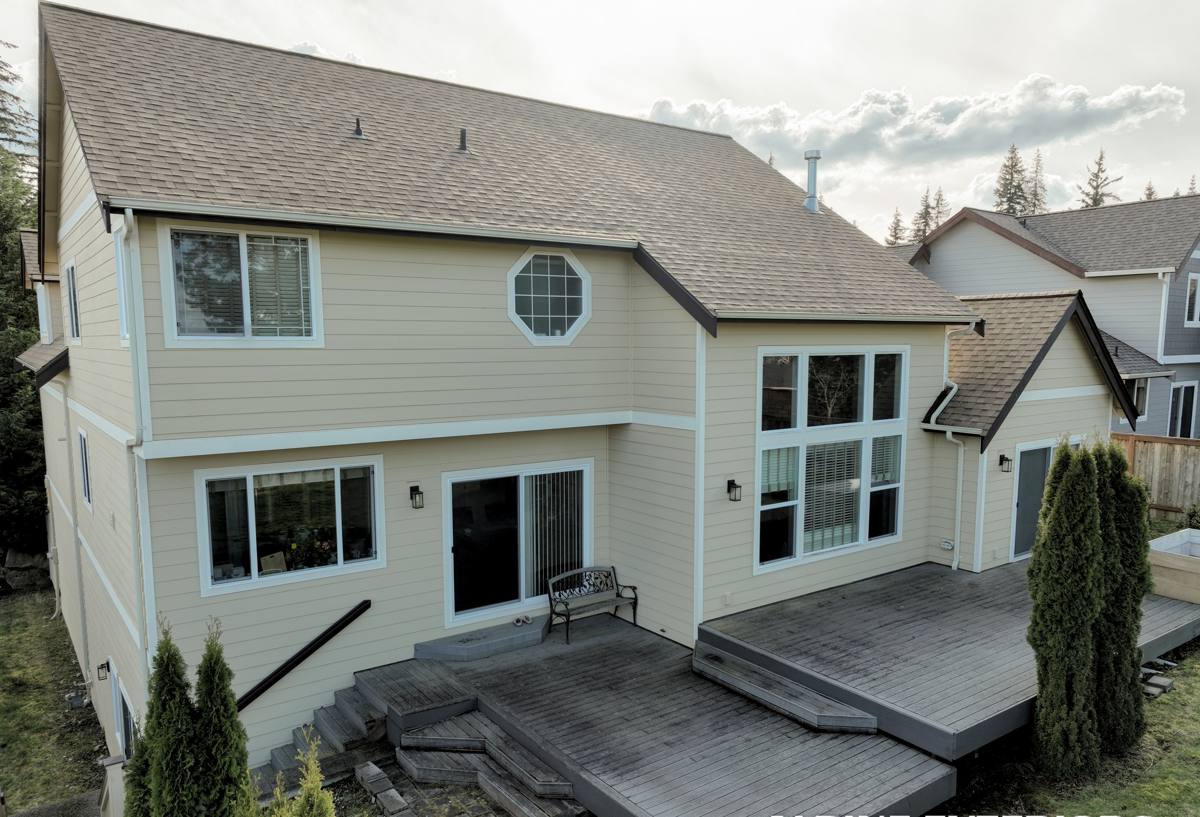
What Old Town Anacortes Homes Need From a Deck
Every deck in Skagit County has to deal with rain. But a deck in Old Town Anacortes is also dealing with salt air pushing off the water, which accelerates corrosion on anything metal and speeds up the breakdown of lower-grade wood finishes. Add in the shade many older lots have from mature trees and neighboring structures, and you get the third factor: moss and algae growth that starts early in the fall and doesn't fully let go until late spring.
The Three Forces at Work
- Salt air corrosion: Standard fasteners and hardware corrode faster near the water, which can lead to staining, weakened connections, and premature hardware failure if the wrong grade is used.
- Driving rain: Wind-driven rain gets up under railings, into end-grain cuts, and behind ledger boards — areas a lot of builds don't seal as carefully as the open, flat surfaces.
- Moss and algae: Shaded, damp decking surfaces grow a slick biological film that's both a slip hazard and, over time, a moisture trap that feeds rot in the boards underneath it.
None of these forces are dramatic on their own. The problem is cumulative — a deck that gets rained on, salted, and shaded month after month for years needs to be built from materials and details that are designed to shrug that off, not just survive one season of it.
What a Correctly Built Deck Involves
A deck that's going to last in this environment starts below the decking boards, not at them. The structure underneath — footings, posts, beams, joists, and the ledger connection to the house — carries the load and takes the brunt of moisture exposure over time, often out of sight.
Footings and Framing
Footings need to be sized and set to local frost and soil conditions, and the framing lumber should be rated for ground contact or exterior exposure as appropriate to its position. We flash and seal the ledger board connection to the house carefully — this is one of the most common failure points on decks generally, and it's worse near the water where wind-driven rain pushes moisture into any gap that isn't properly sealed.
Fastener and Hardware Selection
In a salt-air environment, fastener choice isn't a minor detail — it's one of the things that determines how long the structure lasts. We use corrosion-resistant hardware rated for coastal and treated-lumber exposure rather than defaulting to standard-grade fasteners, because the cost difference up front is small compared to the cost of replacing corroded connectors down the line.
Decking Material and Airflow
Whatever decking material a homeowner chooses, the framing underneath needs enough airflow to let the structure dry out between rain events. Decks built too low to the ground, or without adequate spacing and drainage planning, stay damp longer — and a structure that stays damp longer is a structure where moss, algae, and rot all get a head start.
Decking Material Options for a Coastal, Shaded Site
There's no single "right" decking material for every home — the right choice depends on budget, how much upkeep the homeowner wants to take on, and how shaded and exposed the site is. Here's how the common options compare for a neighborhood dealing with salt air, rain, and moss:
| Material | Moss/Algae Resistance | Maintenance | Typical Lifespan Here |
|---|---|---|---|
| Pressure-treated wood | Moderate — needs regular cleaning and sealing | Higher — annual cleaning, periodic re-staining/sealing | 15-20 years with upkeep |
| Cedar | Good natural resistance, but surface film still forms in shade | Moderate — periodic cleaning and oil/sealer | 15-25 years with upkeep |
| Composite decking | Good — dense surface resists moisture uptake, though film can still form and needs washing | Low — occasional washing, no sealing/staining | 25-30+ years |
| PVC decking | Very good — non-porous surface | Low — occasional washing | 25-30+ years |
We're upfront with homeowners about the trade-offs. Wood costs less up front and has a natural look many people prefer, but it asks for real annual maintenance in this climate — skip a year of cleaning and sealing on a shaded deck near the water, and moss and gray-out can get ahead of you. Composite and PVC cost more initially but ask for very little upkeep, which matters if a deck sits under tree cover where moss pressure is constant. Neither choice is wrong; it's about matching the material to how much maintenance time a homeowner actually wants to spend.
Design Considerations Specific to This Neighborhood
Slope and Drainage
Decking should be installed with a slight slope away from the house and enough gap between boards to let water shed quickly rather than pool. On a shaded lot, standing water is exactly what feeds moss growth, so drainage detail matters more here than it would on a sunny, open site.
Railings and Fastener Exposure
Railing posts and connections are some of the most exposed parts of a deck to wind-driven rain and salt air, since they stand up into the weather rather than lying flat. We pay particular attention to how railing hardware is sealed and specified so it isn't the first thing to show corrosion.
Fit With the Existing Home
Older homes in Old Town Anacortes often have their own character — certain siding profiles, trim details, roof lines. We build decks that tie into the existing structure cleanly, both visually and at the actual attachment points, rather than treating the deck as a separate add-on that happens to be bolted to the house.
Our Process for a Deck Project in Old Town Anacortes
- On-site assessment: We walk the property, look at sun/shade exposure, drainage patterns, and the condition of the house at the point where the deck will attach.
- Design and material discussion: We talk through decking material options, layout, railing style, and budget honestly, including the maintenance trade-offs of each material.
- Written estimate: A clear, itemized estimate so there are no surprises on scope or cost.
- Permitting: We handle the permitting process required for the project, since most deck construction in this area requires a permit and inspection.
- Construction: Footings and framing first, with careful ledger flashing and corrosion-resistant hardware throughout, followed by decking, railings, and any stairs.
- Final walkthrough: We go over the finished deck with the homeowner and cover basic care specific to the material chosen.
Why a Local Crew Matters for This Kind of Project
Deck building isn't complicated in the abstract, but building one that's going to hold up in Old Town Anacortes specifically means knowing how salt air, rain exposure, and shade behave on this stretch of Skagit County waterfront — not just what a general building code requires. A crew that works this neighborhood regularly already knows which fastener grades hold up, which decking materials are worth the added cost on a shaded lot, and where water tends to collect on homes with this kind of siting. That local pattern recognition is hard to replicate on a one-off job from a crew that doesn't normally work this area.
It also matters for follow-up. If a question comes up two years after the build — a squeak, a spot that's holding moisture, a railing connection worth checking — a local contractor is easy to reach and has the original project details on file.
Signs an Existing Deck Needs Attention
- Soft or spongy spots when you walk across the decking, especially near the house or at stair landings
- Rust streaks running down from screws, bolts, or metal railing hardware
- Persistent green or black film on the decking surface that comes back quickly after cleaning
- Gaps opening up at the ledger board where the deck meets the house
- Wobble or give in railings or posts
- Standing water that doesn't drain within a few hours after rain stops
Catching these early is almost always cheaper than waiting — a soft joist repaired now is a far smaller job than a full rebuild after rot has spread.
Getting Started
Whether you're planning a new deck for a home in Old Town Anacortes or need an honest look at one that's showing its age, we're happy to come take a look. We'll give you a straightforward assessment of what your project actually needs — no pressure, no upsell — and a written estimate you can take your time with. Reach out below for a free estimate.