 Anacortes
 Why Burlington Homes Need Siding Built for This Climate
Burlington sits in the Skagit Valley, close enough to Padilla Bay and the Salish Sea that salt-laden air is a constant fact of life for anything on the outside of a house. Add in the driving, wind-pushed rain that comes through the valley off the water, plus a shoulder season that stretches from fall through spring where moisture barely lets up, and you have a climate that is genuinely hard on exterior building materials. Then there's moss. Skagit County's damp, shaded conditions grow moss on roofs, fences, decks, and siding for a good chunk of the year, and moss holds moisture against whatever it's growing on.
None of this is unique to Burlington, but it's more pronounced here than in drier parts of Washington, and it's exactly the combination that separates siding materials that hold up from siding materials that quietly fail from the inside out. Wood rots. Vinyl gets brittle and lets water track behind it at the seams. Engineered wood products with any moisture sensitivity are working against the odds in a place like this. Fiber cement, installed correctly, is not.
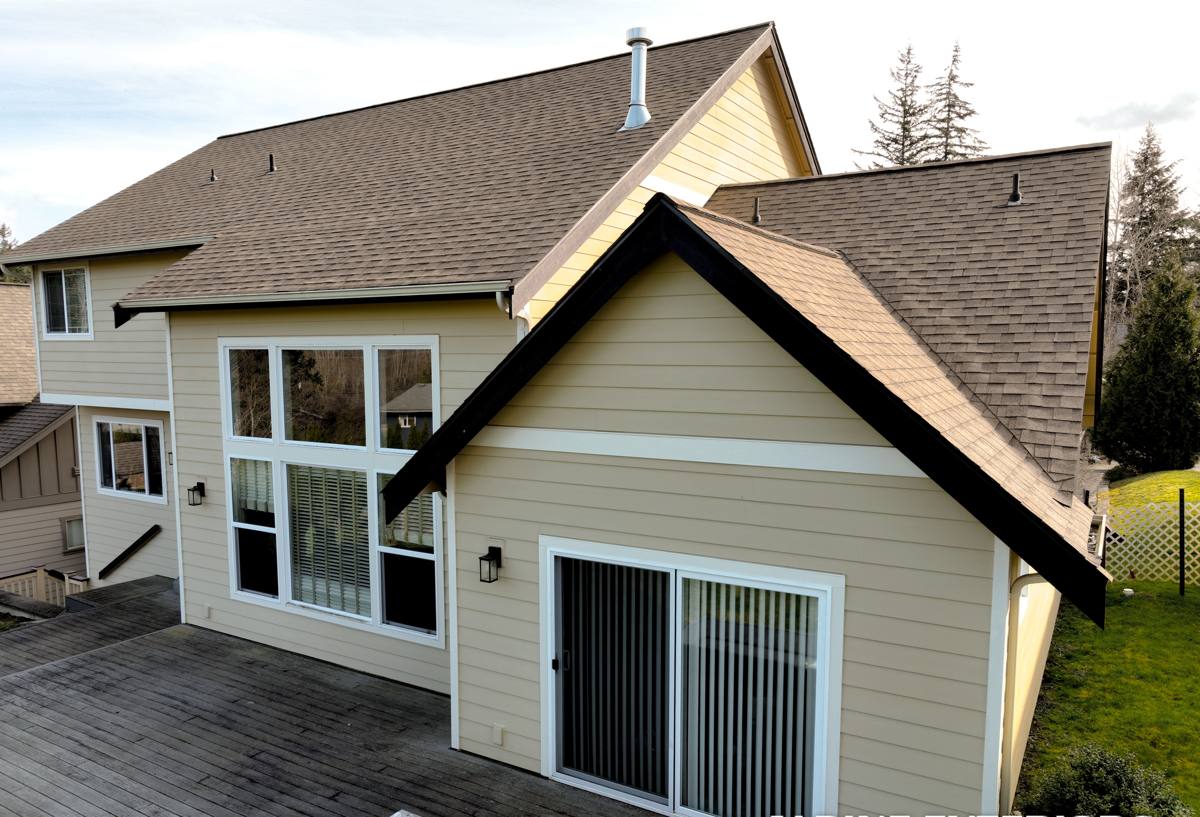
What Fiber Cement Actually Does Better Here
Fiber cement siding is a mix of cement, sand, and cellulose fibers, pressed and cured into planks and panels. It doesn't rot, it isn't a food source for the fungus and moss spores that thrive in Skagit County's humidity, and it doesn't expand and contract with moisture the way wood-based products do. That matters a lot in a coastal-influenced climate, because the failure mode for most siding isn't one big storm — it's years of small moisture cycles working into seams, fastener holes, and butt joints.
We install James Hardie fiber cement exclusively, and the reason comes down to how the product is engineered for climates like this one. Hardie's HZ5 product line is formulated specifically for regions with cold, wet weather and freeze-thaw cycles — which describes a Burlington winter well. The factory-applied ColorPlus finish is baked on under controlled conditions, so the color layer is more consistent and more resistant to fading and moisture intrusion than field-applied paint. That finish also means fewer repaint cycles over the life of the siding, which matters when your house is getting rained on for a large share of the year.
Salt Air and Corrosion
Coastal-adjacent siding jobs live or die on the small stuff: fastener material, flashing metal, and trim details. Fiber cement itself doesn't corrode, but a siding job is a system — nails, screws, flashing, and trim all have to be chosen to resist the same salt air that's aging everything else on the exterior. Cutting corners on fastener quality is a common way a technically "fiber cement" job still fails early in a place like Burlington.
Moss and Sustained Moisture
Moss doesn't grow on the fiber cement itself as readily as it does on wood, but it will happily colonize dirt, pollen, and organic debris that builds up on any siding surface, especially on north-facing walls and areas shaded by trees or neighboring structures. The material's job is to shed that moisture and not degrade underneath it — which is a function of the water-resistive barrier and flashing behind the siding as much as the siding itself.
What a Correct Fiber Cement Install Involves
Fiber cement is not a forgiving material to install badly. Because it's rigid and doesn't flex the way vinyl or wood does, mistakes in the install don't work themselves out over time — they stay as gaps, cracks, or trapped moisture pockets. A correct install includes:
- A continuous, properly lapped water-resistive barrier behind the siding, with all penetrations sealed
- Correct clearances — siding held up off decks, patios, and grade per manufacturer spec, so splash-back and standing water don't sit against the bottom edge
- Proper flashing at every window, door, and roof-to-wall transition, installed so water sheds outward rather than behind the cladding
- Fastener placement and spacing that match Hardie's published install requirements, not just "close enough"
- Butt joints back-primed or factory-sealed and staggered correctly, with gaps caulked using a product rated for the movement and exposure
- Field-cut edges primed or sealed before installation, since raw cut edges are the most common point of moisture intrusion
Every one of those details is inspectable, and every one of them is something a rushed or unfamiliar crew is more likely to skip. This is where a lot of "fiber cement failures" actually come from — not the material, but an install that ignored the manufacturer's own requirements for a wet, coastal-influenced climate.
Our Process for a Burlington Siding Project
We walk every job the same way, because skipping steps is how moisture problems get built into a house.
- Assessment. We look at existing siding, sheathing, and any trouble spots — soft spots, staining, or trim that's already showing wear — before quoting anything.
- Tear-off and sheathing check. Old siding comes off and we inspect the sheathing underneath for rot or damage before anything new goes up. Damaged sheathing gets addressed, not covered over.
- Water-resistive barrier and flashing. This is the layer that actually keeps a house dry — it goes in correctly before a single piece of siding is hung.
- Installation to spec. James Hardie planks, panels, or trim installed to the manufacturer's fastening, clearance, and joint requirements — not shortcuts.
- Trim, caulking, and detail work. The parts most likely to be rushed on a bad job are where we spend the most care.
- Final walkthrough. We go over the finished job with you before calling it done.
Comparing Siding Materials for This Climate
| Material | Moisture/Rot Resistance | Performance in Salt Air | Typical Maintenance |
|---|---|---|---|
| James Hardie Fiber Cement | Excellent — won't rot, resists moss growth on the surface | Very good; system durability depends on fasteners/flashing | Occasional wash; ColorPlus finish reduces repainting |
| Vinyl | Fair — doesn't rot, but seams and laps let water track behind it | Can become brittle and fade faster with UV and salt exposure | Low, but cracks/warps over time and can't be repainted easily |
| Cedar/Wood | Poor to fair without diligent upkeep — rot and moss-prone | Salt air accelerates weathering and finish breakdown | High — regular staining/sealing and moss treatment |
| Primed Spruce/Engineered Wood | Moisture-sensitive at cut edges and seams | Prone to swelling and finish failure in sustained damp | Moderate to high; edge sealing is critical and easy to miss |
What Drives Cost on a Burlington Job
| Factor | Why It Matters |
|---|---|
| Home size and wall complexity | More corners, gables, and cutouts mean more cuts, trim, and labor time |
| Existing siding removal | Tear-off and disposal of old material adds time versus a bare-sheathed wall |
| Sheathing condition | Rot or moisture damage found underneath old siding needs repair before install |
| Product line and profile | Lap width, panel style, and trim choices affect material cost |
| Site access | Tight lots, fencing, or landscaping near the house can add setup time |
We give a firm, itemized estimate after seeing the house in person — not a phone-quote guess. Broad ranges vary a lot by these factors, so an accurate number only comes from a walkthrough.
Living With Fiber Cement Siding Through a Skagit County Year
One advantage homeowners notice after switching to Hardie in this area is how little the siding itself needs during moss season. Because the surface isn't an organic food source the way wood is, moss and algae are easier to rinse off rather than needing to be scraped or treated. A yearly rinse-down, keeping gutters clear so water isn't sheeting down the wall face, and trimming back vegetation that keeps a wall shaded and damp go a long way. What we tell every Burlington customer: the siding material handles the climate, but the roof, gutters, and grading around the house still have to do their job too — siding isn't a substitute for good drainage.
Why a Crew That Already Works This Area Matters
Skagit County's coastal-influenced weather isn't identical to inland Washington or even to nearby areas with less direct exposure to the water. A crew that installs siding here regularly already knows where driving rain hits hardest on a typical wall orientation, how much clearance really holds up over a wet winter, and which flashing details matter most given the rainfall this area actually sees — not just the manufacturer's minimum spec. That local pattern recognition is the difference between a job that looks right on installation day and one that's still performing correctly five winters later.
Questions to Ask Before You Hire
- Are you a certified or factory-trained installer for the specific fiber cement product you're proposing?
- What water-resistive barrier and flashing details will you use, specifically, on this house?
- How will cut edges and butt joints be sealed?
- What's the fastening pattern, and does it match the manufacturer's published requirements?
- What does the warranty actually cover — material only, or labor too — and who backs it?
If a contractor can't answer those clearly, that's worth paying attention to before any siding goes up.
If your Burlington home's siding is showing its age — or you're planning ahead before the next wet season sets in — we're happy to take a look and walk you through what a correct James Hardie install would involve for your house. The estimate is free, there's no pressure, and you'll get a straight answer either way.