 Anacortes
 Old Town Anacortes is one of the oldest residential pockets in the city, sitting close to the water on Fidalgo Island with a housing stock that goes back to the late 1800s and early 1900s. Homes here weren't built to modern window-sizing standards, and decades of exposure to Skagit County's marine climate has taken its own toll on whatever went into those openings originally. "Custom windows" in this neighborhood usually isn't a design upgrade — it's what's actually required to get a window that fits the opening, seals correctly, and holds up to the specific punishment that comes with living this close to saltwater.
Why "Custom" Is the Norm, Not the Exception, in Old Town
A straight stock-size swap works fine when a house was framed to modern standard dimensions. A lot of Old Town Anacortes housing wasn't. Openings were framed by hand to whatever made sense at the time, additions and porch conversions over the decades created window openings that don't match anything in a manufacturer's catalog, and settling in older foundations has left more than a few openings slightly out of square after a century of shifting. On top of that, some of these homes carry original architectural details worth preserving — deep-set trim, taller or narrower proportions than what's typical today — that a generic stock window simply won't match.
None of that makes the job harder in a bad way. It just means the project starts with real field measurement and an honest look at the opening, not a size pulled off a shelf. Where an opening can take a standard unit without compromising fit or trim, we'll say so — custom fabrication costs more and takes longer to arrive, so we don't push it where it isn't needed.
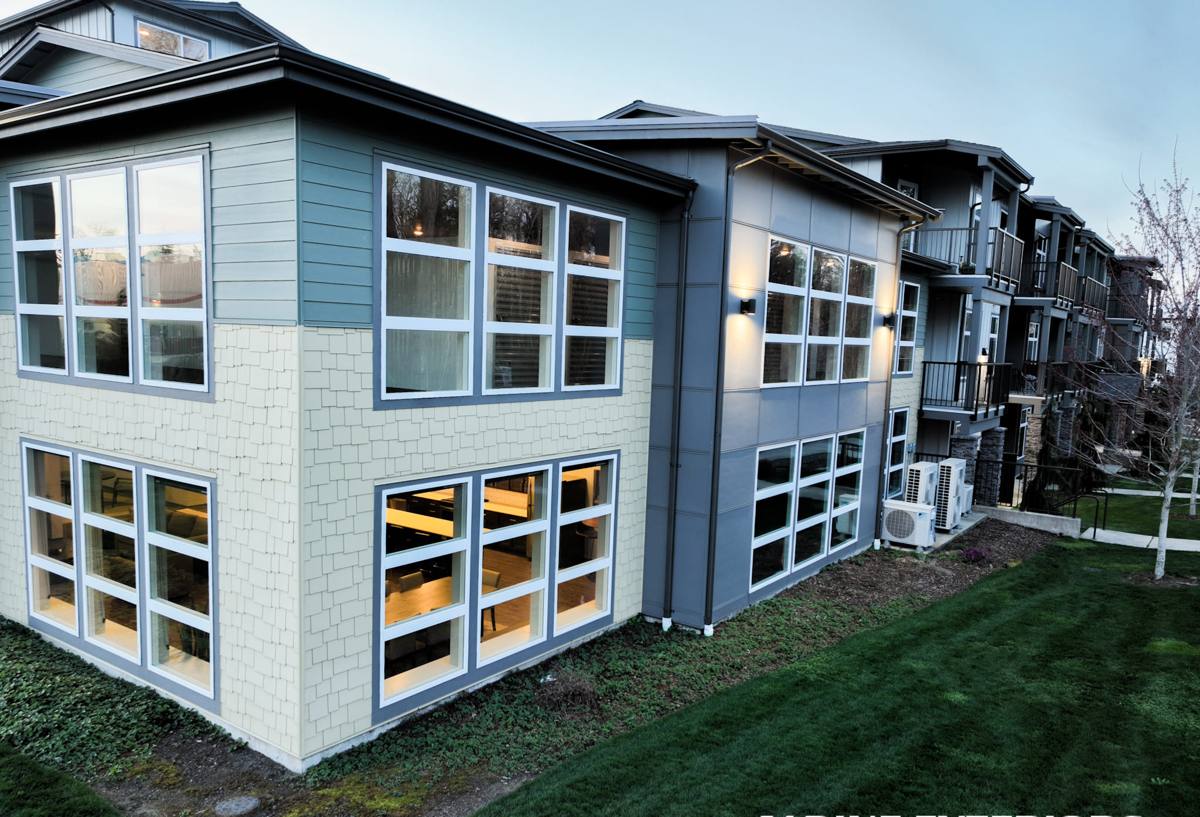
What Anacortes' Marine Climate Does to Windows Over Time
Old Town sits close enough to the water that salt-laden air is a constant, not an occasional weather event. That air works on hardware, fasteners, and lower-grade frame components steadily, year after year, in ways a window built for an inland climate was never tested against. Add in the driving rain that comes through Skagit County in fall and winter storms — wind pushing water sideways into wall assemblies rather than letting gravity carry it down and away — and you have two separate stresses attacking the same joints and seals from different angles.
Then there's moss. Shaded, damp corners of older lots around Anacortes — north-facing walls, mature trees close to the house, narrow side yards that don't get much sun or airflow — support a moss season that runs most of the year in this climate. Moss holding moisture against a wood sill or sash for months at a time does real damage that a homeowner often doesn't notice until the wood underneath has already started to soften.
Where Old Windows Actually Fail
It's rarely the glass itself. On older homes in this neighborhood, failure almost always starts at the sill, the lower corners of the frame, or wherever the original flashing (if there was any real flashing at all) has broken down. Those are the spots holding water the longest, and they're the spots a rushed replacement is most likely to leave unaddressed because they take more time to get right than just swapping the sash.
Signs a Window Needs More Than a Repair
Not every window in an older Old Town home needs full replacement, but certain signs mean it's past the point where caulk and paint will hold the line.
- Fogging or a milky haze between panes on double-pane units — the seal has failed and moisture is inside the glass
- Soft, spongy, or visibly darkened wood at the sill or lower frame corners
- Moss or dark staining building up in the track or along the bottom rail
- Noticeable drafts you can feel with a hand near the frame on a windy day
- Sashes that stick, swell, or won't stay open due to moisture-swollen wood
- Condensation forming on the inside of the glass regularly, even in mild weather
- Paint peeling or bubbling at the corners, often a sign water is already behind it
- Visible gaps or cracked, shrunken caulk lines around the exterior trim
Choosing a Frame Material for This Climate
Frame material matters more here than in a drier inland market, because whatever you choose is going to sit against salt air and sustained moisture for decades. We'll walk through the real trade-offs for your specific opening rather than defaulting to whatever's easiest to install.
| Material | Salt Air / Moisture Behavior | Maintenance | Typical Cost Range | Best Fit |
|---|---|---|---|---|
| Vinyl | Won't rot or corrode; performs well in coastal air | Low — occasional cleaning, no painting | Lower end of the range | Straightforward replacements where budget matters |
| Fiberglass | Excellent moisture and salt resistance; very stable dimensionally | Low | Mid to upper range | Larger openings and homes where long-term performance is the priority |
| Wood-clad (exterior-protected) | Good if the exterior cladding is intact; interior wood adds warmth for historic character | Higher — cladding and seals need periodic inspection | Upper range | Homes where matching original interior trim character matters most |
| Bare wood (uncladded) | Poor in this specific climate without constant upkeep | High — regular repainting and sealing required | Varies | Rarely our recommendation for exterior-facing units this close to the water |
For most Old Town replacements facing weather directly, we lead with vinyl or fiberglass because they take salt air and driving rain out of the maintenance equation almost entirely. Where the interior look of a historic wood sash matters and the budget supports it, a wood-clad unit with a properly protected exterior can still be the right call — the key is making sure the exterior cladding and seals are genuinely sound, not just cosmetically wood-look.
Full-Frame Replacement vs. Insert Windows
This decision matters more on an older home than a newer one. An insert (or "pocket") replacement fits a new window into the existing frame, leaving the old exterior trim and flashing in place — faster and less disruptive, but only appropriate when that existing frame and flashing are actually still sound. A full-frame replacement removes the window down to the rough opening, which is more work but lets us inspect and correct whatever's behind the trim: old flashing, water damage, insulation gaps, or framing that's shifted out of square over the decades.
On a lot of Old Town homes, what looks like a simple insert job turns into a full-frame recommendation once we actually open things up — because the original flashing (if it exists at all) predates modern standards, or because we find soft framing that an insert would just seal moisture behind rather than fix. We'll tell you which one your specific window needs and why, before you commit to a price.
Our Process, Start to Finish
- On-site assessment — we measure every opening, check for square and level, and look behind the trim where we can to gauge the condition of the existing frame and flashing
- Honest recommendation — stock size, custom fabrication, insert, or full-frame, explained with the reasoning specific to that opening
- Material selection — we walk through frame material trade-offs for your budget and how exposed that particular window is to weather
- Ordering and lead time — custom units take longer than stock sizes; we give you a realistic timeline before you commit
- Careful removal — old units come out without unnecessary damage to surrounding trim or siding, and hidden problems get flagged before the new window goes in
- Installation and flashing — the new unit is set, shimmed level and plumb, and flashed in a sequence built to shed water outward and downward, not trap it
- Trim and finish — exterior trim is matched to the rest of the house so the result looks original to the home, not obviously new
Why the Flashing Detail Matters More Than the Window Itself
A quality window installed with careless flashing will still leak. A modest window installed with correct flashing will hold up for decades. That's true everywhere, but it matters more in Old Town Anacortes because driving rain off the water tests every gap that a calmer inland climate never would, and because so many of these openings sit on wall assemblies that are already older and less forgiving than new construction. We build the flashing plan around the specific opening — sill pan, correct lap sequence, sealant only where it belongs rather than as a substitute for proper flashing — because that's the layer that actually decides whether the job holds up.
Living With Custom Windows in a Salt-Air, Moss-Prone Climate
A correctly installed window in this climate still needs a little attention to get its full lifespan. Rinsing salt film off exterior hardware and glass periodically keeps corrosion from getting a foothold, especially on homes with a more direct water exposure. Keeping tracks, weep holes, and sills clear of moss, needles, and debris matters more here than in most climates, since blocked weep holes are one of the more common reasons a well-installed window starts holding water where it shouldn't. A quick annual look at exterior caulk lines — checking for shrinkage, cracking, or gaps — catches small problems while they're still small.
None of this is heavy maintenance. It's the kind of five-minutes-a-season attention that keeps a properly installed custom window performing the way it's supposed to for its full warranty life, instead of quietly failing at a seam nobody checked.
Quick Checklist Before You Commit to a Window Project
- Confirm the opening has been field-measured, not estimated from old plans or guesswork
- Ask whether your project needs a full-frame replacement or an insert, and why
- Get a straight answer on frame material trade-offs for a home this close to the water
- Ask what the flashing plan looks like for your specific opening, not a generic answer
- Get a realistic lead time in writing, especially for custom-sized or -shaped units
- Confirm what's covered under warranty — the window unit and the installation labor are often separate
Why Local Experience in Old Town Anacortes Actually Matters
Manufacturer installation instructions are written for average conditions on a standard modern wall assembly. A lot of Old Town Anacortes homes don't match that description, and the climate here doesn't either. A crew that has actually worked this neighborhood — pulled trim off these older wall assemblies, found what decades of salt air and moss have done to a sill, fit custom units into openings that predate modern sizing — knows which parts of a generic installation guide are non-negotiable here and where extra time on flashing is worth it even when it looks unnecessary from the outside.
That experience shows up in decisions that never make it into a sales pitch: which sills need a sloped composite cap instead of relying on caulk, how much lap a flashing course needs given this area's wind-driven rain, when an opening that looks fine from the street actually needs to be opened up and corrected rather than covered over. Those are the calls that decide whether a window project is still performing cleanly in twenty years or showing rot and drafts in five.
If you're dealing with a drafty, foggy, or moss-stained window in Old Town Anacortes — or planning ahead on a home you know has original windows nearing the end of their life — it's worth having someone take a real look at the opening before you start pricing units. We offer free, no-pressure estimates for custom window projects in Old Town Anacortes and throughout the surrounding Skagit County area; use the form below to get a time on the schedule.