 Anacortes
 Ship Harbor's Marine Climate Is Hard on Decks
Ship Harbor sits close enough to the water that homes here deal with a different set of conditions than a deck a few miles inland in Skagit County. Salt-laden air off the water accelerates corrosion on fasteners, hardware, and any metal connector that wasn't rated for it. Driving rain, pushed sideways by wind coming off Rosario Strait and the surrounding waterways, gets up under railings and into ledger connections in ways a straight-down rain never would. And the long, wet moss season that runs from fall through spring keeps horizontal surfaces damp for months at a stretch, which is exactly the condition that rots wood decking and framing from the inside out.
None of that means a deck can't last in Ship Harbor — it means the deck has to be built and maintained with that exposure in mind from the start. A lot of the deck failures we see out here aren't from bad luck. They're from a deck that was built to a generic spec instead of one that accounted for salt air, wind-driven rain, and near-constant moss growth.
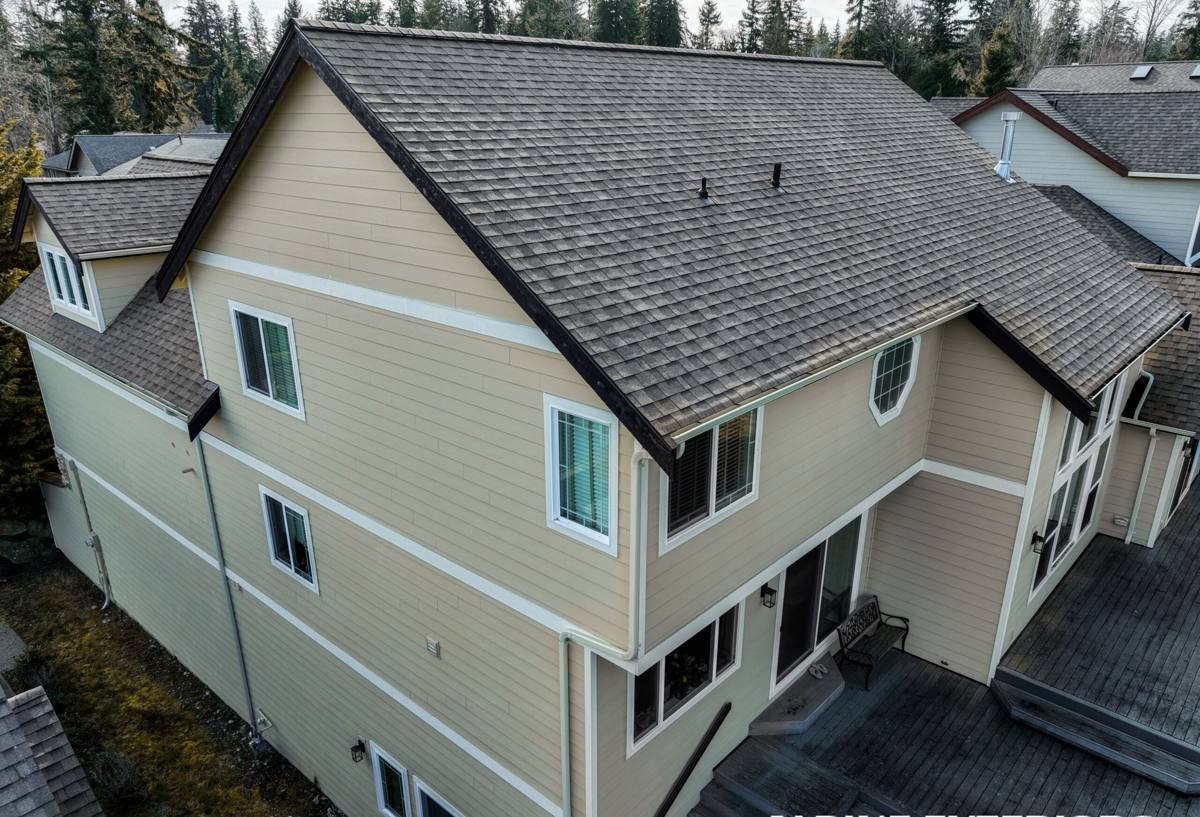
Signs Your Deck Has Reached Replacement, Not Repair
Not every tired-looking deck needs to be torn out. But there's a point where patching boards or swapping a few posts is just delaying a bigger problem — and often costing more in the long run than doing the job right once. Here's what tells us a deck is past the repair stage:
- Soft, spongy, or spring-back decking boards, especially near the ledger or in shaded, moss-covered areas that never fully dry
- Rust streaking down from screws, joist hangers, or post bases — a sign the hardware itself is corroding, not just staining the wood
- Any give or movement where the deck attaches to the house (the ledger board) — this is a structural safety issue, not cosmetic
- Posts or footings that have shifted, heaved, or show rot at the base where they meet the ground or concrete
- Railings that flex more than they should, especially after being repainted or re-stained to hide surface damage
- A deck more than 20-25 years old built to older code, without proper flashing at the house connection
If you're only seeing weathered color or minor surface checking on the boards themselves, that's often a cleaning and refinishing job, not a replacement. We'll tell you honestly which category your deck falls into — we don't have any reason to sell a full rebuild when a repair will genuinely hold up.
What a Correct Deck Replacement Involves
A deck replacement is more than pulling up old boards and screwing down new ones. In a marine-exposure area like Ship Harbor, the parts you don't see — flashing, fasteners, footings — matter more than the decking surface, because those are the components that fail first when they're undersized or the wrong material for the exposure.
Ledger Board and Flashing
Where the deck attaches to the house is the single most common point of failure on any deck, and it's the one place where a mistake is hidden until it causes real damage — including rot in the house's rim joist. A correct replacement means proper flashing that sheds water away from the house wall, not just a ledger bolted flush against siding. Given how much wind-driven rain this area gets, we treat ledger flashing as non-negotiable, not an upgrade.
Framing, Fasteners, and Hardware
Standard galvanized fasteners don't hold up well long-term this close to salt air — they can start showing rust within a few years, well before the wood around them has aged at all. We use stainless steel or high-grade coated fasteners and connectors rated for coastal exposure, along with joist hangers and post bases sized correctly for the actual load, not the minimum the framing lumber will technically allow.
Footings and Post Bases
Skagit County's frost depth and drainage conditions matter here — footings that are too shallow or poured without accounting for how water moves through the soil can heave or settle over time, which throws the whole deck out of level and stresses every connection above it. We set footings to depth, and we keep post bases elevated off the concrete so the post end isn't sitting in standing water after every rain.
Choosing a Decking Material for This Climate
There's no single "best" decking material — there's a best material for how you plan to use the deck and how much upkeep you actually want to do. Here's how the common options hold up specifically in a salt-air, high-moisture, moss-prone setting like Ship Harbor:
| Material | How It Handles This Climate | Maintenance |
|---|---|---|
| Pressure-treated wood | Affordable and strong, but needs consistent sealing to resist moisture and moss staining; more prone to checking and splintering over time in constant damp conditions | Annual cleaning and re-sealing recommended |
| Cedar | Naturally rot-resistant and a good look for this region, but still needs periodic sealing to hold its color and resist moss growth in shaded, damp spots | Sealing every 1-3 years |
| Capped composite | Strong resistance to moisture absorption and salt exposure; the cap layer resists staining and makes moss easier to rinse off compared to bare wood grain | Periodic washing, no sealing or staining |
| PVC decking | Fully synthetic, doesn't absorb moisture at all, holds up very well to salt air and constant damp shade; some homeowners prefer the look of wood grain composite instead | Occasional washing |
We install all of the above and will walk you through the real trade-offs — cost up front, appearance, and how much time you want to spend maintaining it — rather than pushing whichever material has the best margin.
Our Deck Replacement Process
Here's how a typical replacement goes from first call to finished deck:
- On-site assessment of the existing deck — framing, ledger connection, footings, and decking condition, so we know exactly what's driving the need for replacement
- A written estimate that separates structural work from surface decking, so you can see what you're paying for and where
- Permitting where required — we handle the paperwork with the local building department
- Careful demolition, checking the house's rim joist and siding behind the old ledger for hidden moisture damage before anything new goes up
- Framing rebuild with corrosion-rated fasteners and hardware sized for the actual span and load
- Proper ledger flashing and house-side waterproofing before the new decking goes down
- Decking installation per the manufacturer's spacing and fastening specs (this matters more than people expect — improper gapping is a common cause of premature composite decking failure)
- Final walkthrough so you know how to maintain the specific material you chose
Moss, Drainage, and Keeping a New Deck Looking Right
Moss is less about the material you choose and more about how the deck is built to drain and dry. A deck built tight against the house, with poor airflow underneath or gaps too narrow between boards, will hold moisture and grow moss no matter what it's made of. Part of doing this job right is spacing decking correctly, keeping any skirting or under-deck areas ventilated, and grading the ground below so water doesn't pool and wick back up into the framing.
Once the deck is in, a simple seasonal routine goes a long way: clearing debris out of gaps between boards before it composts into a moss bed, keeping gutters and downspouts near the deck clear so runoff doesn't dump directly onto it, and giving it an occasional wash before moss gets a foothold rather than after. We'll go over the specific care routine for whatever material you choose at the end of the job.
What Affects the Cost of a Deck Replacement
Every deck is different, but the same handful of factors drive the price on most jobs we quote in this area:
| Factor | Why It Matters |
|---|---|
| Size and shape | Square footage plus complexity — multiple levels, angles, or built-in features add labor beyond a simple rectangle |
| Decking material | Pressure-treated wood costs the least up front; composite and PVC cost more initially but less in upkeep over the deck's life |
| Height and railing requirements | Decks above a certain height require code-compliant railing systems, which adds materials and labor |
| Condition of existing structure | If footings or framing need full replacement rather than reuse, that's more work than a decking-only swap |
| Access and site conditions | Tight side yards, slopes, or limited equipment access near the water can add time to demolition and material staging |
We give real numbers based on your specific deck, not a ballpark that changes once the crew shows up. If there's a lower-cost way to get you a safe, long-lasting deck, we'll say so.
Why Hire a Crew That Already Works in Ship Harbor
A contractor who mostly works inland doesn't always think about salt-air fastener corrosion, wind-driven rain at ledger connections, or how long moss season really runs in a given microclimate — because they don't have to, most of the year, most other places. Working this neighborhood regularly means we've already seen what fails here, and what holds up. That shows up in the small decisions: which hardware grade we default to, how we flash a ledger, how much drainage we build in without being asked.
It also means straightforward logistics — we know the local permitting process for Anacortes and Skagit County, and we're not learning site access or working around ferry-related traffic patterns for the first time on your job.
If your deck in Ship Harbor is showing its age, we're happy to take a look and give you a straight answer on repair versus replacement, along with a free, no-pressure estimate — just fill out the form below.