 Anacortes
 Why West Anacortes Siding Has to Work Harder
Homes on the west side of Anacortes sit closer to open water than most of Skagit County, and that changes what siding has to put up with year after year. Salt-laden air off Rosario Strait and the surrounding channels doesn't just make things feel damp — it accelerates corrosion on fasteners and trim metal, and it keeps painted and wood-based surfaces from ever fully drying out between weather systems. Add driving rain that comes in sideways off the water during fall and winter storms, plus a long, gray moss season that stretches from October well into spring, and you have a set of conditions that punishes any siding product with a weak point.
This isn't a generic "Pacific Northwest is wet" problem. It's specific to homes with direct or partial water exposure in this part of Anacortes, where wind-driven moisture hits siding at angles that flatter drainage details never see. A product and installation that hold up fine two miles inland can fail years earlier out here if the details weren't built for it.
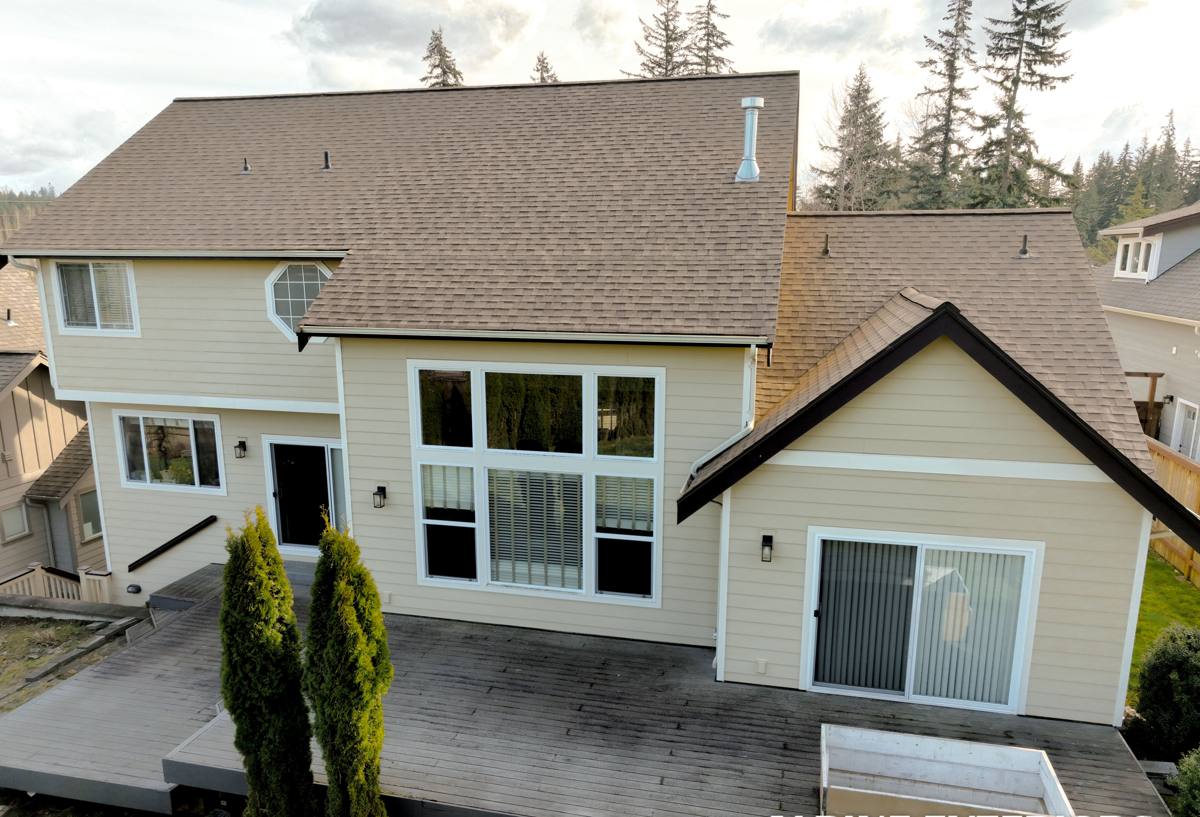
What Salt Air, Rain, and Moss Actually Do Over Time
Salt air and corrosion
Airborne salt accelerates the breakdown of unprotected or poorly coated fasteners, flashing, and trim. Once a fastener starts to corrode behind a piece of siding, you often don't see the problem until staining, streaking, or a loose board shows up — by which point moisture has usually already found its way behind the cladding.
Driving rain and wind-loaded moisture
Rain that falls straight down mostly runs off. Rain that's pushed sideways by wind off the water gets forced up under laps, into seams, and against end cuts and butt joints — the exact spots where siding is most vulnerable if they weren't properly sealed, flashed, or gapped during installation.
Moss, algae, and a slow drying cycle
Skagit County's moss season isn't just cosmetic. Moss and algae hold moisture directly against a siding surface for extended stretches, and on siding that can absorb or swell with water, that constant dampness shortens the material's working life. Homes with shaded north- or west-facing walls near mature trees see this the worst.
Why We Install Only James Hardie Fiber Cement
We made a deliberate decision to install James Hardie fiber cement siding exclusively — not vinyl, not LP SmartSide, not primed wood products, not other fiber cement brands. That's not a marketing position, it's a standard we hold because of what we've seen these products do (and not do) in exactly the kind of marine-influenced climate West Anacortes sits in.
Fiber cement is cement, sand, and cellulose fiber — it doesn't rot, it isn't a food source for moss or mildew the way wood-based products can be, and it doesn't degrade from UV and salt exposure the way vinyl can over a couple of decades. James Hardie's ColorPlus factory-applied finish is baked on under controlled conditions, which gives it more consistent coverage and better fade resistance than field-applied paint — a real advantage on a coastline where sun, salt, and rain all work against a finish at once.
James Hardie also engineers regional product lines (HZ5 for climates like ours) specifically for wind-driven rain and moisture cycling, rather than selling one formulation everywhere. That regional engineering, backed by a strong transferable warranty, is why we standardized on this one manufacturer instead of carrying multiple product lines.
Choosing the Right Hardie Product for a Water-Exposed Lot
Not every Hardie product or profile is the right fit for every home, and this is where local judgment matters more than a catalog page.
- HardiePlank lap siding — the most common choice, available in several exposure widths and textures; performs well on most West Anacortes homes when detailed correctly at laps and joints.
- HardiePanel vertical siding — often used for accent sections, gables, or a modern look; requires careful joint treatment since vertical seams see more direct water exposure.
- HardieTrim — matched trim boards that resist the same moisture and salt exposure as the field siding; mixing in wood trim on an otherwise fiber cement job reintroduces the weak point you were trying to eliminate.
- HZ5 formulation — the cold/wet climate zone product, appropriate for this part of Washington and what we spec by default here.
The right call depends on the home's exposure, wall orientation, existing water damage (if any), and how much wind-driven rain a given elevation actually takes. Part of a proper estimate is walking the exterior and identifying which walls need the most attention.
What a Correct Installation Actually Involves
Fiber cement siding is only as good as the installation behind it. Most siding failures we're called out to inspect — on any brand — trace back to installation shortcuts, not the material itself. In a wind- and salt-exposed location, these details matter more than usual:
Flashing and water management first
Housewrap, window and door flashing, and kick-out flashing at rooflines have to be correct before a single piece of siding goes up. Siding is the last line of defense, not the only one — if the water management behind it is wrong, no cladding will fix that.
Proper gapping and fastening
Hardie siding needs specific gaps at butt joints, corners, and penetrations to allow for expansion and to keep water from wicking in, along with correct fastener spacing, type, and depth. Manufacturer install specs exist for a reason — following them is what keeps the warranty valid and the siding performing for decades.
Caulking and sealant only where specified
Over-caulking is as much a problem as under-caulking. Hardie's install guide specifies exactly where sealant belongs and where a gap should be left open to drain and dry. Crews that caulk everything "to be safe" often trap moisture instead of keeping it out.
Our Process, Start to Finish
- On-site walk and assessment — we look at every elevation, note water exposure, existing damage, and any rot or flashing issues under the current siding.
- Product and color selection — matching HardiePlank, panel, and trim profiles to the home, with ColorPlus finish options.
- Written estimate — a clear scope covering removal, water management repairs if needed, materials, and installation.
- Tear-off and inspection of sheathing — once old siding is off, we check for hidden moisture damage before closing anything back up.
- Housewrap, flashing, and installation — done to James Hardie's published specifications for our climate zone.
- Final walk-through — reviewing the finished job with the homeowner before we consider it done.
What Drives the Cost
| Factor | Why It Matters Here |
|---|---|
| Wall exposure and water damage found at tear-off | West-facing and water-exposed walls more often reveal hidden rot or flashing issues once old siding comes off |
| Siding profile and trim complexity | Multiple elevations, gables, or accent panels take more labor and material than a simple rectangular home |
| Story height and access | Multi-story homes near steep or waterfront lots may need additional staging or equipment |
| Color and finish selection | Factory ColorPlus finishes vs. field-applied paint affect material cost and long-term maintenance |
| Scope of water management repair | Replacing damaged sheathing, housewrap, or flashing adds cost but is not optional if found |
Every home is different, which is why we walk the property in person rather than quoting off square footage alone.
Living With Fiber Cement Siding in a Moss-Prone Climate
Fiber cement is genuinely low-maintenance compared to wood, but "low-maintenance" doesn't mean "no maintenance," especially with a Skagit County moss season to contend with.
- Rinse siding gently once or twice a year to remove built-up salt residue, pollen, and organic growth — a garden hose is usually enough; avoid high-pressure washing directly into laps and seams.
- Keep gutters clear so runoff doesn't sheet down the siding face during storms.
- Trim back vegetation and tree canopy that keeps a wall shaded and damp longer than the rest of the house.
- Check caulking at trim and penetrations every couple of years and have any cracked or missing sealant addressed promptly.
- Watch for moss or algae taking hold on north- or west-facing walls and clean it off before it spreads.
Why Local Experience in West Anacortes Matters
A crew that primarily works drier, inland jobs doesn't always think about kick-out flashing at a roof-to-wall intersection, or how far wind-driven rain travels up a wall on an exposed elevation, the same way a crew that works this stretch of Anacortes every season does. We've seen what happens to siding — Hardie and otherwise — installed without those details accounted for, and we build every West Anacortes job around avoiding those failure points from the start, not fixing them five years later.
If you're planning a siding project on the west side of Anacortes, we'd be glad to walk the property, look at what your home's exposure actually demands, and put together a straightforward, no-pressure estimate using the form below.