 Anacortes
 Why Decks in the Burlington Area Wear Out Faster Than Homeowners Expect
Burlington sits in the Skagit Valley, close enough to Anacortes and the Salish Sea that the region's weather pattern shapes everything about how a deck ages here. Long, wet winters mean a deck can stay damp for days at a stretch, not just after a single storm. Add in the salt-tinged air that moves through this part of Skagit County off the water, and you get a combination that's hard on fasteners, ledger boards, and any wood surface that doesn't drain and dry properly.
Most decks don't fail all at once. They fail slowly, in the places you can't see from the top: the ledger board bolted to the house, the post bases sitting in standing water, the joist hangers rusting from the inside out. By the time boards are visibly cupping or springy underfoot, the structure underneath has usually been losing integrity for a while. That's the pattern we run into again and again on deck replacement calls in this area — the surface looks tired before the frame does, but the frame is often further gone than it looks.
Understanding that pattern matters because it changes how a replacement should be scoped. A deck built for a drier climate, or built to a minimum-code standard without accounting for how much moisture this region actually sees, tends to need full replacement years before it should.
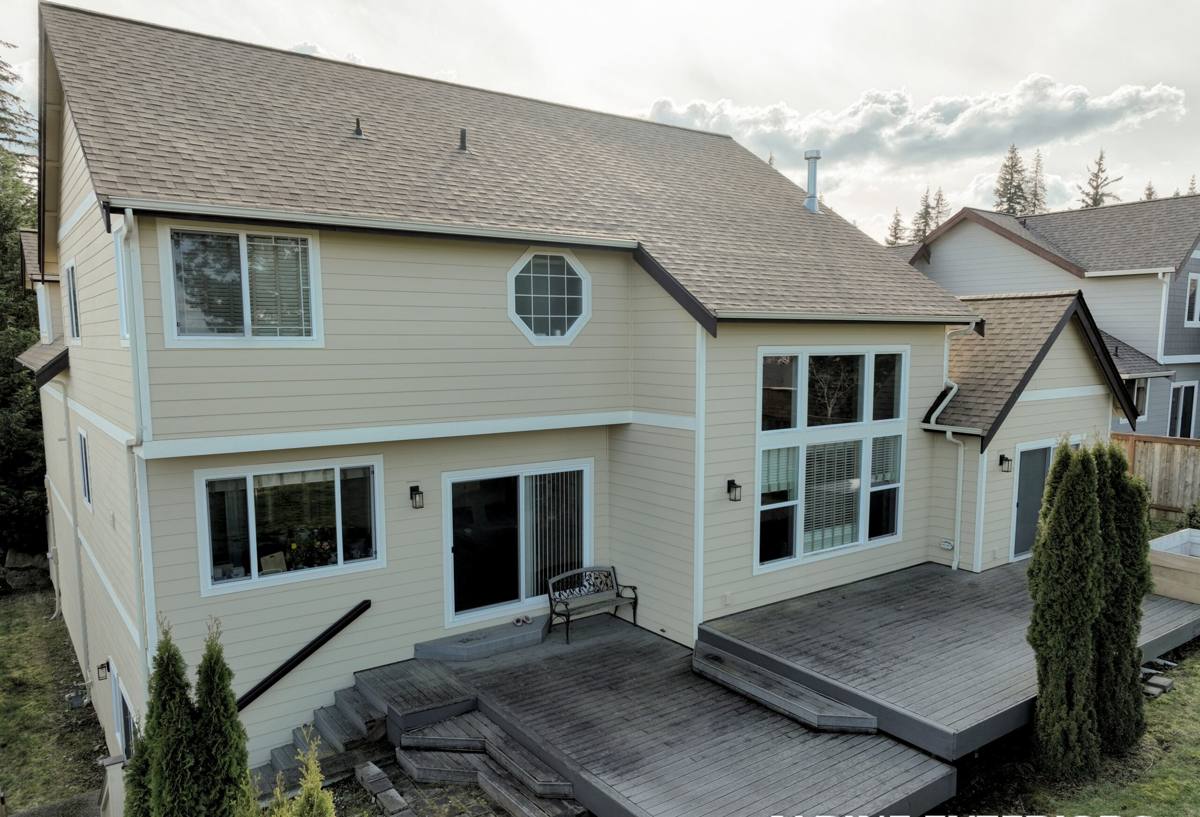
Signs a Burlington Deck Needs Replacement, Not Just Repair
Repair makes sense when the problem is isolated. Replacement makes sense when the problem is systemic — when the moisture, rot, or structural fatigue has spread through the frame rather than sitting in one board or one post. Here's what we check for when we're deciding which category a deck falls into:
- Soft or spongy decking in more than one area, not just around a single stain or leak point
- Rust streaking from joist hangers, bolts, or screws — a sign moisture has been sitting against metal for a long time
- Movement or bounce in the frame when you walk across it, especially near the house
- Visible gaps or separation where the ledger board meets the house siding or rim joist
- Posts that feel loose at the base, or footings that have shifted, cracked, or heaved
- Persistent moss or algae growth on the decking surface that returns within weeks of cleaning
- A railing that flexes noticeably when leaned on — a code and safety issue, not just cosmetic
- A deck more than 20-25 years old that has never had the ledger connection or footings inspected
If you're seeing two or more of these, especially anything involving the frame, footings, or ledger connection, repair is usually a temporary patch rather than a real fix. That's not a sales pitch — it's just how deck failure tends to progress once moisture gets into the structural wood.
What a Correct Deck Replacement Actually Involves
It starts below the surface
A deck replacement that's done right isn't just new boards on an old frame. The framing, footings, and ledger connection are what determine whether the deck lasts 10 years or 30, and in Skagit County's wet climate, those are the components most likely to have failed quietly. Reusing a frame without inspecting it defeats the point of a replacement.
The ledger board is the most important connection on the deck
The ledger is where the deck attaches to the house, and it's also the single most common point of structural failure nationally, largely because it's the hardest place for water to drain away from. A correct replacement means proper flashing between the ledger and the house, structural screws or bolts (not just nails), and a clear gap or drainage path so water doesn't sit trapped against the siding.
Footings need to match the soil, not just the code minimum
Skagit Valley soil holds moisture longer than sandier or more well-drained ground, which affects how footings perform over time. Footings need to be poured below frost depth, sized appropriately for the deck's load, and set so they don't heave or shift as the ground freezes and thaws through the winter.
Joist hangers, fasteners, and hardware all need to be rated for exterior use
Not all hardware is created equal. Galvanized or stainless fasteners rated for ground contact and treated lumber are non-negotiable in this climate — mismatched or under-rated hardware is one of the most common causes of premature rust and hanger failure we see on older decks in this area.
Choosing Decking Material for Burlington's Climate
There's no single "best" decking material — there's a best fit for how much maintenance a homeowner wants to do and how the deck will be used. Here's an honest comparison of the main options we install:
| Material | Moisture Performance | Maintenance | Typical Lifespan |
|---|---|---|---|
| Pressure-treated wood | Good if sealed and re-sealed regularly | Annual cleaning and re-sealing recommended | 15-20 years |
| Cedar | Naturally moisture and insect resistant | Periodic sealing to maintain color and grain | 15-25 years |
| Composite decking | Excellent — doesn't rot, warp, or splinter | Occasional washing, no sealing needed | 25-30+ years |
| PVC/capped polymer decking | Excellent — fully moisture sealed | Low; occasional washing | 25-30+ years |
Composite and capped polymer boards have become the more common choice for homeowners in this area specifically because they don't require the annual maintenance that wood does to keep moisture and moss from taking hold. That said, wood decking done correctly — proper spacing, proper sealing schedule — still performs well and is a reasonable choice for homeowners who prefer the look and don't mind the upkeep. We'll walk through the real trade-offs for your specific deck rather than pushing one product as the only right answer.
Cost Factors for Deck Replacement
Deck replacement costs vary more than most exterior projects because so much depends on what's underneath the old decking once it's removed. Rather than quote a number that won't mean much without seeing the deck, here's what actually drives the cost:
| Factor | Why It Matters |
|---|---|
| Deck size and shape | Square footage and complexity (multi-level, curves, built-in features) drive material and labor |
| Framing condition | If joists, posts, or the ledger need replacement, that's structural work beyond surface decking |
| Footing condition | Failed or undersized footings need to be re-poured, which adds excavation and cure time |
| Decking material chosen | Composite and PVC cost more upfront than wood but less over the deck's lifetime |
| Railing and stair requirements | Code-compliant railing height, baluster spacing, and stair geometry affect scope |
| Site access | Decks that are hard to reach with equipment or material take longer to build |
We give a firm, written estimate after actually looking at the deck — not a phone-quote guess — because the framing condition alone can change the scope significantly once the old boards come off.
How Our Deck Replacement Process Works
- On-site assessment. We look at the existing deck, frame, footings, and ledger connection, and give you a straight answer on repair versus replacement.
- Written estimate. You get a clear scope and price before any work starts, including material options and what they cost relative to each other.
- Permitting. We handle the permit application and inspections required for the project so you don't have to navigate that process yourself.
- Demolition and disposal. Old decking, framing, and debris are removed and hauled off the site.
- Framing and footings. New or repaired footings, posts, joists, and ledger connection are installed to current code, sized for the deck's actual load.
- Decking, railing, and stairs. The surface material, railing system, and any stairs are installed per the agreed scope.
- Final walkthrough. We walk the finished deck with you, and it goes through final inspection where required.
Permits and Code Requirements
Most deck replacements in Skagit County require a building permit, particularly when the deck is attached to the house, elevated above a certain height, or when footings and framing are being replaced rather than just the surface boards. Requirements typically cover footing depth and size, ledger attachment method, guardrail height, and baluster spacing on railings. Skipping the permit process might save time upfront, but it can create real problems at resale, since an unpermitted deck can hold up a home sale or trigger a retroactive inspection. We handle the permit application as part of the project so it's done correctly the first time.
Why Hiring a Crew That Already Works in Burlington Matters
Deck replacement isn't a generic build-anywhere project. A crew that regularly works in Burlington and the greater Anacortes area already knows how the local moisture pattern and moss season affect framing choices, which footing depths hold up in this soil, and what local building departments expect on a permit application. That local familiarity shows up in fewer surprises during inspection and a deck that's actually built for what this climate does to it, not for a generic weather assumption.
It also means someone is nearby if a warranty question or a maintenance question comes up years down the line — not a crew that built the deck and then moved on to a different region entirely.
Get a Straight Answer on Your Deck
If your deck is showing signs of wear, or you're just not sure whether it needs a repair or a full replacement, we're happy to take a look and give you an honest read — no pressure, no upsell. Fill out the form below for a free estimate on deck replacement in Burlington and the surrounding Anacortes area.