 Anacortes
 Why Cap Sante Siding Wears Differently
Cap Sante sits up on the bluff above the marina, which means homes here catch weather that inland Anacortes properties simply don't see as often. The elevation and open water exposure toward Fidalgo Bay and Guemes Channel bring a steady mix of salt-laden air, wind-driven rain, and the kind of persistent dampness that Skagit County is known for. Add in the shade from mature evergreens that many Cap Sante lots have, and you get long stretches where siding just doesn't dry out between storms.
That combination — salt, moisture, and shade — is a tough one for exterior siding. Salt air is mildly corrosive to metal fasteners and trim, driving rain finds its way into any gap in the water-resistive barrier, and shaded, damp siding is exactly where moss and algae take hold fastest. None of this means Cap Sante homes are doomed to constant repair. It means the repairs, when they're needed, have to account for what actually caused the damage — not just patch the symptom.
What "Correct" Siding Repair Actually Means
A lot of siding repair in this region gets done as a quick cosmetic fix: cut out the bad section, nail up a new piece, caulk the seams, done. That approach might look fine for a season, but if the underlying cause — a failed flashing detail, a gap in the house wrap, trapped moisture behind the panel — isn't addressed, the same spot fails again within a year or two.
A correct repair starts with figuring out why that section failed in the first place. In our experience working around Anacortes' waterfront neighborhoods, siding failures usually trace back to one of a handful of causes:
- Flashing that's missing, undersized, or was never properly integrated above a window, door, or roofline
- A gap or tear in the weather-resistive barrier behind the siding, letting wind-driven rain track in sideways
- Caulk joints that have shrunk, cracked, or were never the right joint to caulk in the first place
- Fasteners that have corroded or backed out, common in salt-air exposure over enough years
- Moss and organic growth holding moisture against the surface long enough for it to work its way into seams
Fix the visible board without fixing one of those root causes and you've bought yourself a year, maybe two, before you're looking at the same repair.
Repair or Replace? How We Decide
Not every siding problem calls for a full replacement, and not every problem should be treated as a spot repair. The honest answer depends on how much of the wall is affected and what's happening behind the surface.
| Situation | Likely Cause | Typical Recommendation |
|---|---|---|
| Isolated cracked or impact-damaged board, sheathing behind is dry | Physical damage, one-time event | Spot repair — cut out and replace the affected board(s) |
| Soft or spongy siding near ground level or under a downspout | Chronic moisture, possible sheathing damage | Open the wall, inspect sheathing, repair or replace as needed |
| Recurring staining or paint failure below a window | Missing or failed flashing | Flashing correction plus localized siding repair |
| Heavy moss/algae across a shaded elevation | Persistent dampness, limited sun exposure | Cleaning and maintenance, repair only where moss has caused damage |
| Multiple failure points across several walls, siding at or past its expected service life | Cumulative age and moisture exposure | Full re-side rather than continued patchwork |
When repairs start showing up in three or four different spots on the same elevation, that's usually a sign the siding system as a whole is reaching the end of what it can protect against — and continuing to patch it piecemeal starts costing more than a planned replacement would.
Why We Repair With James Hardie Fiber Cement
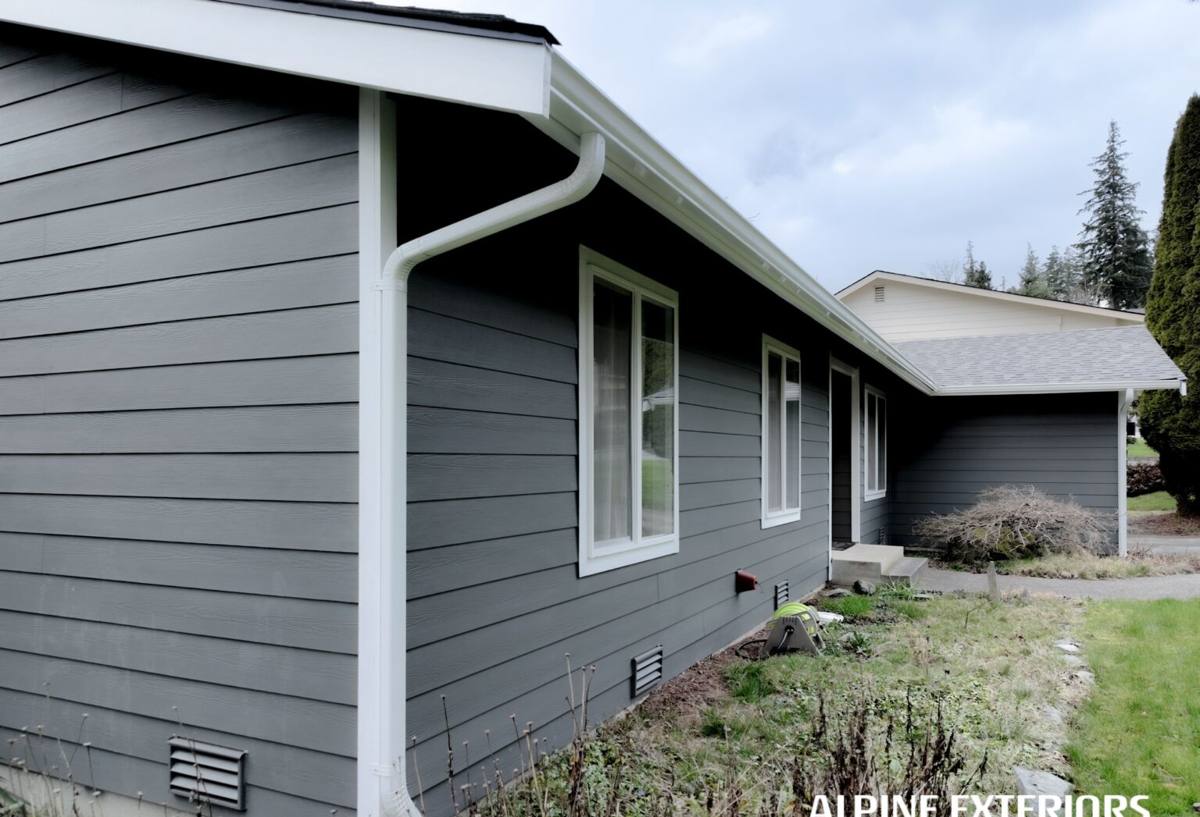
We install and repair exclusively with James Hardie fiber cement siding, and in a climate like Cap Sante's, that choice matters as much for repair work as it does for new installs. Fiber cement doesn't absorb water the way wood-based products can, doesn't rot, and isn't a food source for the moss and mildew that thrive in shaded, salt-humid air. When we cut into a wall to make a repair, we're not introducing a material that behaves differently than what's already there — Hardie panels and planks are dimensionally stable and hold up consistently over time, which makes patch repairs blend in and stay solid rather than becoming the next weak point.
Hardie's ColorPlus factory-finished boards also make repairs far less noticeable. Because the color is baked on at the factory to a consistent standard, a well-matched replacement board doesn't stand out the way a field-painted patch often does against sun-faded or salt-weathered paint. We match by product line, color, and exposure profile so a repaired section reads as part of the wall, not an obvious add-on.
What We Won't Do
We don't patch failing vinyl siding, LP SmartSide, cedar, or primed spruce with more of the same material just because that's what's already on the house. If a home in Cap Sante has one of those products and it's failing from moisture intrusion, we'll say so plainly and explain the trade-offs — vinyl can't stop water that gets behind it, engineered wood products are sensitive to edge and cut-line moisture exposure, and cedar and primed spruce need consistent maintenance to hold up in a marine climate. In some cases a targeted repair in the existing material is still the right call for the budget. In others, especially where damage is spreading, converting the affected wall (or the whole house) to Hardie is the more durable long-term answer. We'll walk you through both, honestly.
Our Repair Process
Every repair call starts with an actual inspection, not a guess from the driveway. Here's how we approach it:
- Inspect the damage and its surroundings. We look at the failed area plus the flashing, trim, and adjacent boards above and around it, since the visible damage is rarely the whole story.
- Check for moisture behind the surface. Where there's any sign of chronic dampness, we open the wall enough to check the sheathing and water-resistive barrier before closing anything back up.
- Diagnose the cause. Flashing failure, caulk failure, fastener corrosion, moss-driven moisture — we identify it so the repair actually solves the problem.
- Repair the root cause first. Flashing gets corrected, barrier gaps get sealed, damaged sheathing gets replaced — before any new siding goes back on.
- Install matched Hardie material. We match product line and ColorPlus color as closely as possible and install to manufacturer fastening and clearance specs.
- Confirm drainage and clearance. We check that water has a way out — proper flashing laps, weep paths, and ground clearance — so the repair doesn't just repeat the original failure.
Moss, Algae, and Salt: The Maintenance Side of Repair
A good share of what looks like "siding damage" in shaded, waterfront neighborhoods like Cap Sante is actually a maintenance issue that hasn't been addressed yet. Moss and algae growth on siding isn't just cosmetic — left long enough, it holds moisture against the surface and against fasteners, which accelerates the kind of damage that eventually does require repair. Salt air adds a second layer: it settles on surfaces and can corrode standard fasteners and trim over years, especially in areas that don't get regular rinsing from wind or rain.
Part of doing this job right in Cap Sante is telling homeowners when what they're dealing with is a cleaning and maintenance issue rather than a structural repair — and when a maintenance issue has gone on long enough that it's caused real damage underneath. We'll always tell you which one you're looking at.
Homeowner Checklist: What to Look For Between Inspections
- Dark streaking or green/black growth concentrated on shaded or north-facing walls
- Soft spots, or siding that flexes when pressed near the ground or below windows
- Peeling or bubbling paint in one consistent spot, especially below a window or roofline
- Visible gaps, cracks, or missing caulk at trim and window joints
- Rust streaking near fasteners or metal flashing
- Any section of siding that looks or feels different from the surrounding wall
None of these automatically mean a major repair, but any of them are worth a call before the next stretch of driving rain finds the weak point.
Why Local Experience in Cap Sante Matters
Siding repair on a waterfront bluff in Anacortes isn't the same job as siding repair on a sheltered inland lot twenty minutes away. The wind loading, the salt exposure, and the moisture patterns are all more aggressive here, and a crew that hasn't worked this specific kind of exposure can miss the details that actually matter — like where flashing tends to fail first on a marine-facing wall, or which elevations need extra attention to moss and drainage. We work throughout Anacortes and Skagit County, and repair calls in the Cap Sante area are a regular part of that work, not a one-off. That familiarity means we know what to check first, and we don't treat every repair as a mystery to solve from scratch.
If you've got a section of siding on your Cap Sante home that's cracked, stained, soft, or just not holding paint the way it should, we're happy to take a look. We'll give you a straight read on whether it's a spot repair, a bigger moisture problem, or something in between — with a free, no-pressure estimate and no obligation to move forward. The form below is the easiest way to get that conversation started.